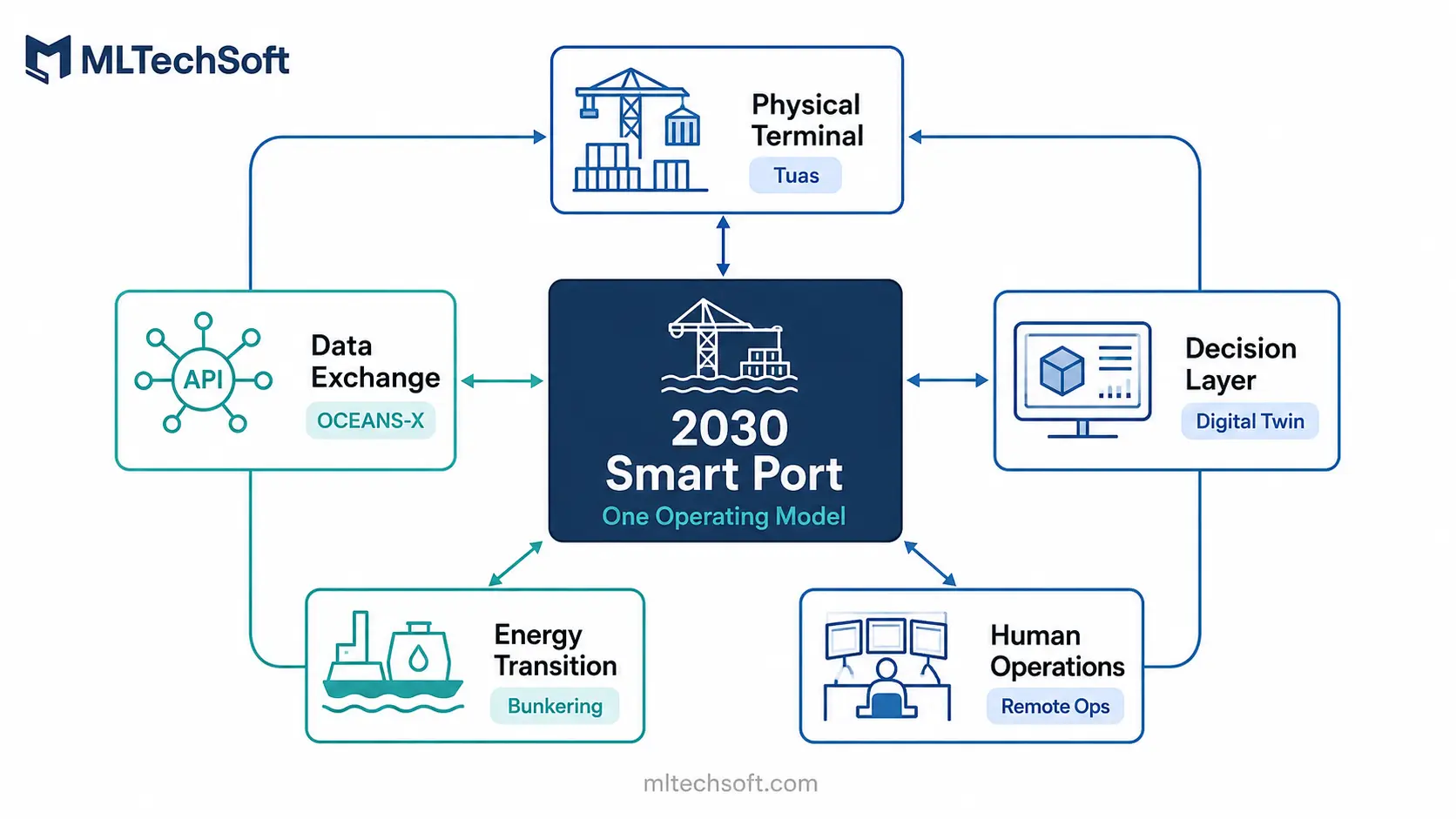
A truly smart port by 2030 has five interlocking capabilities: a consolidated, deep-water physical terminal (Singapore reaches this through Tuas Port Phases 1–4), a live system-to-system data exchange layer (Singapore is building this through OCEANS-X), a real-time virtual replica that drives operational decisions (Singapore’s Maritime Digital Twin), autonomous and multi-fuel bunkering as standard (methanol-and-cargo simultaneous operations are already proven at Tuas in 2026), and remote operations centres that compress shore-side decision time. Singapore is on track to have all five operational by 2030 — making it the global reference implementation.
Singapore’s Smart Port in 2030 — The One-Page Picture
The way to understand Singapore’s 2030 smart port is to read it as five overlapping construction projects, not one. The physical port. The data exchange layer. The decision layer. The energy transition. And the human skill mix. Each project is independently on track; the value is in the way they reinforce each other.
A vessel calling at Tuas Port in 2030 arrives at a berth that was assigned by a digital twin that ran scenarios in advance. It clears port via system-to-system data exchange that completes before the vessel ties up. It bunkers on methanol, simultaneous with cargo operations, from an autonomous barge dispatched by the digital twin. The decisions for the call are taken in a remote operations centre that sees the entire fleet, not a control tower that sees one terminal. None of this is science fiction. Every component is already in pilot or production in 2026.
The point of this article is to make the picture concrete enough that the reader can plan against it. The risk is not that Singapore fails to deliver on its 2030 vision. The risk is that the rest of the maritime ecosystem — shipping lines, ship managers, bunker suppliers, agents, classification societies — arrives at 2030 with software that cannot fully participate.
The Physical Build: Tuas Mega Port and What Phase 1 in 2027 Actually Means
Tuas Port Phase 1 is on track to be fully operational in 2027, with 21 deep-water berths and an annual handling capacity of 20 million TEU. By 2030, Phases 2 and 3 are scheduled to bring further capacity online, with Phase 4 completion projected later in the decade. The consolidation moves the entire Port of Singapore container operation away from the city terminals at Tanjong Pagar, Brani, Keppel, and eventually Pasir Panjang into a single deep-water complex at the western end of the island.
The architectural significance of consolidation matters as much as the capacity. A single terminal complex enables a single operating model: one digital twin, one data exchange surface, one fleet of automated yard equipment, one remote operations centre. The fragmented city-terminal architecture that grew up over fifty years is the architecture that the consolidation replaces.
For a shipping line that calls Singapore weekly with vessels of 15,000 TEU and above, the operational implication is that the 2027–2030 window includes a one-time set of changes to call planning, agent relationships, and onboard system integration with the terminal. The vessels do not change. The interface to the port does.
The Data Build: OCEANS-X and the System-to-System Future
OCEANS-X is the live data and API platform MPA launched to make every maritime company a system-to-system participant in Singapore’s port, not a portal user. Digital port clearance — the first OCEANS-X service — already lets shipping lines connect their in-house systems directly to MPA, removing the manual paperwork layer that used to cost hours per port call.
The acronym matters: Open / Common Exchange And Network Standardisation. The platform is being built as an interoperability standard, not a single MPA product. By 2030, the expectation is that every routine information exchange between maritime companies and the Port of Singapore — clearances, bunker delivery notes, vessel arrivals and departures, declarations — flows through OCEANS-X APIs rather than through forms, emails, or proprietary portals.
The architectural consequence for shipping lines and ship managers is the same one that hit financial services when payment systems went API-first a decade ago: companies that had not invested in their own integration layer found themselves dependent on slow, manual paths that competitors had eliminated. The 2026–2028 window is the analogous moment for maritime.
From our team’s ongoing maintenance engagement with PSA Marine — a long-running ISO 27001-aligned relationship covering the Marine Pilot Management System — the practical signal we see is that OCEANS-X participation is not just a development project. It is an information-security project. The platform’s participant baseline is closer to a financial services API than to a traditional maritime portal.
The Decision Build: The Maritime Digital Twin Becomes the Operating Console
Singapore’s Maritime Digital Twin — built by MPA in partnership with GovTech — is a real-time virtual replica of the Port of Singapore. It integrates live data from vessel movements, port operations, environmental sensors, and the surrounding sea space. In 2026 it is used to refine operational decisions, model trade-offs before capital commitments, and simulate scenarios across the port system. By 2030, it is the operating console: the screen on which port managers and operators see, decide, and act.
The shift from analytical tool to operational console is the one that matters. An analytical digital twin is consulted occasionally. An operational digital twin is the place from which routine decisions are made. The transition requires three things to mature in parallel: data quality from every participant in the port system, decision-grade simulation models, and the user-experience design that lets a port operator trust the twin enough to act on it.
For a terminal operator, this changes the daily work in a specific way: berth allocation, equipment dispatch, and vessel sequencing move from being decisions taken on a control room dashboard to being recommendations issued by the twin and approved by humans. The trade-off — and there always is one — is that the operator who used to make the decision now has to read it, evaluate it, and override it when needed. That is a different skill, and the human build below is the response to that.
The Energy Build: Autonomous and Multi-Fuel Bunkering as a 2030 Default
Methanol bunkering simultaneous with cargo operations has been proven at Tuas Port. The first successful SIMOPs trial demonstrated the ability to transmit essential methanol bunkering information electronically to stakeholders and MPA — enabling near-real-time visibility of the bunker delivery process. The pattern is clear: by 2030, multi-fuel bunkering (methanol, ammonia, LNG, biofuels, conventional) is standard, simultaneous-with-cargo is the default time-saver, and autonomous bunker barges are a normalised part of the fleet.
The autonomous bunker barge is the most visible expression of the trajectory. Singapore’s published EOIs include proposals for autonomous technologies and remote operations centres specifically aimed at port efficiency and safety. By 2030, the picture is autonomous barges dispatched by the digital twin to vessels in the anchorage or alongside, with the entire fuel transaction documented electronically end to end.
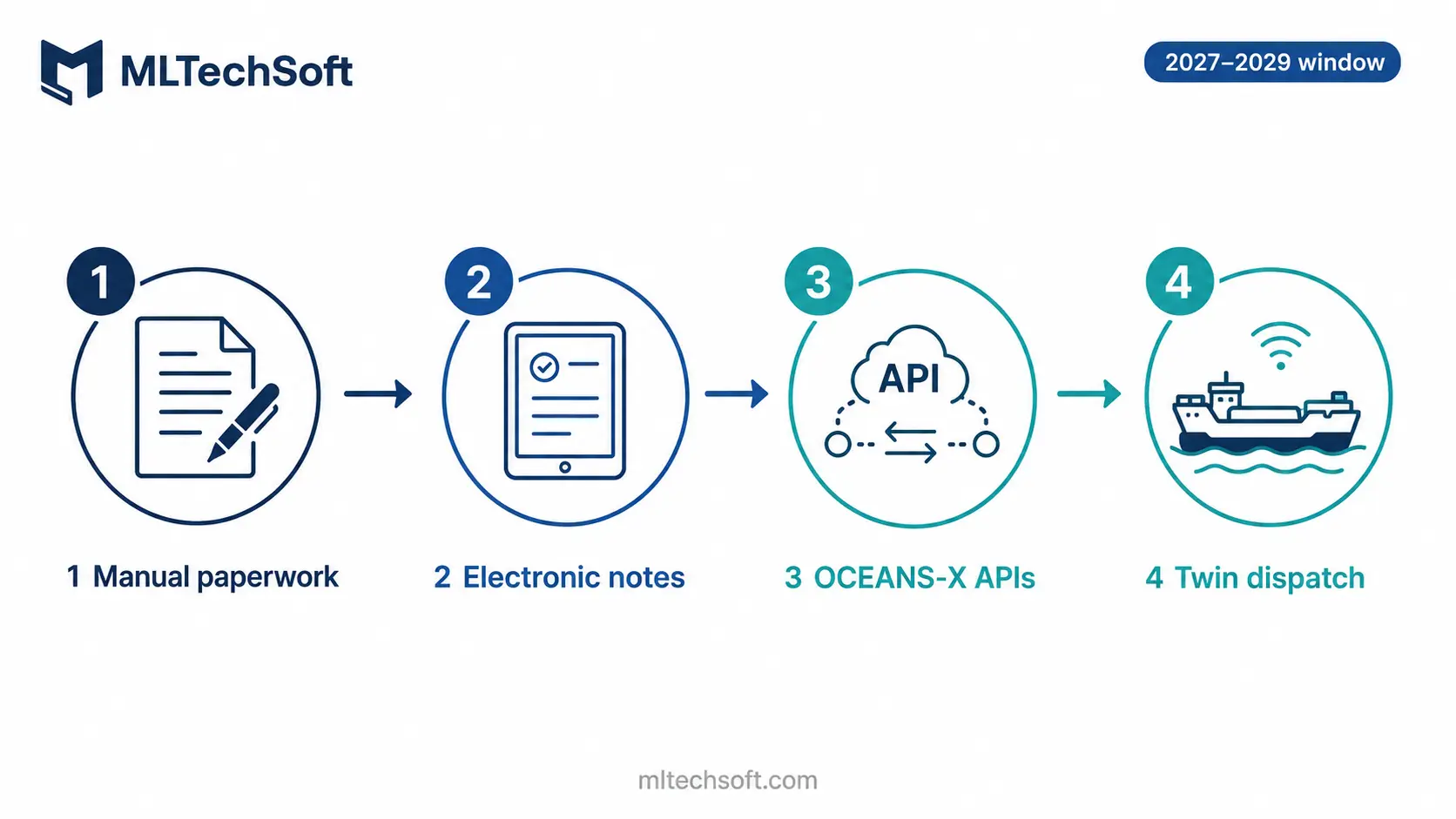
For bunker suppliers, this is a 2027–2029 software readiness window in its own right. The transition is not from manual to autonomous in one step. It is from manual paperwork to electronic delivery notes, then to API-mediated participation in OCEANS-X, then to digital-twin-orchestrated dispatch. A bunker supplier whose 2030 stack cannot participate in steps two and three will visibly slow the operation of any vessel they serve.
The Human Build: Remote Operations Centres and the New Skill Mix
A 2030 smart port runs from remote operations centres, not control towers. The remote operations centre is the human counterpart to the digital twin: a small team of senior operators monitoring multiple terminals, supported by AI-augmented dashboards and acting through agentic and semi-autonomous systems rather than through manual radio dispatch.
The skill mix shifts accordingly. The 2030 port operator looks more like an air traffic controller than a yard supervisor — fewer people doing each minute of physical coordination, more senior people doing strategic exception handling and override at the moments when human judgment is required. Training, certification, and career paths all have to be rebuilt for that profile.
The honest trade-off here is one Singapore is already navigating publicly: a more automated port runs with fewer of certain job categories than a manually operated one. The new categories created — digital twin operators, fleet remote-operations supervisors, integration engineers, port cyber analysts — are not one-for-one replacements. The 2030 picture is a smaller, more technically sophisticated operations workforce supported by a much larger ecosystem of software and remote-managed equipment.
The Story No One Is Telling Yet — The 2027–2030 Software Readiness Window for Everyone Else
The five Builds above are the port’s story. The story no one is telling clearly enough is what the same trajectory means for everyone connected to the port.
By 2030, the bottleneck on a fully smart port will not be the port. It will be the shipping lines, ship managers, bunker suppliers, port agents, classification societies, and maritime services providers whose own systems cannot fully participate. A vessel arriving with a 2018-era port-call management system will visibly slow the operation of a 2030 Tuas berth. A bunker supplier whose delivery notes are still PDFs will be slower than the barges that the digital twin can dispatch. A ship manager whose maintenance system cannot exchange data with the terminal cannot participate in the optimisations the terminal is offering.
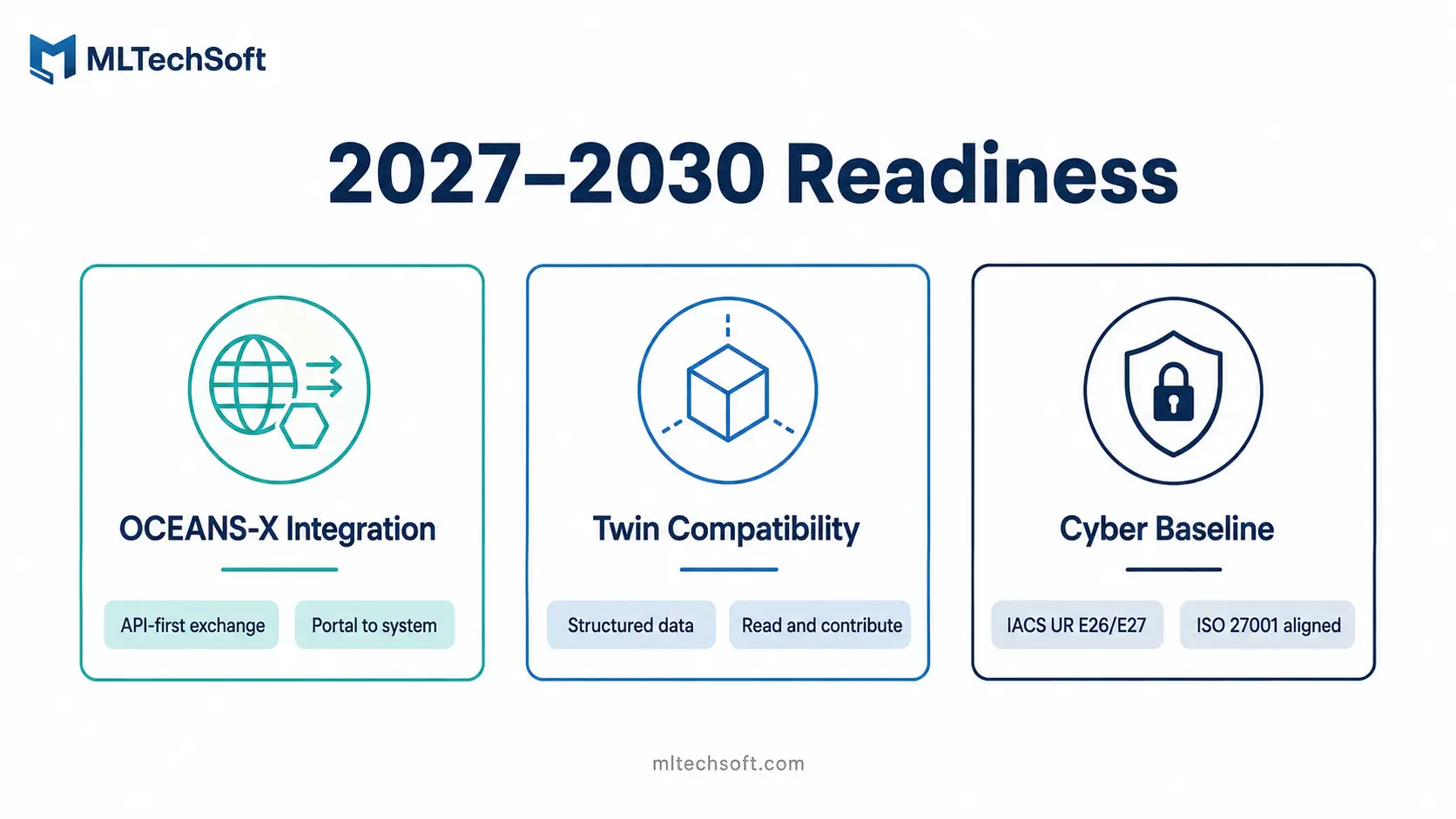
The software readiness window for everyone else is approximately 2027–2030 — a three-year period during which connected ecosystem participants need to make their own integration investments. Three priorities are visible already:
- OCEANS-X integration: every routine information exchange with MPA and the Port of Singapore will be expected via API. Companies whose 2026 stack is portal-and-PDF need to plan the move to system-to-system participation, including the ISO 27001-aligned security baseline that participation implies.
- Digital twin compatibility: providing the data your operations contribute to the Maritime Digital Twin — and reading the data the twin can give back — requires modern, well-structured operational data systems. Legacy systems built before 2018 generally cannot do either cleanly.
- Cyber baseline alignment: IACS UR E26 and E27 set the cyber resilience expectations for ships and onboard systems, and by extension for the vendors supplying them. The cyber baseline expected of any participant in Singapore’s 2030 smart port is closer to the IACS-and-ISO baseline than to traditional maritime IT practice.
For a Singapore-based ship management company scoping OCEANS-X integration in 2026 — a representative scenario across our conversations with operators in the past year — the work is not primarily about MPA’s API. It is about whether the company’s own internal data is consistent and well-typed enough to exchange. The integration project is rarely the bottleneck. The data work behind it is.
The 2030 Smart Port: Capability Snapshot
The five Builds, summarised against where Singapore stood in 2026 and where it is committed to be by 2030:
| Capability | 2026 state | 2030 state |
|---|---|---|
| Physical terminal | Phased construction; city terminals still partially operational | Tuas Port Phases 1–4 progressing, with PSA city terminals consolidated into Tuas from 2027 |
| Data exchange | OCEANS-X live; digital port clearance operating; first wave of system-to-system services | OCEANS-X is the default surface for routine information exchange across the port ecosystem |
| Decision layer | Maritime Digital Twin operating as analytical tool, supporting operational decisions | Maritime Digital Twin is the operating console — twin-orchestrated berthing, dispatch, and bunkering |
| Energy | Methanol-and-cargo SIMOPs trial proven; digital bunker delivery notes in pilot | Multi-fuel bunkering standard; autonomous bunker barges in production; fully electronic delivery |
| Human and operations | Control-tower operations augmented by digital tools | Remote operations centres with senior operators acting through agentic systems |
The picture is consistent across every row: the components exist in 2026, are maturing in parallel, and converge by 2030 into a single operating model.
FAQ: Singapore’s 2030 Smart Port Questions Answered
What does Tuas Port Phase 1 fully operational in 2027 actually mean?
Phase 1 brings 21 deep-water berths and 20 million TEU annual handling capacity online by 2027. The strategic significance is the simultaneous consolidation of PSA’s city terminals — Tanjong Pagar, Brani, Keppel — into Tuas by the same year. The Port of Singapore moves from a fragmented multi-terminal architecture to a unified deep-water complex, which is what makes a single digital twin, a single data exchange layer, and a single operating model possible across the entire container port.
Is OCEANS-X already live, and what does it do today?
Yes. OCEANS-X is MPA’s open data exchange and API platform, and digital port clearance is already operating as a live system-to-system service. Shipping lines can connect their in-house systems directly to the platform to transmit clearance data to MPA. By 2030, the expectation is that most routine information exchange between maritime companies and the Port of Singapore flows through OCEANS-X APIs rather than through forms, emails, or portals.
What is the Maritime Digital Twin used for in 2026?
The Maritime Digital Twin — developed by MPA and GovTech Singapore — is a real-time virtual replica of the Port of Singapore that integrates live data from vessels, port operations, environmental sensors, and the surrounding sea space. In 2026 it is used to refine operational decisions, model trade-offs before capital commitments, and simulate scenarios across the port system. By 2030, it becomes the operational console from which routine port decisions are taken.
How does autonomous bunkering fit into Singapore’s 2030 picture?
Autonomous bunkering is a 2027–2030 transition rather than a single launch event. Singapore has already proven methanol bunkering simultaneous with cargo operations at Tuas, with electronic delivery notes transmitted to stakeholders in near real time. By 2030, multi-fuel bunkering is standard, simultaneous-with-cargo is the default, and autonomous barges dispatched by the digital twin are a normalised part of the fleet. Singapore’s published EOIs include proposals for autonomous technologies aimed specifically at port efficiency and safety.
What does the Singapore 2030 smart port mean for shipping lines and ship managers outside Singapore?
The 2030 smart port is a connectivity standard, not just a Singapore project. By the time it operates at full capacity, ecosystem participants worldwide will be expected to interoperate with it — through OCEANS-X APIs, through compatible digital twin data exchanges, and within the cyber baseline established by IACS UR E26/E27 and equivalent standards. Companies whose internal systems cannot participate will be visibly slower at the berth than those that can. The 2027–2030 window is the software readiness window during which the rest of the ecosystem catches up.
What This Means for the Next Four Years
Singapore’s 2030 smart port is not a forecast. It is a construction project with a published schedule. The capabilities are visible in 2026, the trajectories are consistent, and the consolidation around Tuas is the architectural decision that ties everything together. The question is not whether the port will be ready by 2030 — it is whether everyone else will be.
For shipping lines, ship managers, bunker suppliers, and maritime services providers operating in or through the Port of Singapore, the next four years are a software readiness window. The companies that arrive in 2030 with API-first systems, ISO 27001-aligned security, and operational data clean enough to feed a digital twin will move freely through the port. The companies that do not will be the visible drag on every operation they participate in.
If your organisation will be operating inside Singapore’s 2030 port ecosystem and you want a structured view of where your own software needs to be ready by 2027, our team offers a free maritime software assessment focused on smart-port integration readiness — OCEANS-X, Maritime Digital Twin data flows, and the cyber baseline expected of participants. Book a slot here.