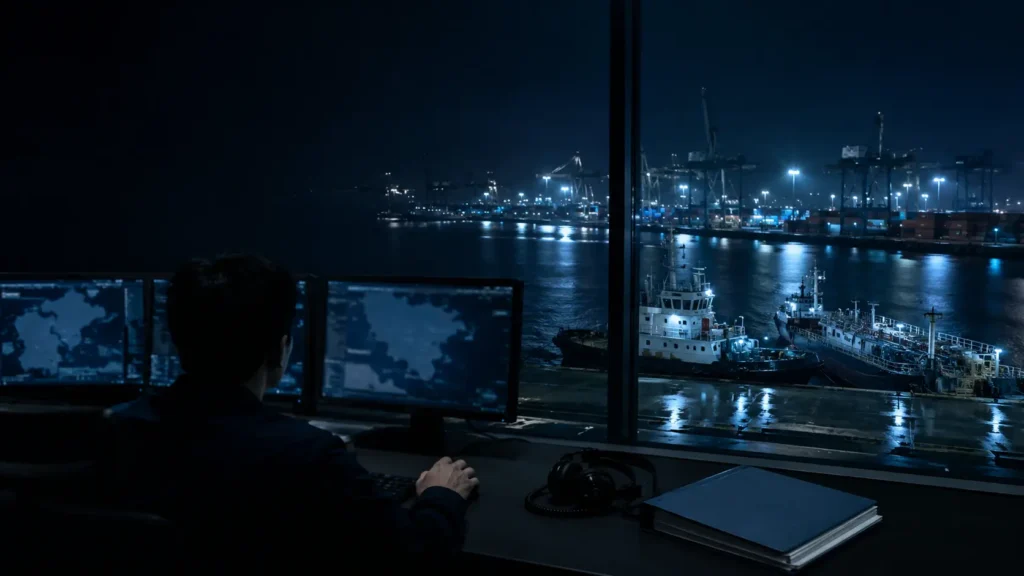
What “AI agent” actually means in 2026 — a working definition
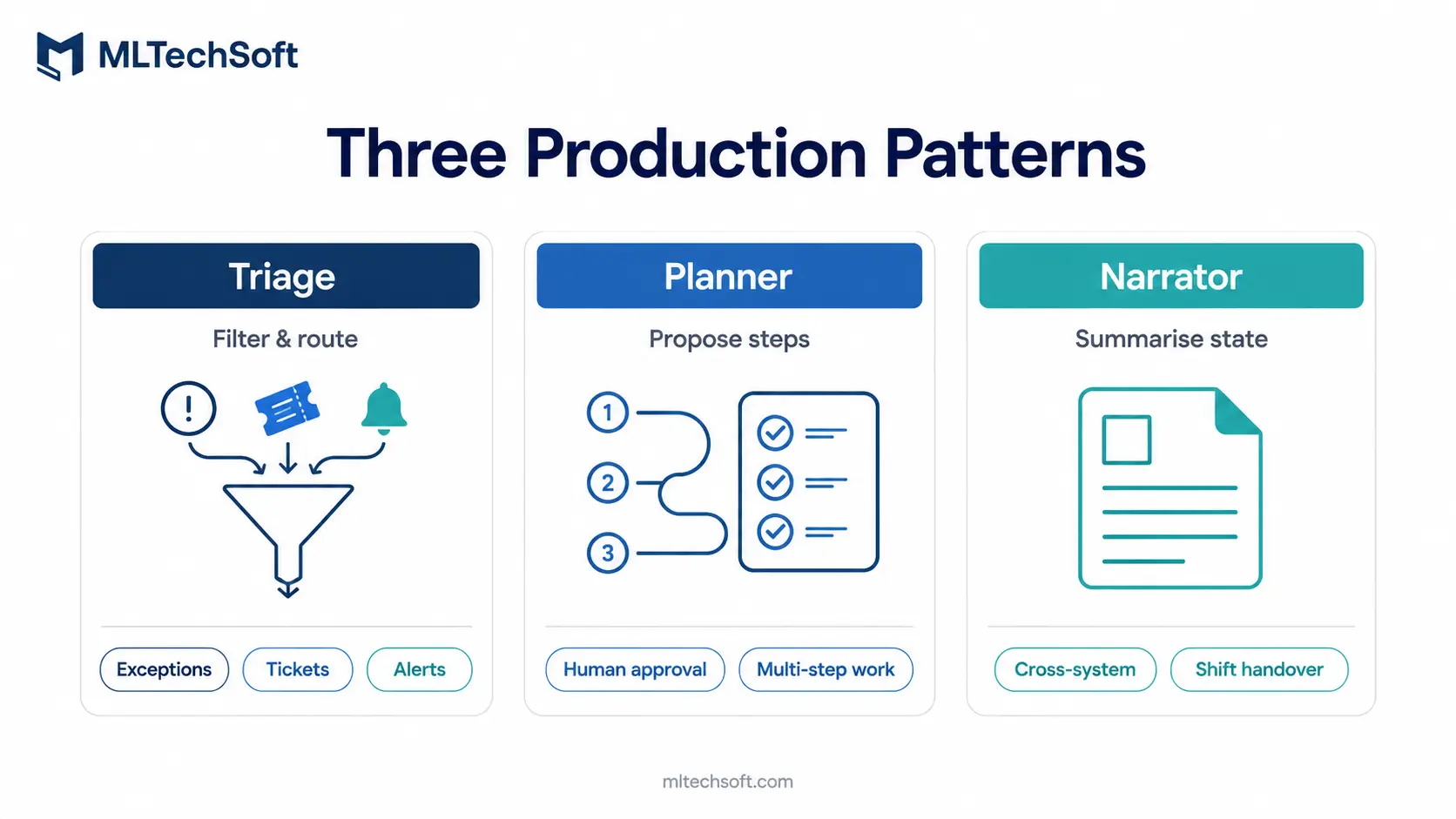
An AI agent in enterprise operations is software that reads operational context, decides on a next action, and executes that action against other systems on behalf of a human operator. In 2026, three patterns are doing most of the real work in production: triage agents that filter and route exceptions, planner agents that propose a sequence of actions for human approval, and narrator agents that summarise state across systems that don’t talk to each other. These patterns are not replacing operations teams — they are replacing the dashboards those teams stare at.
That is a tighter definition than the one in most vendor decks. It excludes a lot of things currently being sold as agents: chat interfaces that only retrieve documents, copilots that suggest code but never run it, and analytics layers that surface insights but cannot act on them. Those are useful tools. They are not agents.
The distinguishing test is whether the system can both decide and act. “Decide” means choosing between two or more concrete next actions based on current state. “Act” means calling another system’s API — to update a record, send a message, raise a ticket, or change a route — without a human pasting anything between two windows.
A quick glossary, because the vocabulary is moving fast: an agent loop is the cycle of read context → decide → act → observe result → decide again. Tool use or function calling is the agent’s ability to call an external system from inside that loop. The Model Context Protocol, a 2024–25 specification that became broadly adopted in 2026, is the de facto standard for connecting agents to enterprise tools without rewriting integrations for every model.
So what? If a vendor cannot point at the specific external systems their “agent” calls during the loop, and the specific decisions it makes between those calls, you are looking at a chat interface, not an agent. Treat it accordingly.
Why dashboards are no longer the bottleneck — and what is
The bottleneck in enterprise operations was never the dashboard. It was always the operator who has to read four of them at 03:00 and decide what to do. Better dashboards do not fix that. They just give the operator more to read.
Across the projects we have delivered at MLTech Soft for Singapore maritime and enterprise clients, the consistent pattern is the same: investment in observability has outpaced investment in decision support. Operations teams now have richer telemetry than at any point in industry history. They also have more open browser tabs than they can usefully scan.
Agents change this by collapsing the read-then-decide loop. A triage agent that reads twelve dashboards every thirty seconds and surfaces only the three exceptions that need a human is doing something a dashboard cannot do — it is not showing the operator the other 117 normal items. That negative work is where the operational leverage lives.
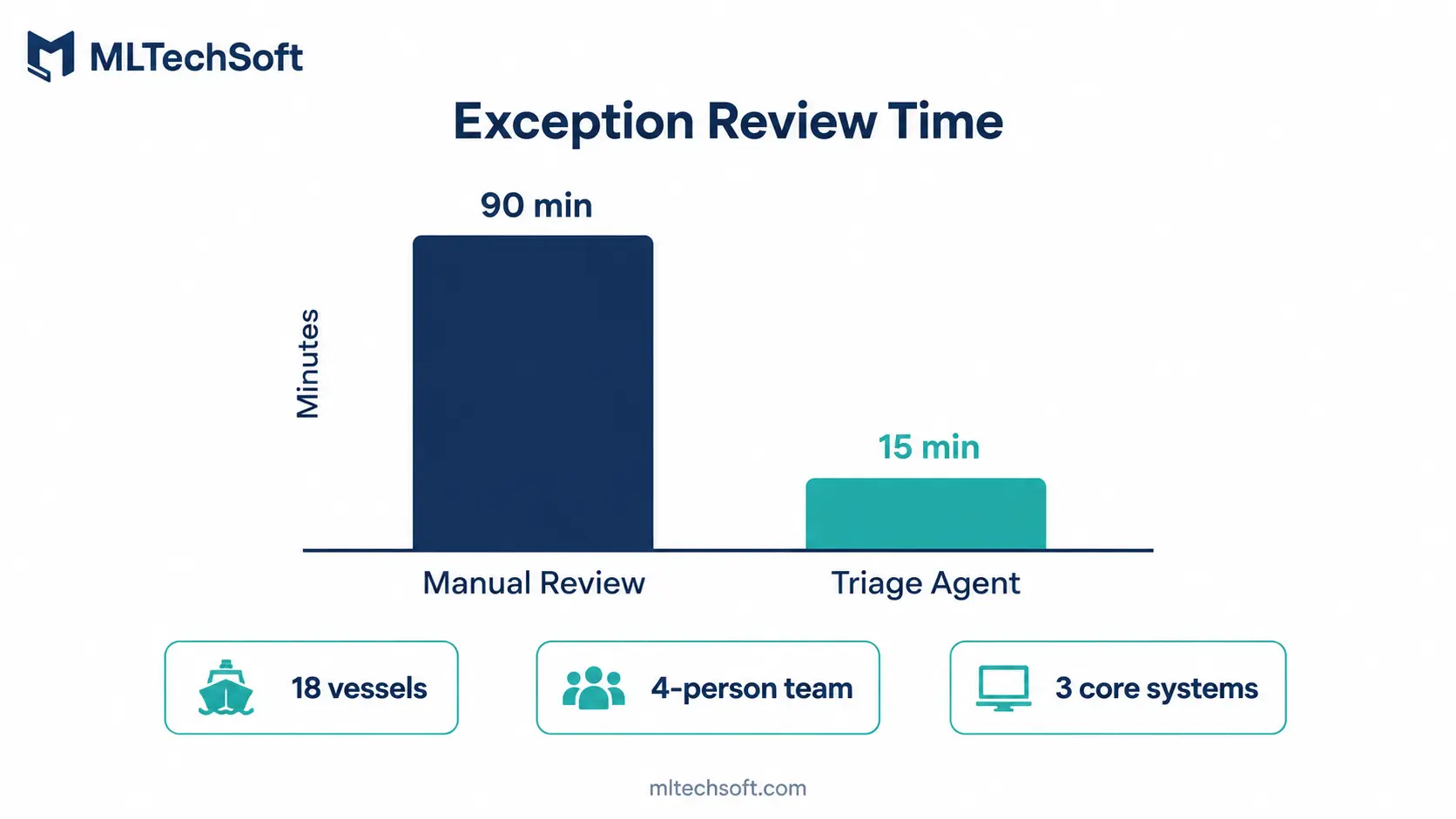
Here’s what this looks like in practice: a Singapore-based ship management company with 18 vessels, a four-person operations team, and three commercial-off-the-shelf systems for crewing, technical management, and procurement. At 06:00 Singapore time, the team comes on shift and reviews exceptions across all three systems before the day’s vessel calls. The dashboards have been “fine” for years. The problem is that exception review takes ninety minutes, and on Mondays the team is already behind by 07:30.
A well-scoped triage agent reads all three systems’ exception queues, applies a learned model of what the team actually intervenes on, and shortens that ninety minutes to roughly fifteen. Nobody added a new dashboard. Nobody removed an old one. The operator’s attention budget simply got bigger.
So what? Stop scoping your next agent project as “AI for the dashboard.” Scope it as “AI for the operator’s attention.” The dashboard inventory you already own is fine. The attention budget is what is exhausted.
The three agent patterns you will actually deploy this year
Three patterns describe the overwhelming majority of agent deployments we have seen reach production in 2026. They are not the only patterns possible — they are the ones that work given today’s models, today’s enterprise systems, and today’s risk appetite.
The triage agent: filtering and routing
A triage agent classifies incoming items — exceptions, tickets, alerts, vessel position alarms, customs queries — and routes each to the right destination. The destination can be a human queue, an automated workflow, a silent drop, or another agent. The agent does not solve the problem; it decides who or what should.
This is the most common production agent pattern in 2026, partly because it is the easiest to retire if it underperforms. A bad triage agent is a slower email filter. A bad planner agent is an outage.
Triage agents are typically the first pattern an operations team should deploy. They are bounded, they fail visibly, and they produce a clear performance metric: the ratio of items the human accepted as correctly routed versus reroutings.
The planner agent: proposing a sequence of actions
A planner agent takes a goal — “get this vessel its required bunker call, customs clearance, and pilot booking before its 16:00 departure” — and proposes a sequence of actions to achieve it. The actions reference real systems and real entities. A human reviews and approves before any action executes.
Planner agents are powerful and dangerous in the same way. They are powerful because they collapse coordination work that previously required three or four humans talking to each other. They are dangerous because the proposed sequence looks plausible whether it is right or wrong, and a tired operator will rubber-stamp a confidently-wrong plan.
The discipline that makes planner agents work is forcing the plan to be inspectable: each step shows its inputs, the system it will call, and the rollback path if the step fails. If a planner agent cannot show its work, it does not belong in production.
The narrator agent: summarising state across systems
A narrator agent reads the current state across systems that do not natively talk to each other and produces a single, current, plain-language summary. It does not propose actions. It does not route exceptions. It tells the human, in a paragraph, what is happening right now.
Narrator agents are the quietest of the three patterns and often the most loved by operations teams. They are what makes shift handovers shorter, what makes the 03:00 wake-up call shorter, and what makes a CTO’s Monday-morning briefing readable.
The narrator agent’s failure mode is also the most subtle: it sounds confident. A narrator that gets the situation 70% right will sound exactly as confident as one that gets it 99% right. Verification has to be built into the agent’s output — not bolted on afterwards.
So what? Match the pattern to the work. Triage for exception queues. Planner for multi-step coordination. Narrator for cross-system situational awareness. A single deployment that tries to be all three is what most failed 2026 pilots look like.
A worked operations example for each pattern
A maritime operations centre overseeing roughly fifty vessels makes a useful worked example, because all three agent patterns find a clear home in that workflow.
Triage agent — bunker queries. Bunker queries arrive from vessels, suppliers, and surveyors throughout the day, in mixed formats: email, Teams messages, a portal submission, and the occasional WhatsApp note. A triage agent reads each query, classifies it by urgency and category, and routes it. Urgent specification disputes go to the technical superintendent. Routine confirmations go to a templated reply. Anything ambiguous goes to a human queue for review. The agent’s measured success is the percentage of routings the team accepted unchanged.
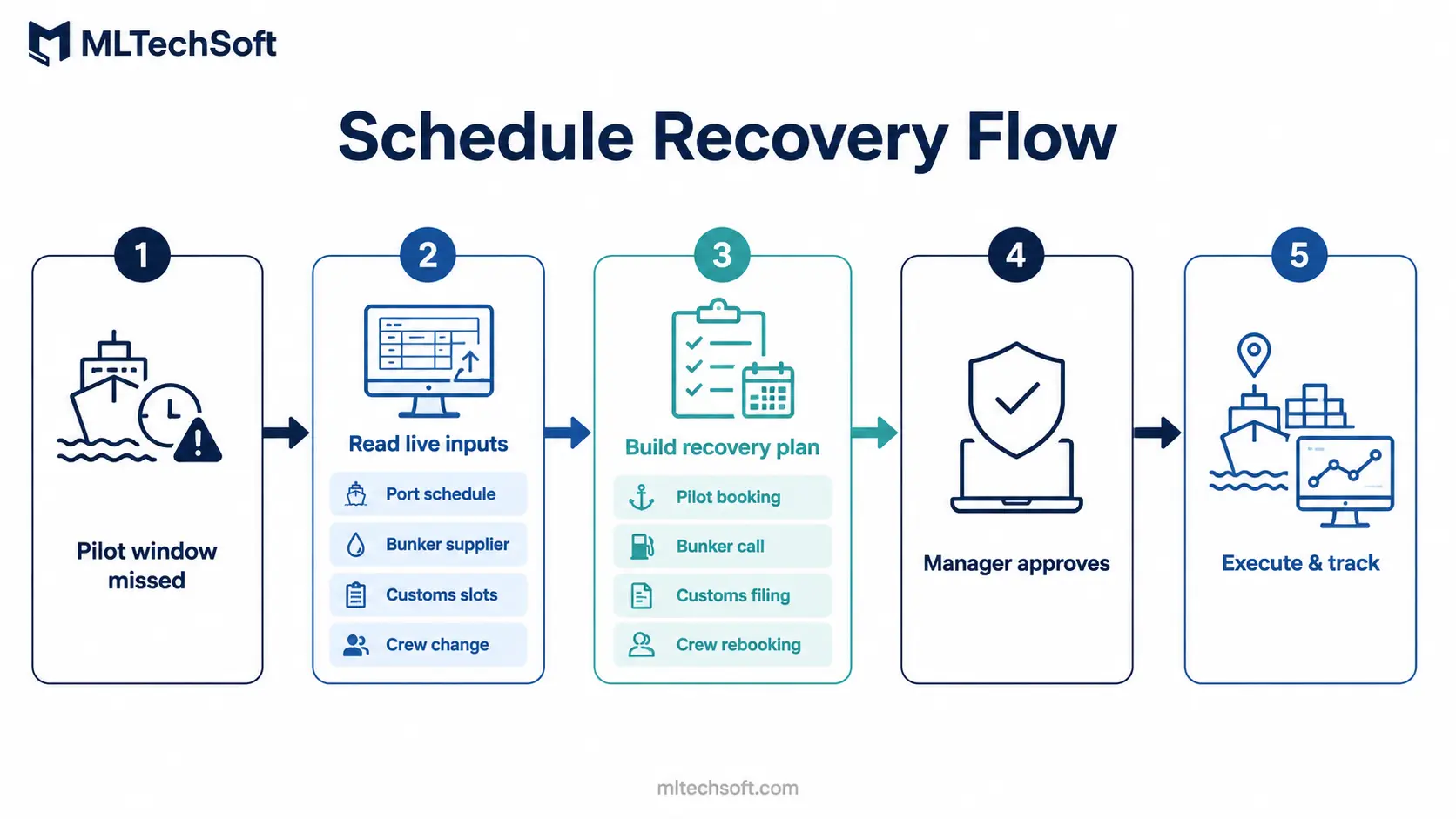
Planner agent — last-minute schedule recovery. A vessel misses its pilot window by an hour. The planner agent reads the current port schedule, the vessel’s required tasks, the bunker supplier’s availability, and the customs broker’s open slots — and proposes a sequence to recover the day: new pilot booking, adjusted bunker call, customs filing delay, crew change rebooking. The operations manager reviews the sequence on screen, approves it with one click, and watches each step execute. The plan is never executed without approval. The approval is a single decision, not nine.
Narrator agent — shift handover. At the end of each shift, the narrator agent reads the current state across all major systems and produces a half-page paragraph for the incoming shift. It names every vessel currently in unusual states, summarises any open exceptions, and flags decisions the outgoing shift made that the incoming shift should know about. The handover meeting goes from twenty-five minutes to under ten, because the incoming shift is not reading the same dashboards from scratch.
So what? None of these examples replaces a person. Each replaces a specific, expensive form of attention — sorting, coordinating, summarising — that the team was bleeding to today. That is the realistic 2026 framing of agent value.
The architectural prerequisites most teams haven’t built yet
The most expensive part of an agent rollout is not the model. It is the work that has to happen in the systems the agent will touch.
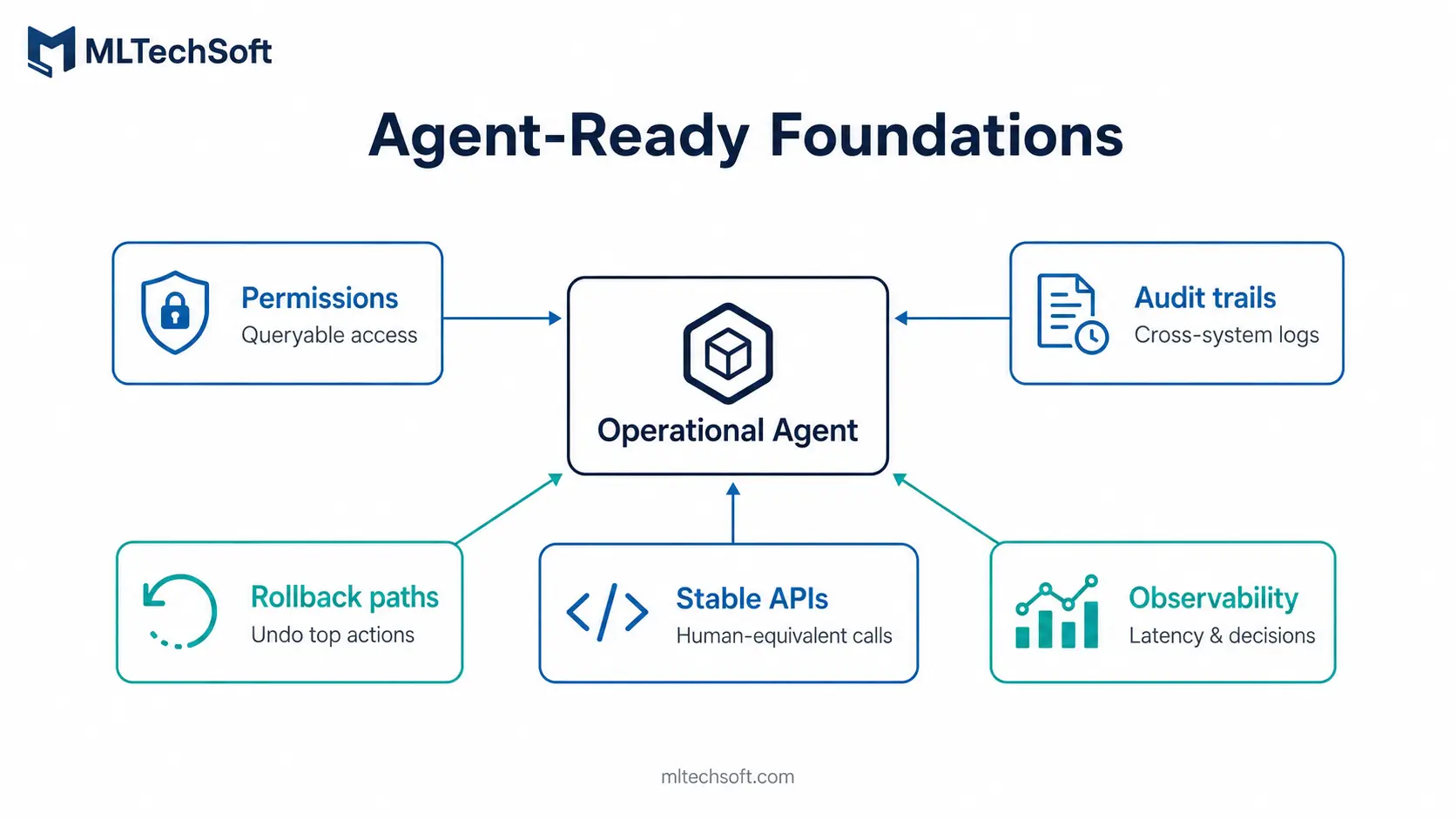
There are five prerequisites we now look for before scoping an agent integration. None of them are exotic. All of them are commonly missing.
- Machine-readable permissions. Who is allowed to do what, in which system, against which records, expressed as a query an agent can execute against — not a confluence page describing the policy. Without this, the agent inherits whatever access the integration credentials hold, which is almost always too much.
- Structured audit trails. A record, per action, of who initiated it, what inputs were passed, what was returned, and what the system did next. The audit must be queryable across systems, not buried in each system’s local logs.
- A clean rollback path for at least the top ten action types. If the agent updates a vessel’s voyage record incorrectly, the team must be able to undo it without an engineer. If that path does not exist for human users today, it will not magically exist for the agent.
- Stable, documented APIs for human-equivalent actions. If your operations team does something via a browser, the agent will need to do it via an API. If your systems do not expose those actions as APIs today, the integration project starts there.
- Observability of the agent itself. Token use, latency per step, decision logs, model version per run. Without this, you cannot debug a bad day, and you cannot prove behaviour to a regulator or auditor.
Key gap: In our work integrating AI assistants for Singapore maritime operations teams, the most common single blocker we have hit is not model accuracy — it is that the systems the agent needs to act against were never designed to be audited at the action level. The audit work has to be done before the agent work begins.
So what? Map your operations systems against those five prerequisites before the next vendor demo. Most pilots fail because the foundation was not in place. The model was the only thing that worked.
Where AI agents still do not belong — and probably won’t in 2026
Agents are useful inside a narrow band of work. Outside that band, in 2026, they are still a liability.
They do not belong in regulatory filings — port state control submissions, flag-state declarations, classification society audits, MPA filings. The signing party is human, the consequences of error are legal, and an agent’s confident-sounding paragraph is not a substitute for a controlled, reviewed, signed document.
They do not belong in safety-of-life decisions. Routing a vessel away from weather, advising on crew medical evacuations, or making any decision where a wrong action endangers people stays with the human. An agent can summarise the situation and surface options. It should not propose the action.
They do not belong in contract negotiation or commercial commitment. Even a planner agent should stop short of sending a quote, accepting a charter party, or confirming a price. The cost of a wrong commercial commitment is too high relative to the cost of the human round-trip.
And they do not belong in work that has no measurable outcome. If you cannot define what “the agent did this well” means, you cannot tell whether to trust it. Vague work — strategic synthesis, board-level judgment, cross-functional politics — is exactly the wrong place to put an autonomous system right now.
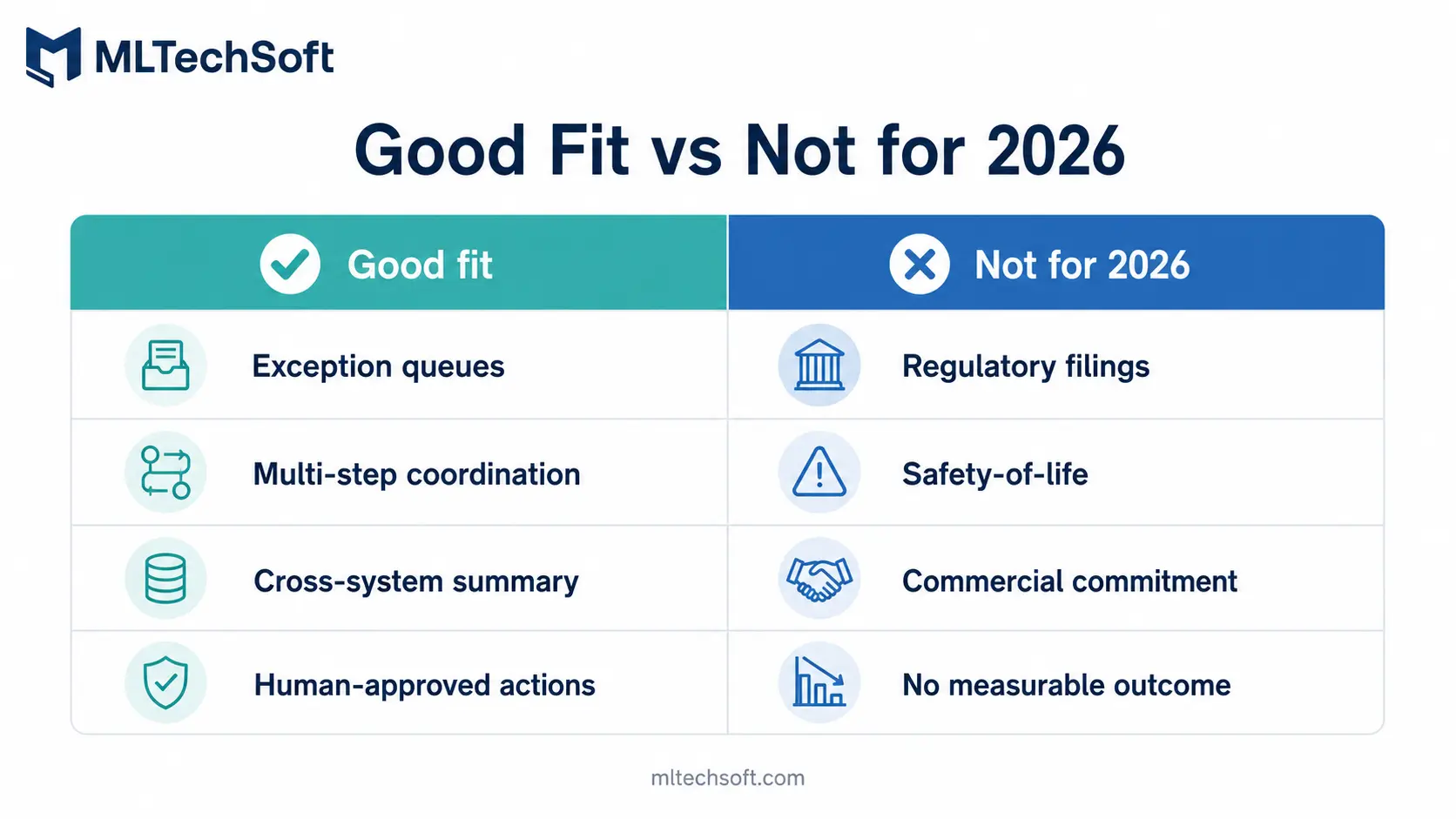
So what? When a vendor pitches an agent for one of those four areas, ask how they measure correctness. If the answer is vague, the agent does not belong there yet.
FAQ: AI Agents in Enterprise Operations
Are AI agents the same as a chatbot or a copilot? No. A chatbot replies in text. A copilot suggests actions for a human to take. An agent reads context, decides on a next action, and executes that action against another system through an API. The distinguishing test is whether the system can both decide and act inside an agent loop. If the only output is a suggestion, it is a copilot, not an agent.
Do AI agents in enterprise operations replace the operations team? No. In every production deployment we have seen reach steady state in 2026, the team is the same size, doing different work. Routine triage and cross-system summarisation move to the agent. The team’s time shifts to exception resolution, vendor management, and the harder judgment calls. Headcount stays. Throughput goes up.
What does an AI agent deployment cost in 2026? The model itself is a small fraction of the total. The dominant costs are integration work — exposing existing systems as machine-callable APIs, building audit trails, and standing up observability for the agent. For a maritime operations team running three to five core systems, expect a meaningful first-phase build before the agent does anything useful. Subscription costs for the model are almost always under-budgeted as a percentage of total spend.
How do AI agents handle compliance and audit requirements? The agent inherits the audit posture of the integration that wraps it. If the integration logs every action with inputs, outputs, model version, and operator context, the agent is auditable. If the integration calls existing APIs without structured logs, the agent is a compliance gap. ISO 27001-certified integration partners are increasingly the procurement requirement for this reason — the agent is the new attack surface and the new audit surface at the same time.
Can a Singapore maritime operator deploy AI agents safely under current MPA and IMO guidance? Yes, inside the bounded patterns described in this post and with appropriate human-in-the-loop controls on actions that touch regulatory submissions or safety-of-life decisions. The MPA’s broader digitalisation guidance does not prohibit agent use — it expects the operator to demonstrate control, auditability, and clear accountability for outcomes. That requires the architectural prerequisites described above, which is exactly the work most pilots skip.
The Short Version
Agents are not the AI hype cycle catching up with operations. They are a specific, useful pattern with three production-ready shapes — triage, planner, narrator — and a long list of architectural prerequisites that most teams have not yet built.
The teams pulling ahead in 2026 are not the ones picking the best model. They are the ones doing the unglamorous integration work — permissions, audit, rollback, observability — that lets any model behave responsibly inside their stack. The model will keep getting better whether they invest or not. The integration will not.
If your team is mapping a 2026 agent pilot, the first hour is not about vendor selection. It is about whether your systems can survive being acted on autonomously. That is the conversation worth having first.
Next step: If your team is scoping a 2026 agent pilot, MLTech Soft offers a complimentary one-hour AI readiness review. We walk your current operations stack, identify the two or three architectural gaps that would block a useful agent today, and leave you with a written summary. No deck, no sales follow-up sequence. Get in touch via the contact page at mltechsoft.com.