Opening — Direct Answer
Singapore Maritime Week 2026 runs April 20–24 at Suntec Singapore Convention Centre. For ship managers evaluating software vendors, the most productive questions focus on three areas: maritime domain literacy (can they explain ISM Code Section 6?), security credentials (ISO 27001 certification, not ISO 9001), and implementation track record in live maritime environments. Vendors who answer all three credibly are worth a follow-up.
What SMW 2026 Is Really About
The 20th Singapore Maritime Week centres on “Actions Meet Ambition.” The five-day agenda spans decarbonisation, digital innovation, AI, cybersecurity, and talent. Every vendor at the conference will position themselves around these priorities. Some have actually delivered in maritime operations. Others hope the conference noise prevents detailed questions.
For IT directors and CTOs, SMW 2026 is an efficiency play: you’re not there to be sold to—you’re there to filter. The question set below is designed to do exactly that.
The Problem With Conference Floor Conversations
On a busy conference floor, vendors control the demo and demo script. If you don’t ask specific questions, you’ll leave with brochures and a vague sense that everyone has maritime experience. The real problem: vendors are expert at making their capabilities sound maritime-relevant without proving they understand operational reality.
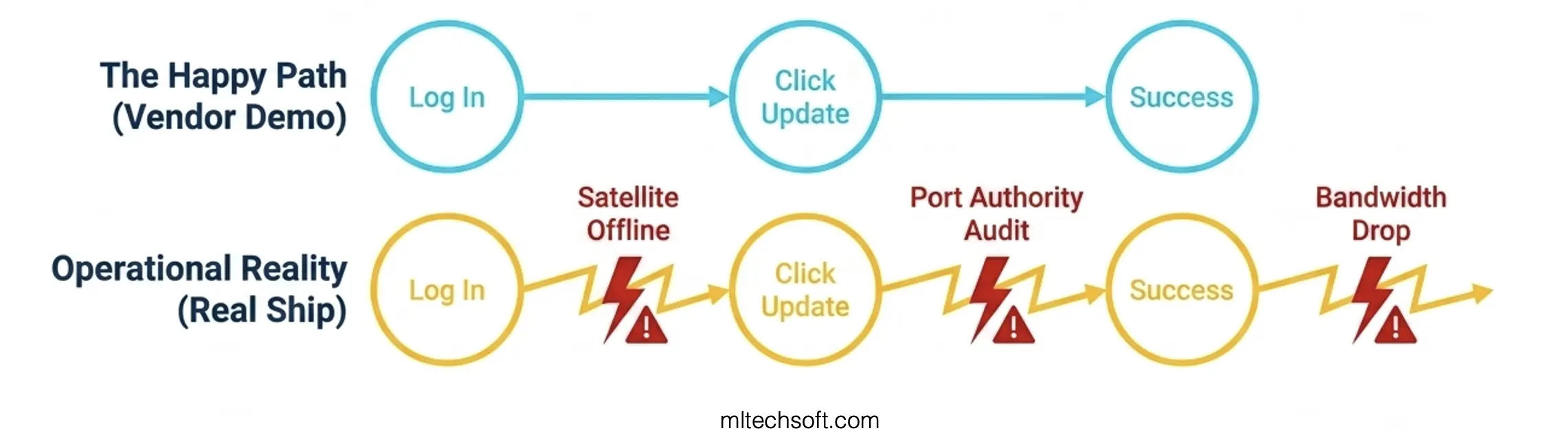
For example, “We’ve built systems for the maritime industry” sounds credible until you ask: “Walk me through how you handle crew certificate expiry during drydocking when your system is offline because the vessel lacks satellite connectivity in that port.” That specific scenario separates vendors who have delivered in real maritime operations from those who haven’t.
The 8 Questions to Ask Every Maritime Software Vendor at SMW This Week
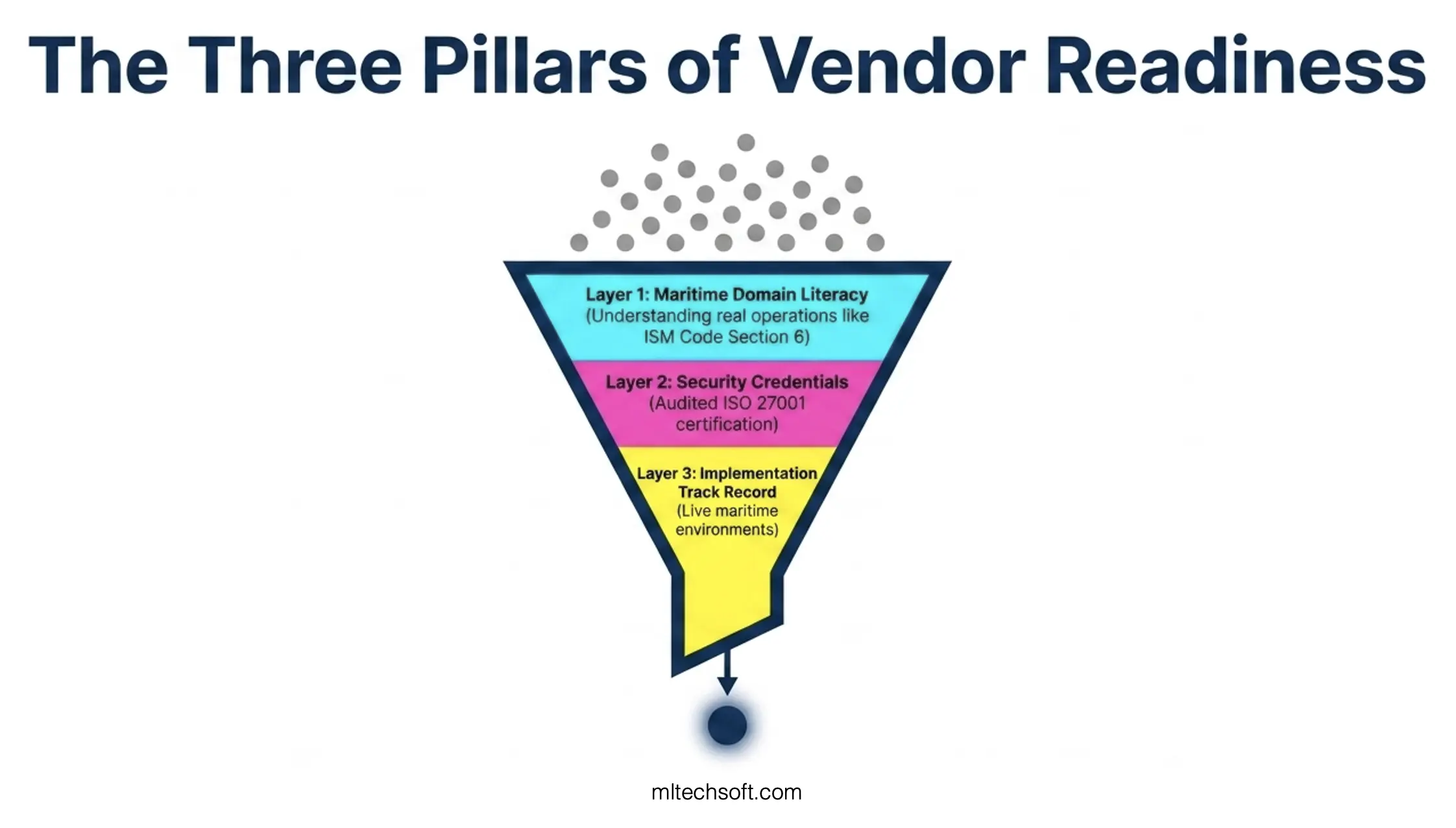
Maritime Domain: Understanding Real Operations
Question 1: Crew Certificate Management “Walk me through how your system handles crew certificate management during rotation in a different port, when the replacement crew documents are being verified by port authority, and your system is offline due to connectivity loss.”
Credible answer: Specific scenario-handling approach (queuing, local storage, sync-on-reconnect). Mention of certificate types (CEC, STCW, medical). Acknowledgement that the system doesn’t block operations during verification delays.
Evasive patterns: “We have a robust system that handles all crew documentation” (generic). “We recommend good connectivity” (shifts problem to you). Long pause then “Let me get back to you on that” (hasn’t thought about it).
Question 2: ISM Code Procedure Changes “If an operator wants to change a procedure mid-voyage, how does your system track version control, user, timestamp, and ensure all crew access the updated version before implementation?”
Credible answer: Describes versioning, audit trails, approval workflows. Explains how crew acknowledge updated procedures. Links to Company Safety Management System (SMS) that regulators review at port state control.
Evasive patterns: “Our system is fully ISM Code compliant” (compliance ≠ specific features). “We use a document management system” (doesn’t address mid-voyage version control). “Work with a maritime compliance advisor” (you’re buying software, not consulting).
Question 3: Remote Troubleshooting Without Connectivity “Describe the last time you troubleshot a system issue on a vessel without internet. What information did you gather from crew, what tools did you use, and how did you resolve it without visiting the vessel?”
Credible answer: Mentions remote tools, satellite screen-sharing, or diagnostic scripts. Describes gathering specific error messages and system behavior. Acknowledges realistic limitations and crew training approaches.
Evasive patterns: “We have excellent 24/7 support” (that’s expected, not an answer). “Our system is very stable” (not realistic). “We’d send a support engineer to the vessel” (costs £15k per visit, impossible in some regions).
Security: Separating Certified from Claimed
Question 4: ISO 27001 Certification Scope “Is your company ISO 27001 certified? If so, what scope does the certification cover — your full software development and maintenance process, or just back-office operations?”
Credible answer: “Yes, ISO 27001 certified. Our certification covers all software development, maintenance, and customer data handling.” Can name certification body and audit date.
Evasive patterns: “We’re very secure” (unverified). “We have ISO 9001” (quality management ≠ information security). “We’re working toward ISO 27001” (not certified yet). “We have SOC 2 Type II” (self-assessed, not independently audited).
Key context: Maritime cyberattacks surged 103% in 2025 — the highest annual increase on record. The IMO published updated cyber guidelines (MSC-FAL.1/Circ.3/Rev.3) in April 2025, now aligned with NIST CSF v2.0. Ship managers are explicitly responsible for third-party supplier cyber risk. ISO 27001 is a minimum requirement for maritime software partners.
Question 5: Incident Response Process “If a customer reported a security vulnerability in your system, what’s your timeline to patch it, and how do you communicate to other affected customers?”
Credible answer: Clear severity classification with remediation windows (e.g., “Critical within 24–48 hours”). Describes customer notification process and disclosure timelines. Acknowledges that maritime systems sometimes can’t patch immediately, so interim workarounds may be offered.
Evasive patterns: “We use best practices” (vague). “Our team will work on it quickly” (no defined process). “We’ll let you know after we’ve patched it” (reactive, not proactive).
Implementation: Track Record in Live Environments
Question 6: Longest-Running Maritime Engagement “Tell me about your longest-running maritime engagement today—how long, and what has changed in that system since go-live?”
Credible answer: Names a client (if permitted) or specifies: “A Singapore-based ship management company managing 40+ vessels. We’ve supported them for 5+ years.” Describes concrete changes: crew roster features, port authority integrations, database migrations, UI upgrades—all while keeping the system operational.
Evasive patterns: “We have many satisfied maritime clients” (no specifics). Brief client name, then won’t elaborate (engagement may not be ongoing or reference-able). Focuses on technology, not client outcomes.
Question 7: Major Change Without Downtime “Describe a time you maintained a live maritime system during a major change—database migration, redesign, infrastructure upgrade—without downtime. What went wrong, and how did you recover?”
Credible answer: Specific scenario with details (e.g., parallel-run migration over a weekend, extended parallel window when sync took longer than expected). Acknowledges what went wrong. Describes safeguards: support standing by, rollback plan ready.
Evasive patterns: “We plan changes very carefully” (expected, not specific). “We’ve never had downtime” (unrealistic). “Our solutions architect would answer that” (deflection).
Question 8: Scope Changes and Adaptation “What’s the biggest operational challenge you’ve solved for a maritime client that wasn’t in your initial scope?”
Credible answer: Describes an unexpected problem and how it was solved—custom integrations, mid-project regulatory changes, adapted data models. Frames it as learning: “That challenge taught us flexibility in system design is critical.”
Evasive patterns: “We always build within scope” (unrealistic). “Our sales team handles scope requests” (not answering). “We rarely have changes” (suggests inflexibility).
What the Answers Tell You About a Vendor’s Real Readiness
Listen for patterns, not individual answers.
Vendors who answer all three categories credibly:
- Describe specific maritime operational scenarios, not just features.
- Understand ISO 27001 vs. ISO 9001 distinction and have the right certification.
- Reference at least one long-term maritime engagement with concrete details.
- Have defined incident response and understand maritime cyber risk.
These vendors are worth a follow-up.
Vendors who answer two categories credibly:
- May be early in maritime but strong in other areas.
- Worth a second conversation if they’re clear about gaps and have a roadmap to close them.
Vendors who answer one or hedge across all three:
- Likely positioning themselves as maritime-ready without real depth.
- Not worth the investment of a long-term partnership.
After SMW: Next Steps
Create a simple ranking matrix:
| Vendor | Maritime Literacy | Security Creds | Implementation Track | Confidence |
|---|---|---|---|---|
| Vendor A | ✓ | ✓ | ✓ | High |
| Vendor B | ✓ | ✗ | ✓ | Medium |
| Vendor C | ✓ | ✓ | ? | Medium |
Prioritize follow-ups with “High” confidence vendors. Schedule 30–45 minute calls with your top two. Ask for references from other maritime operators, not just sales contacts. Listen for how long they’ve been a client and whether they’re solving real operational problems.
FAQ: Maritime Software Questions at SMW
Q: What if a vendor says “we can customize anything”?
A: That means “we don’t have maritime experience in the core product.” Customization is expensive, slow, and risky in maritime. A vendor saying “we can build that” is different from one saying “our crew management system already does that. We’ve run it in Singapore for five years.”
Q: Should I consider a new vendor with excellent technology but weak maritime experience?
A: It depends on your risk tolerance and timeline. Strong technical vendors with weak maritime experience can work if you’re willing to invest in educating them—and budget for that learning to happen during your project. If you can’t afford to be a learning project, stick with vendors who have already done the learning.
Q: How much weight should I give ISO 27001 vs. other security certifications?
A: ISO 27001 specifically covers information security management—encryption, access controls, incident response, third-party risk. It’s independently audited and directly relevant to maritime cyber risk. Given the 103% surge in maritime cyberattacks in 2025 and the IMO’s updated guidelines in April 2025, ISO 27001 should be table stakes for any maritime software partner.
Conclusion
Singapore Maritime Week 2026 is your opportunity to separate signal from noise. Vendors who can answer the eight questions above—with specifics, not generalities—have the maritime depth worth a partnership.
Take notes during conversations. When you get back to the office, rank them on the matrix. Move quickly: the vendors you liked at SMW are talking to your competitors too.
If you’re at SMW this week and want to discuss your current system challenges with a maritime software team that has already delivered for Singapore operators, reach out via mltechsoft.com to arrange a 20-minute conversation. No pitch, just a genuine discussion about where your system is and where it needs to go.
Good luck at SMW.