Offline-first maritime software treats the local device — a tablet on the bridge, a phone in the engine room — as the source of truth, with sync to shore handled as a background, conflict-aware operation. The distinction matters because vessels operate beyond reliable connectivity for days at a time, and software that merely renders offline (offline-capable) without a deterministic conflict-resolution policy can silently lose data on reconnect. Genuine offline-first design is the only architecture that keeps compliance records — crew rest hours, maintenance entries, incident reports — auditable across a multi-day transit.
Three things vendors call “offline”
Offline-first puts local persistence at the centre and treats sync as a conflict-aware background event. Offline-capable apps render offline but treat the server as canonical, so a multi-user edit during a gap produces last-write-wins overwrite without warning. Offline-tolerant is the marketing tier — the page is cached, but the data layer was never designed for it.
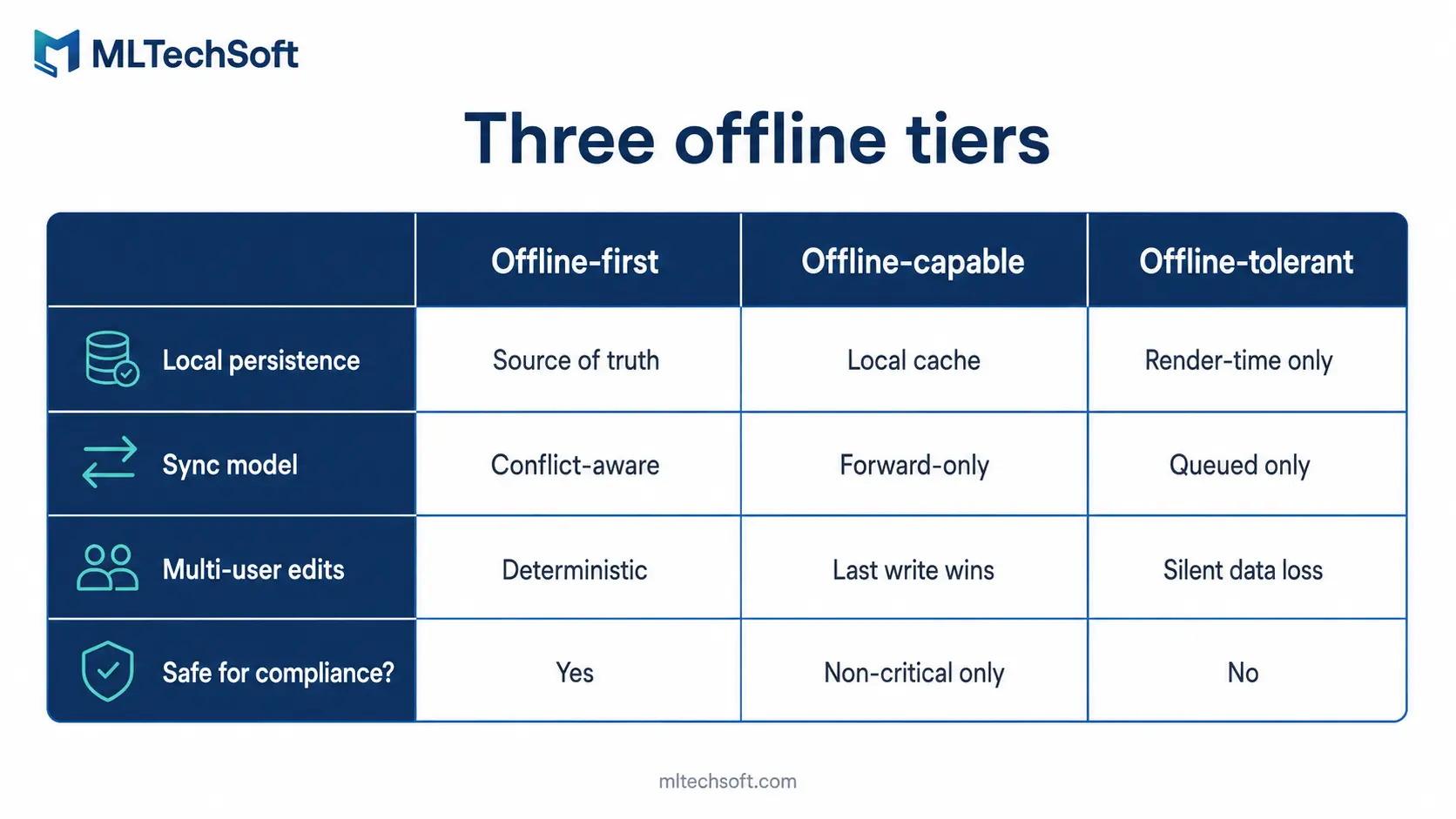
So what? Anything an MLC 2006 inspector or ISM auditor will ask to see must sit on offline-first.
The 7-day transit test
The test: Take the application offline at port departure. For seven days, simulate full operational use — including concurrent edits across at least two crew accounts on different devices. Reconnect on arrival. Do all entries land cleanly, with no silent overwrites or merge conflicts requiring manual resolution?
Seven days exposes conflict resolution. Multi-user edits expose merge policy. Reconnect-on-arrival exposes the sync layer. Vendor demos almost never run this test because their environments are optimised for stable office Wi-Fi, single user, short session.
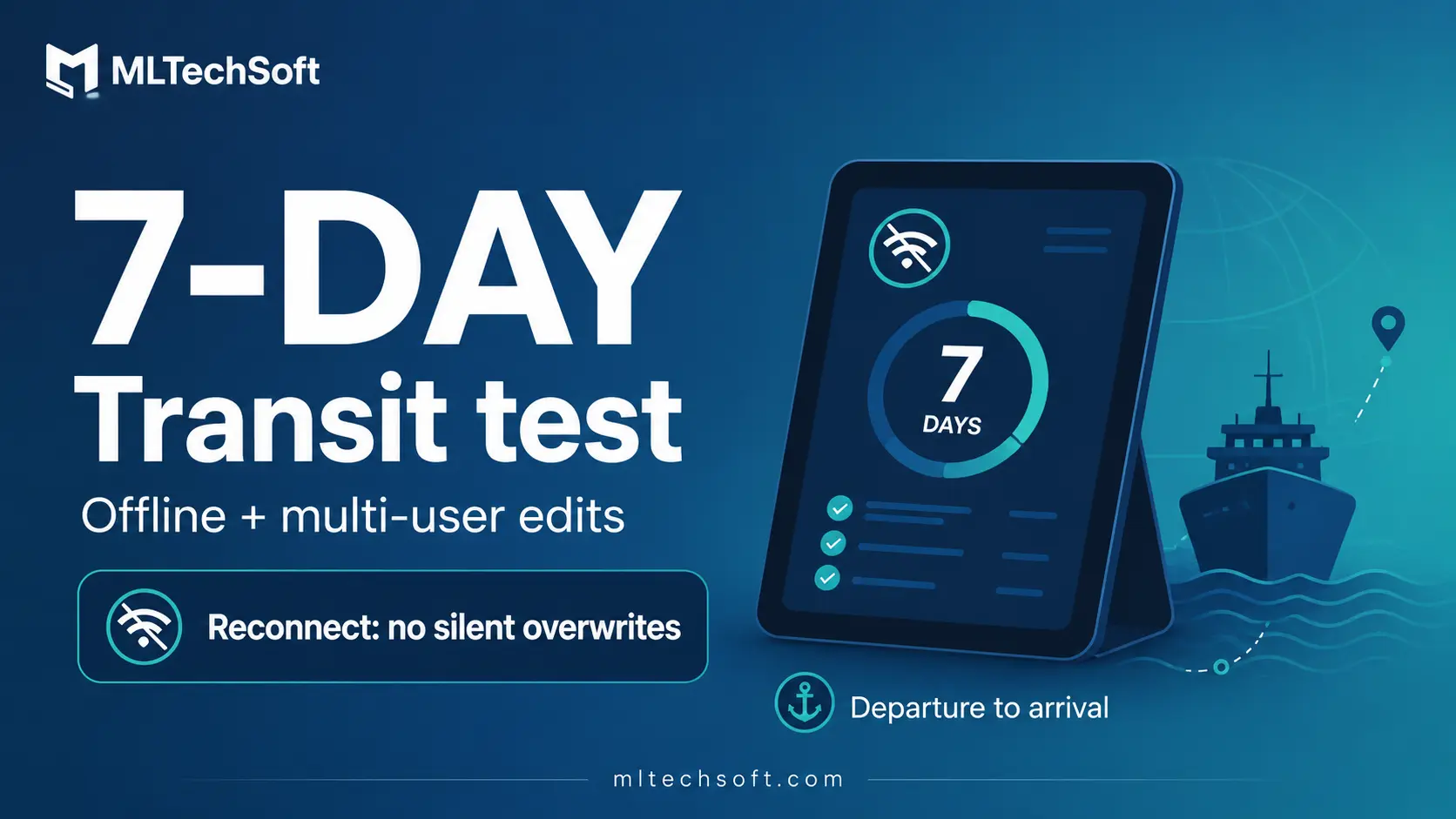
So what? Put the 7-day transit test into your next maritime software RFP as a mandatory acceptance criterion. The vendors who survive it are the ones whose architecture you can trust with rest-hour and maintenance records.
Why most maritime apps fail this test
The failures trace back to three architectural decisions made before maritime was a serious customer.
The cloud-first assumption. Modern web apps were designed in the era of always-on broadband; “offline” was added on top. Service workers cache responses, but the data model assumes the server is the source of truth and conflicts resolve by re-fetching. At sea, there is no server to re-fetch from for days.
No conflict resolution policy. Two crew members update the same record offline. On reconnect, “last sync wins” means whichever device synced last overwrites the other, silently.
Sync visibility is hidden. Crew don’t know whether their entries have synced. No UI affordance distinguishes “local-only” from “reconciled.” When something goes missing during an audit, the trail is impossible to reconstruct.
So what? The dangerous failure mode is not the app that visibly breaks. It’s the app that works smoothly for a week and silently fails to reconcile. Visible failures get fixed. Silent ones become audit findings months later.
The five components of real offline-first design
Real offline-first is not a feature flag. It is five architectural commitments, made together.
1. Local-first persistence. IndexedDB or SQLite on device. The local store is the source of truth; the server is a peer, not a master.
2. Append-only event log. Every change is a versioned event, not a destructive update. Full record history reconstructs even after multiple offline edits across devices.
3. Deterministic conflict resolution. CRDTs or a documented merge policy producing the same result regardless of sync order. No “last sync wins.”
4. Sync state visible in the UI. Every record visibly shows its state — local-only, queued, reconciled, merged. Audit trails reconstruct in seconds.
5. Bandwidth-aware delta sync. Sync moves only changes, prioritising compliance records ahead of non-critical data. On a constrained VSAT link, this separates an audit-ready system from an unusable one.
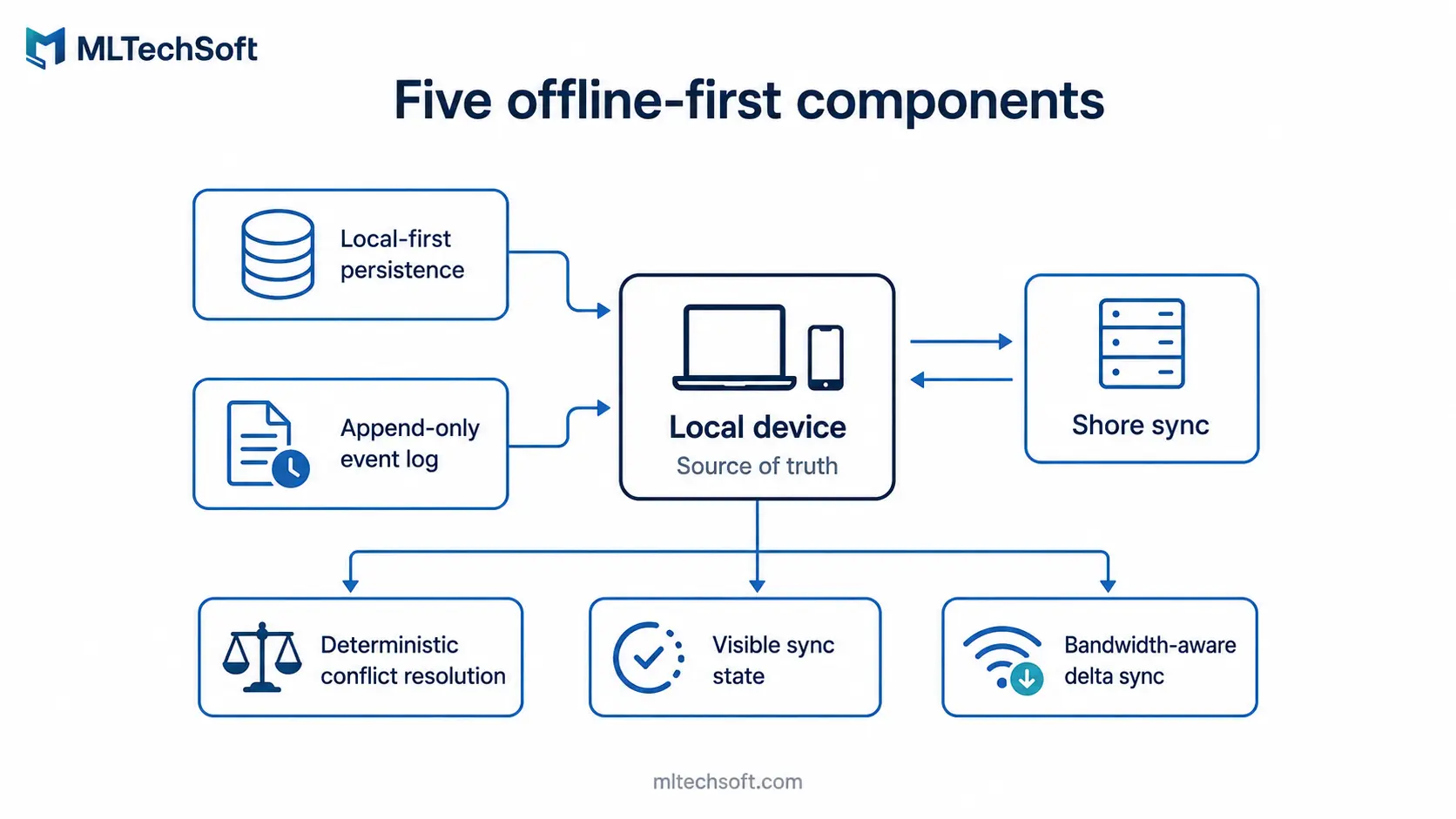
So what? Ask any vendor to point to each of these in their architecture. If they can name three out of five and describe the implementation, you are dealing with engineers who understand sea operations.
What this looks like on a real maritime system
A Singapore-based ship management company managing 30+ vessels asked us to evaluate a crew rest hours app vendor before fleet rollout. We ran a compressed 7-day transit test.
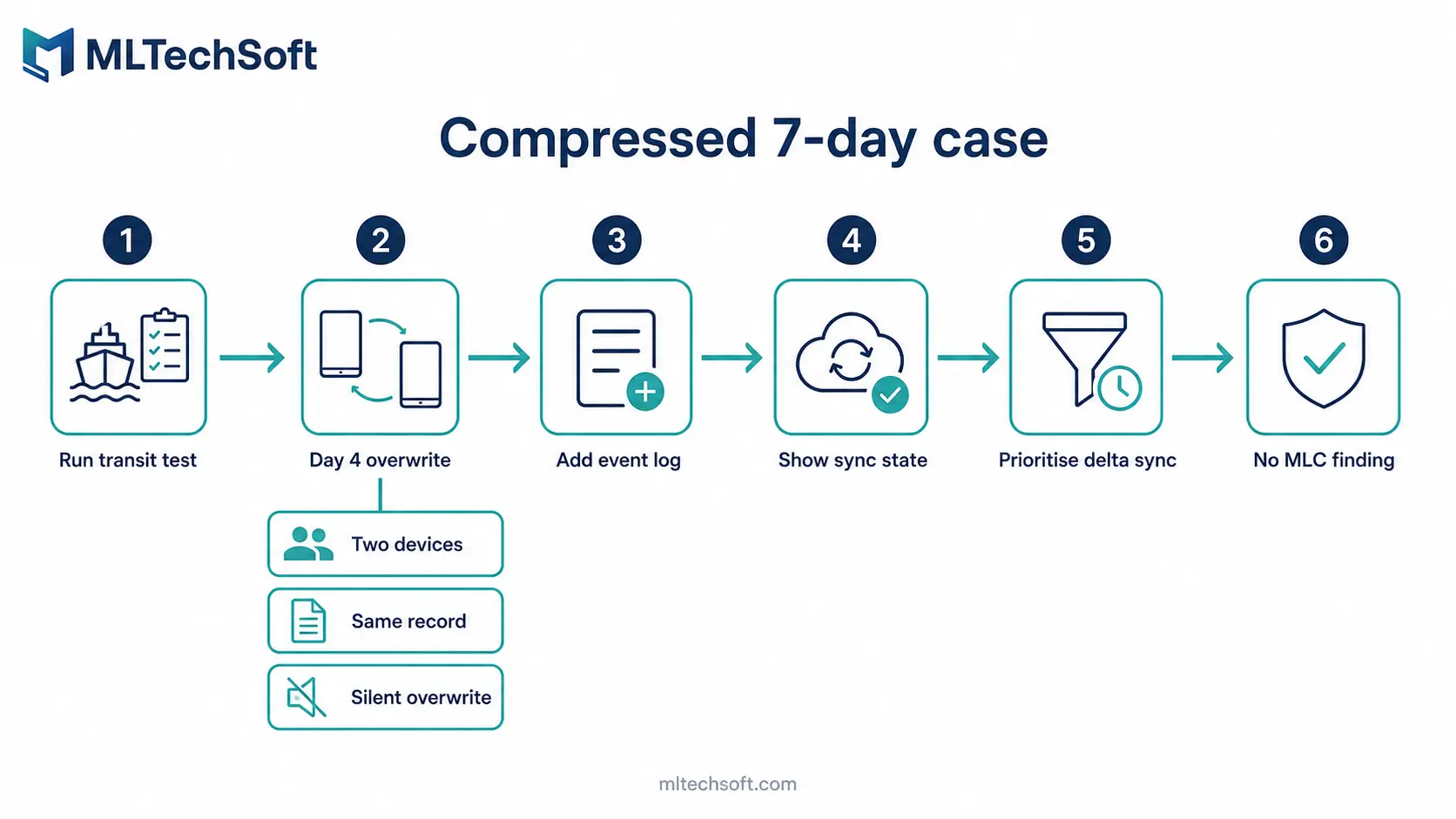
The app failed on day 4. Two duty officers on different devices recorded overlapping rest hour entries during a connectivity gap. On simulated reconnect, the later sync overwrote the earlier one — no audit trail, no conflict notification. The vendor confirmed the architecture: local storage was a cache, sync was last-write-wins, and they had never tested multi-user offline beyond 24 hours.
We rebuilt the sync layer with an append-only event log per record, added visible sync state, and routed through a satellite-aware delta sync that prioritised rest-hour entries — drawing on patterns from enterprise offline systems we’ve built, including a maintenance platform serving 100+ users across multiple sites for 5+ years. The MLC 2006 inspector six months later flagged nothing.
So what? Offline-first is more expensive to build than offline-capable, and for non-critical data — marketing telemetry, optional dashboards — the simpler architecture can be a legitimate choice. The argument is about picking the right tier for the right data.
The vendor questions that surface the architecture
These move a procurement conversation from marketing to engineering.
- Is your local data store a cache, or is it the source of truth?
- What is your conflict resolution policy when two users edit the same record offline?
- Does the UI show users which records have synced and which haven’t?
- How does your sync prioritise compliance records over non-critical data?
- Can you demonstrate a 7-day offline transit with multi-user edits and clean reconciliation?
- What happens to a record if the vessel reconnects, syncs partially, then loses connection mid-sync?
- How long are local records retained on device, and what happens if a device is replaced before sync?
So what? If you can only ask two questions, ask 1 (cache vs source of truth) and 5 (transit test demonstration). Those produce the cleanest separation between vendors who built for sea and vendors who built for office Wi-Fi.
FAQ: Offline-first maritime software questions answered
What is the difference between offline-first and offline-capable software?
Offline-first treats the local device as the source of truth, with sync to shore handled as a background, conflict-aware operation. Offline-capable apps continue to render and accept input without a connection but treat the server as canonical and resolve conflicts on a “last write wins” basis. The practical difference shows up after a multi-day disconnection with concurrent edits: offline-first reconciles deterministically; offline-capable can silently overwrite data.
Can a Progressive Web App work fully offline at sea?
Yes — but only if designed offline-first from the start. PWAs give you the technical primitives (service workers, IndexedDB, background sync); the architecture decisions on top of those — local-first persistence, append-only event logs, conflict policy — determine whether the PWA survives a multi-day transit. A PWA using service workers only to cache responses is offline-capable, not offline-first.
How do you handle data conflicts when multiple crew edit the same record offline?
The two robust approaches are CRDTs and an append-only event log with a documented merge policy. Both share one property: the same set of edits, applied in any order, produces the same final state. “Last write wins” is not a conflict resolution policy — it is the absence of one.
Does Starlink Maritime mean we no longer need offline-first design?
No. Even with Starlink in service across most ocean routes, vessels encounter coverage gaps near land, in port congestion, during peak demand, and during equipment outages. Compliance records cannot depend on connectivity that is “usually fine” — an MLC 2006 inspector does not accept “we had a connectivity gap” as a reason for missing rest hour data.
What to do before the next vendor demo
Connectivity at sea is a fact to be designed around, not a problem to solve with better satellites. Offline-first takes that fact seriously; offline-capable treats it as an edge case.
For your next maritime app procurement, put the 7-day transit test into the RFP, ask the seven vendor questions, and require a multi-user offline demonstration with clean reconciliation before signing. If you are evaluating an app where compliance records depend on offline reliability, MLTech Soft offers a free 1-hour architecture review — we work through the vendor’s data model, conflict-resolution policy, and sync visibility, and produce a written assessment. Book your architecture review →