The most useful question to ask any fleet software vendor in 2026 is whether their AI is bolted on or built in. The two look identical in a demo. They behave very differently three months after go-live.
Bolt-on AI is a chat box, a summary button, or a copilot pane added to an existing UI. The underlying workflow is unchanged. The operator still opens the same screens, fills in the same forms, and clicks through the same approval flow — only now an AI panel offers to help. Some of these features are useful. None of them change the shape of the work.
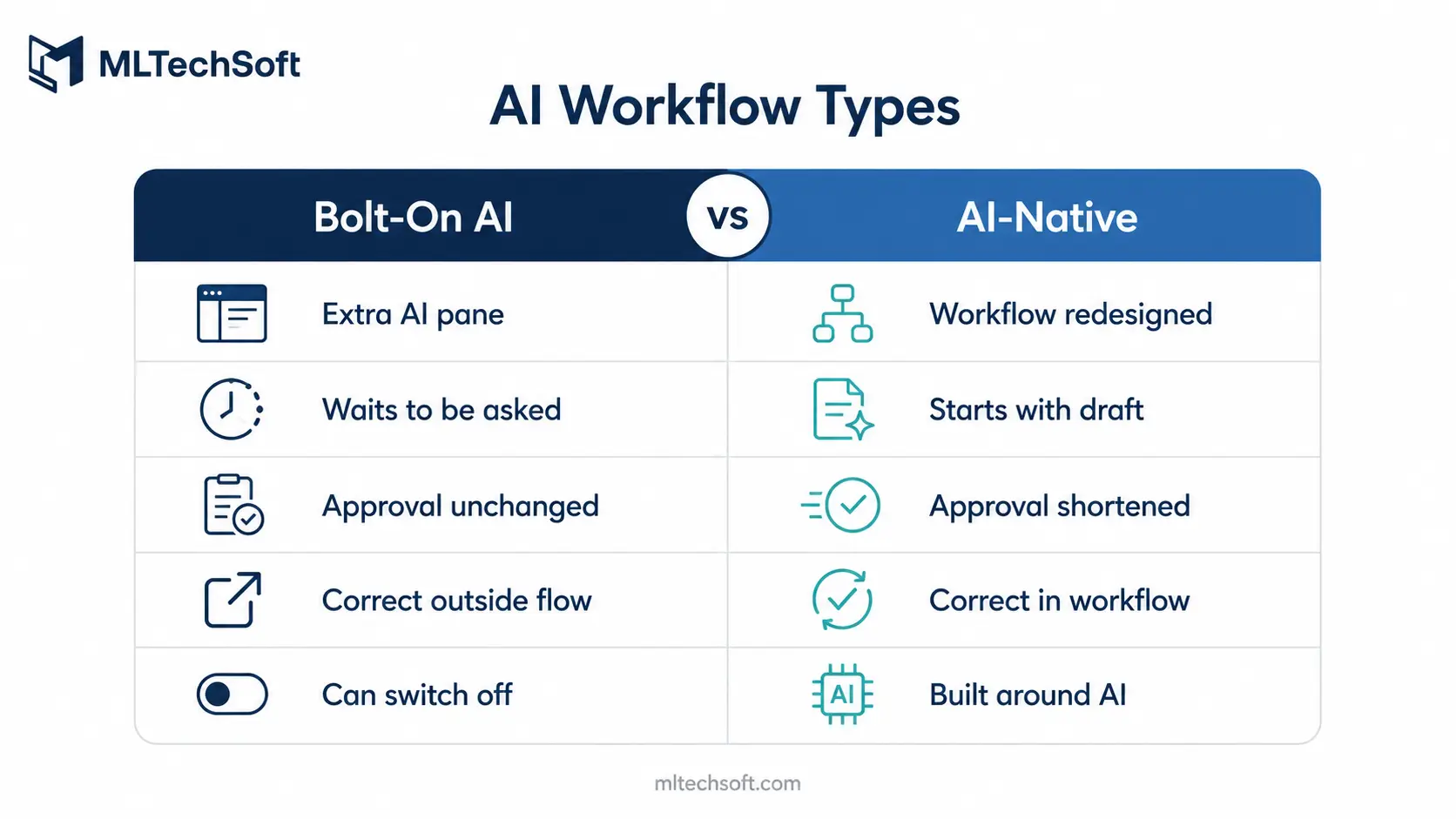
AI-native workflows look different from the first screen. The form is shorter because the AI has already drafted what it can infer. The approval flow has fewer stops because the AI has pre-classified the items that need senior judgment. The handover at the end of watch is a structured artefact the AI assembled from the watch’s events — not a blank text box waiting to be filled.
The split matters because it predicts ROI. A bolt-on AI feature improves average task time by something like 5 to 15 percent — useful but not transformational. An AI-native workflow can compress the same task by 70 to 80 percent and improve consistency at the same time. The difference is not the model. It is whether the workflow was redesigned around what the model can now do.
| Dimension | Bolt-On AI | AI-Native Workflow |
|---|---|---|
| Where you encounter it | A pane, a chat, a button | The whole screen is different |
| What it changes | The speed of optional steps | The shape of the work itself |
| What the operator does | Same clicks plus AI help | Edits a pre-built draft |
| Average ROI in production | 5–15% task-time saving | 70–80% task-time saving |
| Vendor signal | “We added AI features” | “We rebuilt this workflow around the model” |
For a CTO running a fleet of 30 vessels with a lean shore IT team, this matters in one specific way: the bolt-on version makes the existing system marginally better and easier to defend in a board meeting. The native version is the only one that creates the operating leverage that lets you absorb the next regulatory cycle without hiring three more analysts.
Where Generative AI Is Already Paying Off in Fleet Operations
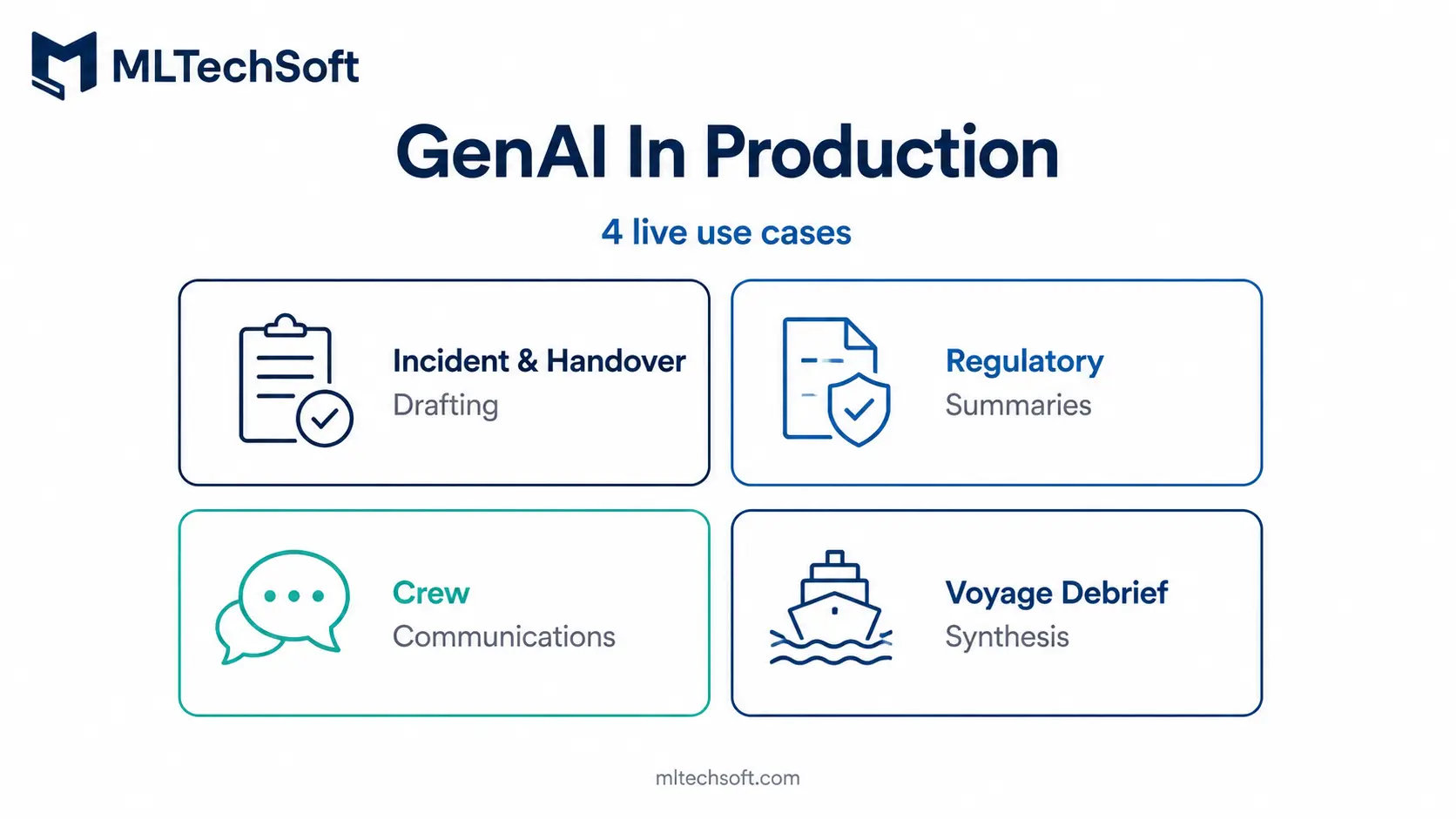
Four use cases have crossed from pilot into production at fleet operators in 2026. None of them are the autonomous vessel. All of them are about turning unstructured operational text into structured, searchable, action-ready output.
Incident reports and watch handover summaries
Generative AI now drafts incident reports and watch handovers at production quality, with the operator’s role shifting from writing to editing. Three Southeast Asian operators we have observed since Q4 2025 cut average report-drafting time by roughly four-fifths — and improved consistency across watchkeepers, which is the more durable benefit.
The pattern that works is the one where the model has access to the watch’s structured event log (alarms, position fixes, manoeuvres, port-call events) and uses it to assemble a first-draft narrative the watchkeeper edits. The pattern that fails is the one where the model is asked to summarise free-text notes the watchkeeper has already written — by that point most of the time has already been spent.
For a ship management company with eighteen vessels, four watch teams, and a Singapore shore office trying to keep handover quality consistent across rotations from Manila, Mumbai, and Jakarta: the value is not the speed-up. It is that the company finally has watch handovers that look the same when read by an incoming Master, regardless of which crew wrote them.
Classification certificate and regulatory document processing
Classification societies issue dense, repetitive paperwork: certificates of class, statutory certificates, condition reports, survey memoranda. Most of this paperwork is read three times — at issuance, at survey, and at port state control. Generative AI in 2026 is good enough to summarise these documents into structured records and flag the inconsistencies between them, which is where the operational risk hides.
In our work integrating generative AI workflows for an anonymised Singapore-based operator running multi-asset operations across Southeast Asia, the highest-value pattern was not the summary feature on its own. It was the cross-document consistency check — the model reading the certificate of class alongside the most recent survey memorandum and flagging the seven lines where the two documents implicitly disagreed. Three of those seven were genuine findings that would have caused friction at the next port state control inspection.
The trade-off is real. The model is sometimes confident about discrepancies that turn out to be artefacts of formatting. Production systems still need a human reviewer to clear the queue. The shape of that reviewer’s job has changed: they read flagged items rather than every document end to end.
Multilingual crew communications
Fleets run on a mix of English, Tagalog, Bahasa Indonesia, Hindi, Russian, and Mandarin. Crew safety briefings, technical bulletins, and port-call instructions need to land cleanly in each. Generative AI in 2026 produces translations that pass internal quality review for operational text in this language set, with the human reviewer focused on terminology consistency rather than baseline fluency.
The non-obvious benefit is in the back-channel: questions from crew via WhatsApp or vessel comms now get coherent shore-side responses in the same language, without waiting for the one Tagalog-speaking superintendent to come back online. For shore teams that used to receive a question at 02:00 Singapore time and acknowledge it eight hours later, the gap closes to under thirty minutes.
The limit is technical content. Classification language, IMO terminology, and equipment-specific procedural text still need a domain reviewer. A general-purpose translation model is not equipped to know that “CSM” means Continuous Survey Machinery in this context, not Customer Success Manager.
Voyage debrief and post-port-call synthesis
After every port call there is a synthesis to do: what happened, what slipped, what should be different next time. In 2025 this either lived in scattered emails or did not happen at all. In 2026, generative AI assembles a debrief draft from the port-call event log, the agent emails, the bunker delivery note, and the crew watch notes. The Master edits it; the Operations team gets a consistent record across the whole fleet.
For an operator who calls forty ports a month and has historically captured zero of those debriefs in any structured form, the value is not that the new system is fast. It is that the debrief now exists at all, and that next year’s contract renegotiation with the same agent in the same port has the receipts attached.
What we tell clients: the four use cases above account for somewhere between 60% and 80% of the genuine generative AI ROI in fleet operations in 2026. Almost everything else is either still in pilot or marketing dressed as engineering.
Where Predictive AI (Not Generative) Is Doing the Real Work
The other half of the AI conversation in fleet operations is predictive AI, and bundling it with generative AI is dishonest marketing.
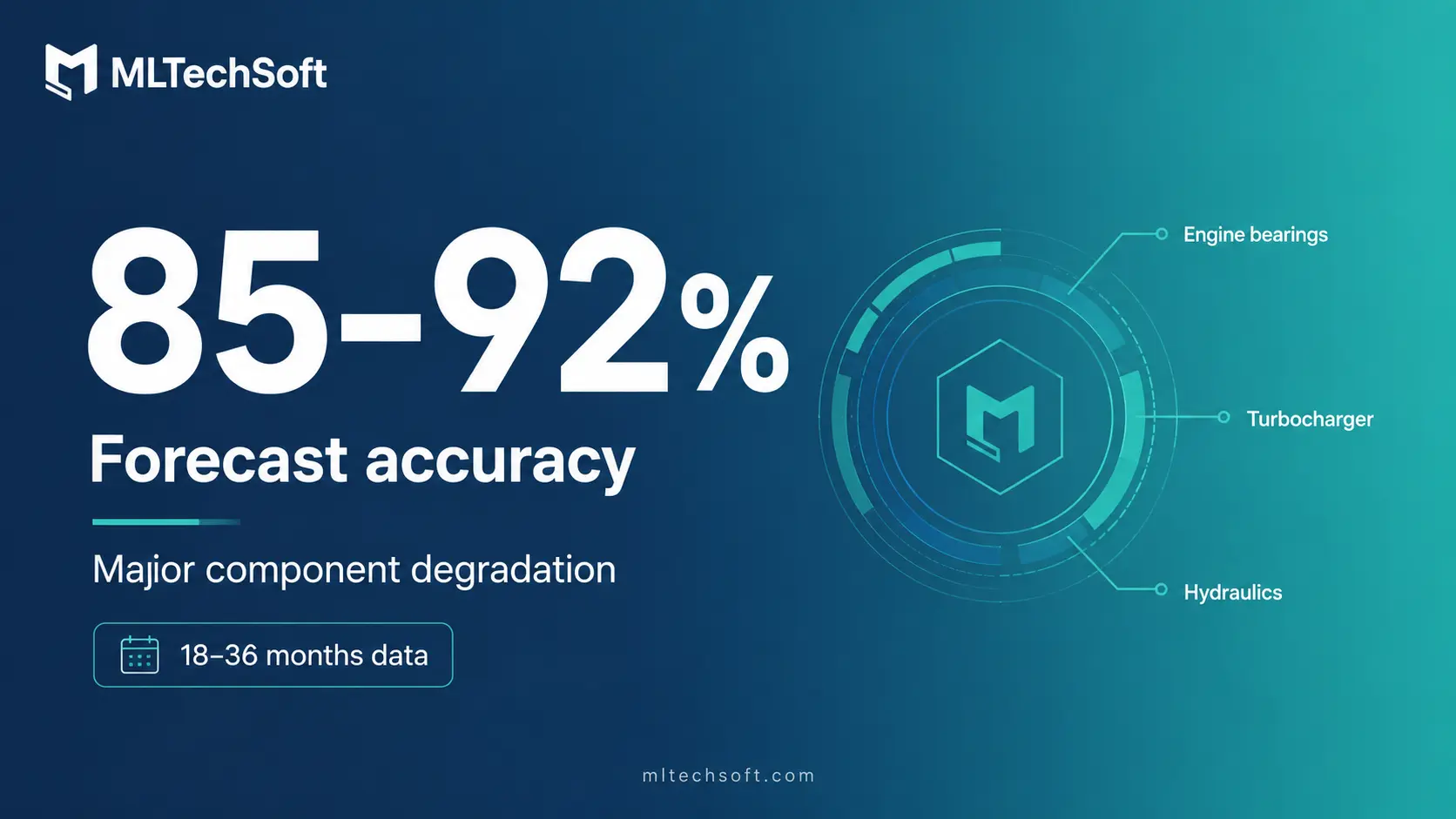
Predictive maintenance models in 2026 are hitting 85–92% accuracy on major component degradation forecasts when fed enough sensor history — main engine bearings, turbocharger performance, auxiliary generator output, hydraulic system pressures. The models are mature. The bottleneck is data. A fleet that has been writing PMS notes by hand into a 2011 system for the past decade does not have the structured sensor history to feed the model. A fleet that has been instrumented with modern condition monitoring for three years does.
This matters for vendor evaluation in one specific way. When a vendor demos “AI-powered predictive maintenance” on stage at Singapore Maritime Week 2026, the right question is not “what’s your model architecture?” It is “what data do you need from us, in what format, for how many months, before the model is genuinely better than a competent chief engineer’s intuition?” The honest answer is usually 18–36 months of well-structured sensor data per equipment class. Vendors who promise a six-week pilot that delivers production-grade predictions are not lying about the model — they are lying about the data.
For a ship manager who has just signed a maintenance contract on the back of a predictive-AI demo, the operational implication is to budget for the data plumbing project first. The model is the easy part.
Where Agentic AI Has Crossed Into Production — and Where It Hasn’t
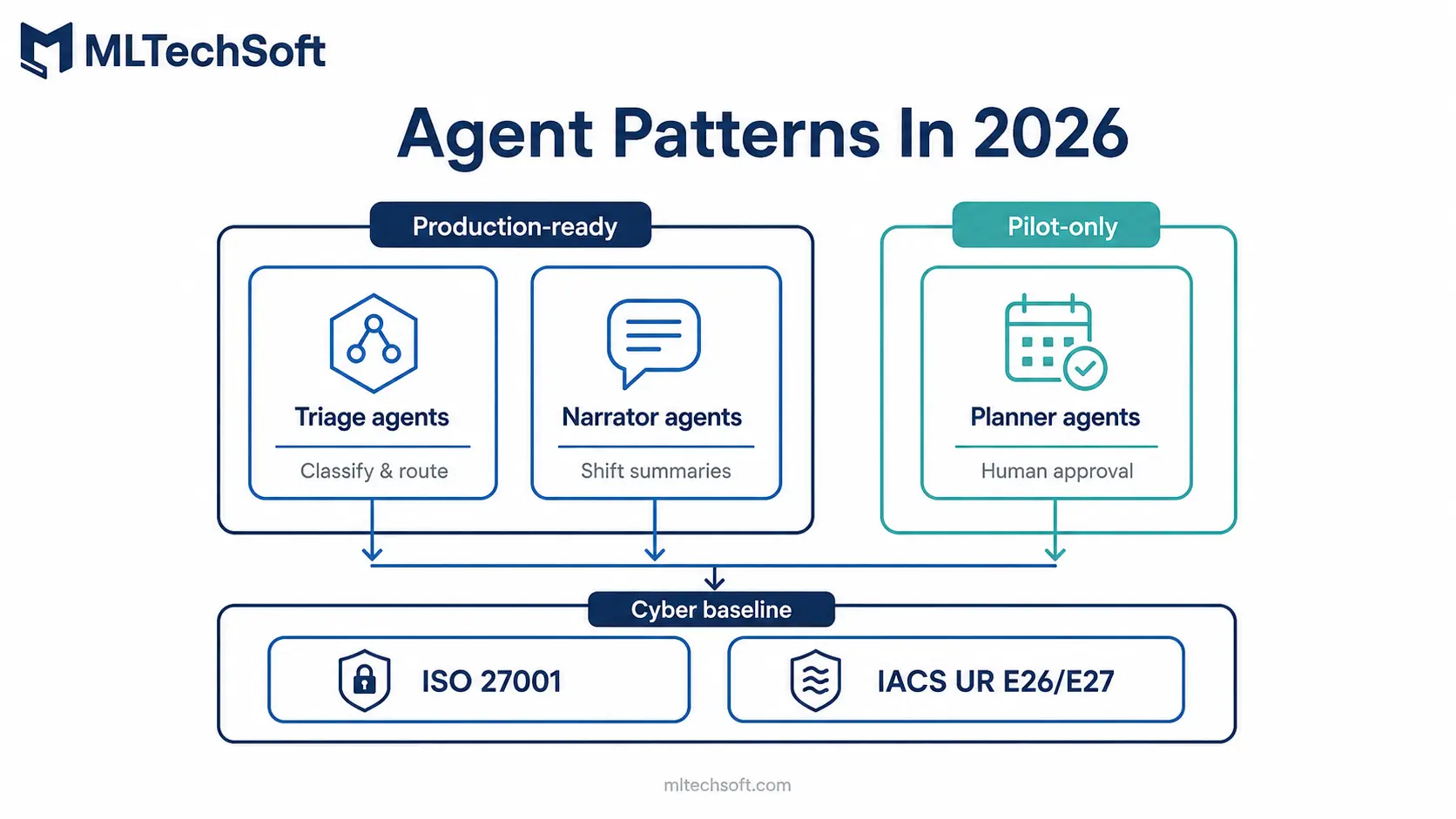
Agentic AI — software that reads context, decides, and acts — is the conversation everyone wanted to have at SMW 2026. Three agent patterns are now in production for fleet operations. One is still firmly in pilot.
Triage agents (production-ready). Inbound emails, vessel alerts, and port-agent notifications flow through an agent that classifies, prioritises, and routes them to the right superintendent or department. The agent does not make operational decisions. It compresses the time between “something happened” and “the right human is looking at it.” In our work on operations platforms for enterprise clients, this is the agent pattern that produces the cleanest, most defensible ROI in the first 90 days.
Narrator agents (production-ready for internal use). An agent that reads the state of the fleet — positions, alarms, ETAs, exceptions — and produces a coherent narrative summary for an operations manager every shift, or on demand. The agent’s output is read by humans, not acted on automatically. This is the safest agent pattern to deploy because the failure mode is “the summary was confusing” rather than “the agent did something we did not authorise.”
Planner agents (pilot-only). An agent that proposes a sequence of actions — reroute the vessel, defer a survey, escalate a crew issue. In 2026 these are still in supervised pilot, with every proposed plan reviewed and approved by a human before it is acted on. The reason is not the planner’s capability. It is the legal, contractual, and insurance ambiguity around what happens when an autonomously proposed action contributes to an incident.
Gartner’s prediction that over 40% of agentic AI projects will be cancelled by the end of 2027 is best read with this split in mind: the cancellations will cluster at planner-agent projects that were sold as production-ready when they were not, and at triage and narrator agents that were deployed without the data hygiene to make them useful.
ISO 27001-certified delivery — which our team treats as a baseline rather than a feature — matters more for agentic AI than for any earlier wave of enterprise AI, because an agent that is acting on data is also a new attack surface. The IACS UR E26/E27 requirements that came into force in 2024 are starting to shape the cyber baseline expected of any agent operating in maritime contexts.
The Use Cases That Sound Impressive But Don’t Pay Off Yet
Three AI use cases dominate vendor decks in 2026 and have not yet earned their keep in production fleet operations.
The first is fully autonomous route optimisation. Models that compute fuel-optimal routes given weather, currents, and port windows exist and work in simulation. In live operation, the constraint is not the model — it is the dozens of soft inputs (charterer preference, geopolitical risk, crew rotation, bunker availability, port congestion) that the model cannot see. The current state of the art is a recommendation surfaced for a human Master to override, not an autonomous optimiser.
The second is AI-driven port call orchestration. The promise is that an agent coordinates the entire port stay — pilot, tug, line handlers, bunker barge, agent, stevedores, customs — and the call clicks through itself. The reality is that port-call orchestration runs on relationships, phone calls, and local context that no current model has access to. A genuinely useful port-call agent in 2026 is one that reads the agent’s emails and flags the deviations from plan. The autonomous orchestrator is still a 2028 question.
The third is conversational AI as the primary interface for operations staff. There is a popular vendor pattern of replacing dashboards with a chat box: “ask anything about your fleet.” It works in demos. It fails in production because experienced operators do not want a chat interface for work they do thirty times a day — they want a dashboard. Conversational AI works well for occasional queries and onboarding new staff. It does not work as the daily operating console for someone who knows their job.
Naming what does not yet work matters because the cost of the wrong AI bet in 2026 is not financial — it is opportunity cost. A budget cycle spent on the conversational-interface pilot is a budget cycle not spent on watch handover automation, which would have paid back inside a quarter.
A Six-Question Self-Assessment: Is Your AI Vendor Selling You Bolt-On or Native?
Run these six questions against any AI feature in your current or proposed fleet software. If the vendor’s answers cluster on the right side of the table, the feature is bolt-on. If they cluster on the left, it is AI-native and probably worth the contract.
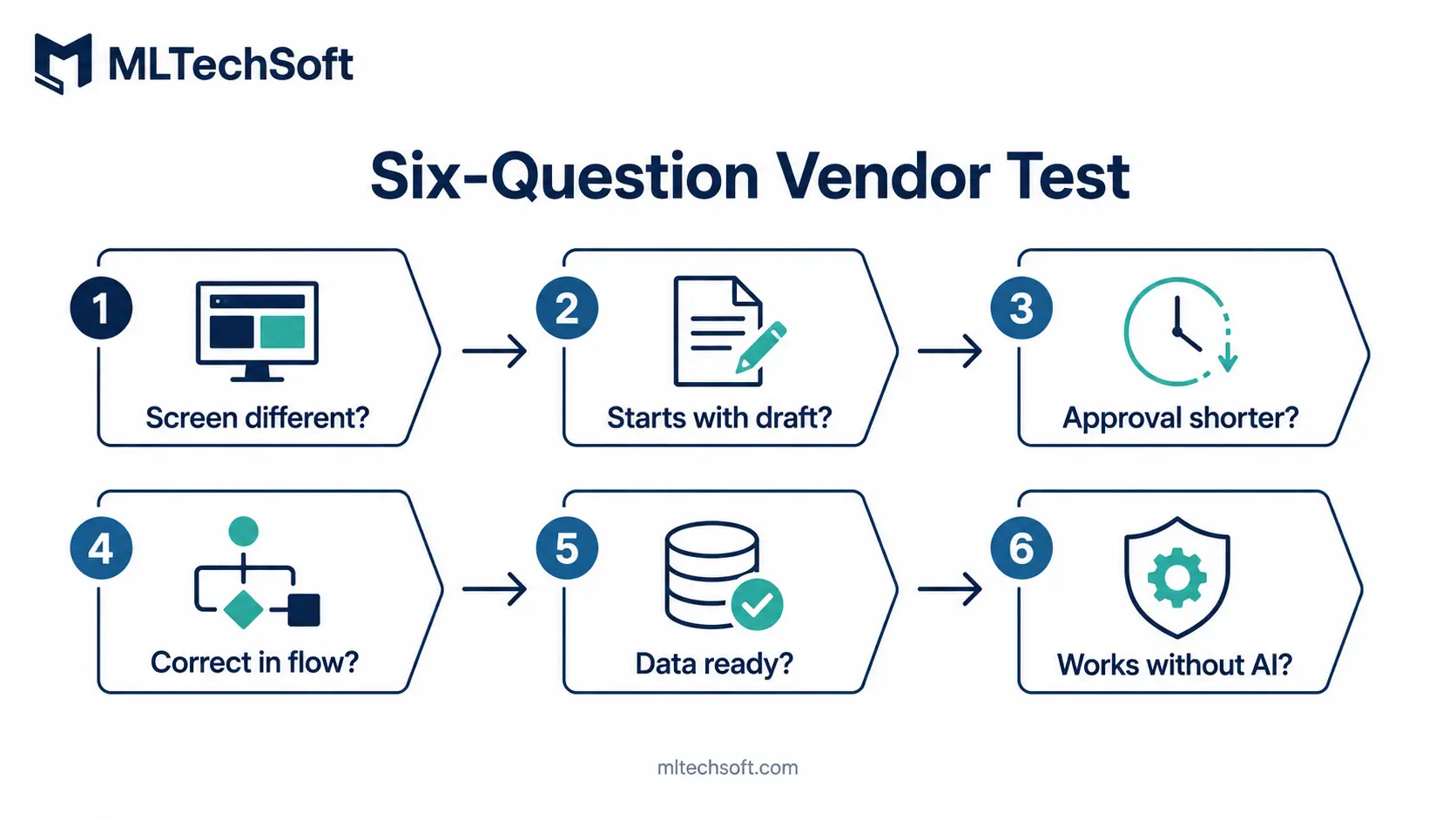
- When the AI is doing its job, does the operator’s screen look different from how it looked before, or is it the same screen with an extra pane?
- Does the AI start the task with a useful draft, or does it wait to be asked?
- Has the approval flow been shortened, or just decorated with an AI summary?
- When the AI is wrong, can the operator correct it without leaving the workflow?
- What data does the AI rely on, and is that data already in your systems in the form the AI needs?
- If the AI was switched off tomorrow, would the workflow still function — or has the workflow been redesigned around the assumption that the AI is there?
The last question is the most diagnostic. A bolt-on feature can be switched off without consequence. An AI-native workflow cannot. That is the trade-off — and that is also why the ROI is asymmetric.
For a fleet operator evaluating two vendors at the end of 2026, this is the working framework: the vendor whose AI passes all six questions has built the system you actually want, and is rarer than the vendor decks suggest.
FAQ: Generative AI in Fleet Operations Answered
Where is generative AI delivering the highest ROI in fleet operations in 2026?
The highest ROI in 2026 is in compressing unstructured operational text — incident reports, watch handovers, multilingual crew communications, and post-port-call debriefs. These are workflows where the work was already text-shaped, and where a generative model can produce a first draft a human edits. The ROI comes from time saved and from consistency improved across watchkeepers and crews.
Is predictive maintenance with AI production-ready in 2026?
Yes, for fleets that have the sensor history. Production-grade predictive maintenance models in 2026 are hitting 85–92% accuracy on major component degradation forecasts when fed 18–36 months of well-structured sensor data per equipment class. The constraint is rarely the model — it is whether the operator’s existing PMS data is rich enough to train it. Vendors who promise short pilots with production-quality predictions are usually understating the data work.
What is the difference between agentic AI and generative AI in fleet operations?
Generative AI produces text or structured output from a prompt and context — drafts, summaries, translations. Agentic AI uses generative models inside a system that can read context, decide, and act on the operator’s behalf. In 2026, triage agents and narrator agents are in production for fleet operations. Planner agents, which propose sequences of operational actions, are still in supervised pilot because the legal and insurance frameworks for autonomous maritime action have not caught up.
How should a fleet operator pilot generative AI without overcommitting?
Start with a workflow that is already text-shaped, where the failure mode is “the draft was not good enough” rather than “the AI made a bad decision.” Watch handovers, incident reports, and port-call debriefs all qualify. Run the pilot for one quarter on a single class of vessels. Measure two things: time saved per artefact, and consistency improved across crews. If both improve materially, the workflow is a candidate for fleet-wide rollout. If only time improves, the gains will fade once the novelty does.
How do regulations like IACS UR E26/E27 affect AI deployments in fleet operations?
IACS UR E26 and E27 set cyber resilience requirements for ships and onboard systems — and by extension, for the software vendors supplying them. Any AI feature that touches vessel data or operational decisions falls inside that scope. Vendors who cannot explain how their AI pipeline complies with the secure-by-design and risk-management expectations of the rules are signalling that their AI was built before security was part of the requirements list. ISO 27001 certification at the vendor level is the minimum credible baseline.
What This Means for the Next Twelve Months
The pattern in 2026 is consistent enough to plan around. Generative AI earns its keep where the work was already text. Predictive AI earns its keep where the data is mature. Agentic AI earns its keep in triage and narration, not yet in autonomous planning. Anything outside those three buckets is either still in pilot or being mis-sold as ready.
The operators with the cleanest results next year will not be the ones with the most AI features — they will be the ones who picked two or three workflows, redesigned them around what the model can now do, and let the rest of their stack continue to work the way it works. That is a less exciting roadmap than the one in the vendor decks. It is also the one that ships.
If you are scoping which generative AI use cases to pilot first, our team offers a free maritime software assessment — a structured working session where we walk through your current workflows and flag the two or three where generative AI is most likely to earn its keep inside ninety days. Book a slot here.