Artificial intelligence is adding measurable value in three ship management workflows today: automated document processing for maritime compliance certificates, predictive maintenance alerts from machinery sensor data, and crew scheduling optimisation. These applications are in production at ship management companies in Singapore and globally — not in trials or roadmaps. A further two — voyage optimisation and generative AI knowledge management — are delivering results in environments where the underlying data infrastructure is in place. The remaining AI applications widely promoted in maritime are still primarily vendor demonstrations. This post maps the distinction clearly, with the questions to ask at Singapore Maritime Week to separate what works from what is being sold.
The Problem with Maritime AI Coverage Right Now
Every maritime technology conference now features vendors claiming AI will “revolutionise” ship management. Some of those claims are grounded in operational reality. Most are not.
The conflation of production deployments with vendor demos has become the central credibility problem in maritime AI coverage. A technology working reliably on 20 vessels in Singapore is genuinely different from a prototype tested in a vendor’s lab. Yet both get discussed as if they’re equally near to market.
This post exists to separate the signal from the noise. Ship management companies evaluating AI — particularly those preparing for vendor conversations at Singapore Maritime Week (April 20, 2026) — need a practical filter: which applications are working in production environments right now, which ones are genuinely promising for 2026–2027, and which ones are still primarily vendor demonstrations with no clear path to operational deployment.
The goal is not to dismiss AI. The goal is to help you invest where the ROI is demonstrable and defer where it’s speculative.
AI That Is Working in Production Ship Management Environments Today
AI-Assisted Document Processing for Maritime Compliance Records
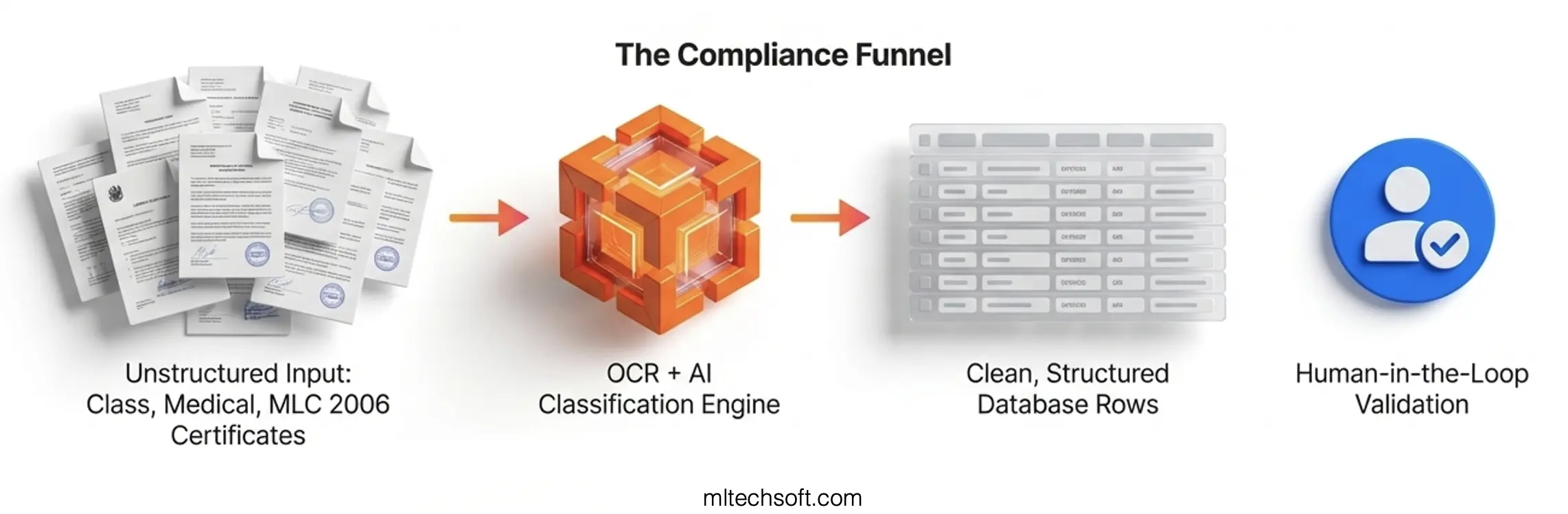
AI-assisted document processing for maritime compliance is in production deployment across leading ship management companies. The technology reads, classifies, and extracts data from certificates, inspection records, and regulatory filings — reducing the manual review burden by 40–60% in documented deployments.
In practice, this works as follows: A new crew member joins your vessel with a sheaf of digital documents — class certificates, medical fitness certificates, maritime labour convention (MLC 2006) records, training credentials. Instead of a shore-based administrator manually entering expiry dates and flagging missing documents, an AI system reads, classifies, and extracts the data. A human verifier still reviews the output, but the 3–4 hour manual process becomes a 15-minute verification task.
Named tools delivering this capability include OceanDocs AI (which uses document intelligence to process maritime compliance materials), Sedna (maritime AI communication platform), and MariApps OceanAI. MLTech Soft has built AI document classification pipelines for regulated industries — including a computer vision system for medical X-ray analysis (V-Dental AI) — and has applied the same pattern logic to maritime certificate processing for ship management clients. The proof point: if the pipeline works on healthcare-grade regulated documents, it transfers to maritime compliance workflows.
Why it works now:
- The documents themselves are relatively standardised (class certificates, medical certificates, training records follow predictable formats).
- A human is still in the loop to verify the AI’s output.
- The ROI is immediate: time saved on data entry and expiry tracking.
Common failure point: Unstructured or poorly scanned documents. If your incoming certificates are hard copies of hard copies, the OCR fails and the AI never sees clean data to work from.
Predictive Maintenance Alerts from Sensor Data
Real-time predictive maintenance AI is in production at major shipping operators globally, using continuous sensor telemetry from engine rooms and propulsion systems to flag anomalies before they become catastrophic failures. Production deployments document a 25% reduction in unplanned maintenance events — a significant ROI given that an unexpected main engine failure can cost tens of thousands of dollars per day in lost revenue, emergency repairs, and deviation charges.
The system works by ingesting real-time data streams: vibration sensors on the main engine, temperature and pressure readings in the fuel system, lube oil analysis results, and historical maintenance records. Machine learning models trained on thousands of hours of normal operation detect patterns that precede failure modes. When anomalies appear — a subtle shift in vibration signature, a temperature trend that suggests imminent bearing wear — the system alerts the chief engineer with enough lead time to schedule preventive maintenance at the next port call rather than dealing with an emergency at sea.
Maersk’s deployment of predictive maintenance systems across its fleet demonstrated on-time arrival improvements of 25% as unplanned repairs decreased and engineers addressed problems proactively alongside normal watch duties. SmartSeas AI’s Maritime Predictive Analytics tools deliver 92% accuracy on diesel-engine fault detection, even when training data is sparse.
Why it works now:
- Modern vessels have increasingly comprehensive sensor suites.
- The algorithms are well-established (anomaly detection is a mature machine learning discipline).
- The ROI is clear: fewer unplanned failures, better scheduling efficiency, reduced emergency repair costs.
Common failure point: Data quality and consistency. The AI model is only as reliable as the sensor data feeding it. If one vessel’s temperature sensors are poorly calibrated or ship-to-shore data transmission is intermittent, the model’s accuracy degrades. This is why data quality — not algorithmic sophistication — is the most common reason AI maintenance projects fail in maritime environments.
AI-Powered Crew Scheduling Optimisation
AI crew scheduling is in production at ship management companies, automating the selection of off-signers and recommending optimal on-signers based on certification records, fatigue data, flag state requirements, and historical voyage patterns. IntelliCrew (MariApps OceanAI) is the named reference tool delivering this capability, with documented scheduling time reductions of 40–60% for ship managers with clean crew databases.
In a traditional workflow, a shore-based crew manager manually assembles a shortlist of candidates for an off-signing: checking certifications, verifying training expiry dates, cross-referencing flag state (Liberian crews must meet Liberian standards; Indian crews must meet Indian standards), reviewing medical fitness certificates, and weighing experience across vessel types. This process for a single sign-off can consume 2–3 hours of a crew manager’s time. Multiply that by dozens of sign-offs per month, and crew scheduling becomes a significant administrative burden.
AI crew scheduling algorithms ingest your crew database and automatically surface the best candidates based on the vessel’s requirements. The output is a ranked recommendation, which the crew manager can accept or override based on factors the algorithm doesn’t see (e.g., “this seafarer just finished an intense contract and requested a shorter deployment”). The AI does not replace judgment; it removes the drudgery.
Why it works now:
- The decision criteria are explicit and rule-based (certifications either exist or they don’t; medical fitness either passes or fails).
- The outcome — a ranked list of candidates — is easily validated by a human in minutes.
- The time savings are immediate and substantial.
Common failure point: Dirty or incomplete crew data. If your crew management system has 30% missing data, inconsistent formats (some records list certification numbers, others don’t), and manual workarounds stored outside the system, the AI can’t extract clean signals. The algorithm performs no better than a crew manager guessing. Cleaning the data usually takes 2–4 weeks before the AI becomes reliable.
AI Applications to Watch — Promising but Not Yet Production-Ready for Most Ship Managers
Voyage Optimisation and Just-in-Time Arrival Routing
Voyage optimisation AI — algorithms that recommend optimal routing, fuel-efficient speeds, and arrival timing to minimise fuel burn and maximise schedule reliability — is a mature technology. The algorithms work. The challenge is infrastructure.
Companies with real-time AIS feeds, integrated weather data, and robust fuel consumption monitoring systems see tangible results: documented fuel savings of 3–8% through optimised routing and speed decisions. But these results are conditional on data quality and integration. A ship manager running voyage optimisation on incomplete or delayed AIS data sees no benefit — the algorithm is only as good as the data feeding it.
Across the industry, most ship managers are still in the integration phase. Building the data plumbing (real-time AIS ingestion, weather API integration, fuel monitoring normalisation) takes 4–8 weeks. Until that infrastructure exists, voyage optimisation is a box on a product roadmap, not an operational reality.
Timeline to production readiness: 12–18 months for most ship managers. The technology is proven; execution and integration are the barrier.
Generative AI for Knowledge Management and Regulatory Q&A
Generative AI — specifically Retrieval Augmented Generation (RAG) systems — is enabling maritime teams to query their safety management system (SMS) manuals, compliance records, and operational procedures conversationally. Instead of a crew manager scrolling through a 500-page PDF to find the crew change procedure, they ask an AI assistant: “What’s the process for removing a crew member with a medical condition?” The system retrieves the relevant sections from the SMS, synthesises the answer, and provides a direct response with citations.
Early production deployments show strong user adoption and time savings of 20–30% on policy lookups. The limitation is clear: RAG systems work well with well-structured, consistently formatted document repositories. They struggle with legacy maritime companies that manage compliance documentation across 50 different folders, three different naming conventions, and a mix of PDFs, scanned paper, and institutional knowledge that lives only in people’s heads.
Deploying a RAG system requires 4–6 weeks of document standardisation and knowledge structuring before the AI becomes genuinely useful. Companies with modern, structured digital repositories can achieve production capability within 8–12 weeks. Companies with legacy filing practices are looking at 4–6 months of data preparation work before RAG becomes practical.
Timeline to production readiness: 12–18 months for ship managers with solid documentation discipline; potentially 2+ years for companies with fragmented legacy systems.

The Three Questions to Ask Every AI Maritime Vendor at SMW 2026
At Singapore Maritime Week 2026, you will hear AI claimed for everything from route optimisation to autonomous port entry. Here are three questions that will separate vendors with real production deployments from those running on aspirations and marketing budgets.
Question 1: “Can you name a live maritime client using this in production and connect me with their operations team?”
A credible answer: “Yes — Company X, a 60-vessel ship manager based in Singapore, has been using our system for 18 months. Their chief engineer can walk you through their predictive maintenance ROI. I’ll make an introduction by email.”
A non-credible answer: “We have trials running with several companies, and we’re close to signing our first deployment contract.” Or worse: “We can’t name them due to NDAs, but our research shows strong potential.”
Production deployments exist. If a vendor doesn’t have one, they’re selling a roadmap, not a product.
Question 2: “What data inputs does this require, and what happens to accuracy if our data quality is inconsistent?”
A credible answer: “Our system requires clean crew certification records and current MLC 2006 fatigue logs. If your crew database has 15% missing data, our accuracy drops to 75%. If it drops below 80% completeness, the system isn’t yet production-ready, and we recommend a 4-week data cleaning sprint before deployment.”
A non-credible answer: “Our system works with any data.” Or: “The AI handles messy data — that’s what machine learning is for.”
The vendors being honest about data dependencies are the ones that have actually deployed. The vendors claiming to magic away data quality issues are still in the prototype phase.
Question 3: “What does your implementation timeline look like for a ship management company with 40 vessels and a legacy crew management system?”
A credible answer: “Three months. Weeks 1–2 are requirements definition and data assessment. Weeks 3–6 are data integration and model training. Weeks 7–12 are phased rollout, staff training, and support. We build in two weeks of buffer for legacy system surprises.”
A non-credible answer: “Four weeks.” Or: “It depends, but we’ve seen very fast deployments.”
Production implementations have learned timelines. If a vendor is vague, they haven’t done many.
Callout: At Singapore Maritime Week 2026, you’ll hear AI claimed for everything from route optimisation to autonomous port entry. The question to ask every vendor: “Can you give me a reference call with a live maritime customer — not a trial?” That single question cuts through the noise faster than any other benchmark.
AI Readiness Matrix: Production vs. Promising vs. Vendor Demo
| AI Application | Status | Key Requirement | Typical ROI |
|---|---|---|---|
| Document Processing (certificates, filings) | Working in Production | Clean document repository; OCR-friendly formats | 40–60% reduction in manual review |
| Predictive Maintenance (sensor data) | Working in Production | Quality sensor data infrastructure; real-time telemetry | 25%+ reduction in unplanned events |
| Crew Scheduling Optimisation | Working in Production | Clean crew data; current certifications | 40–60% faster scheduling |
| Voyage Optimisation / JIT Arrivals | Promising — 12–18 months | Real-time AIS + weather data feeds; integrated fuel monitoring | 3–8% fuel savings (data-dependent) |
| GenAI Knowledge Management (RAG) | Promising — 12–18 months | Structured document repository; consistent naming | Variable — high for well-organised docs |
| Autonomous Port Operations | Vendor Demo Stage | Regulatory approval; port infrastructure alignment | TBD |
| AI-Driven Compliance Auditing | Vendor Demo Stage | Industry-wide data standards; ISM Code standardisation | TBD |
FAQ: AI Automation in Ship Management Operations
Q1: Do we need to replace our existing ship management software to use AI?
A: No. The production-ready AI applications — document processing, predictive maintenance, crew scheduling — can integrate into existing systems via APIs (application programming interfaces) or data feeds. You don’t need to rip out your legacy ship management software. You need an integration layer that connects your current system to the AI application.
That said, integration complexity varies. Integrating crew scheduling AI into a modern, API-friendly system takes 2–3 weeks. Integrating the same AI into a closed, proprietary system from 2010 might take 4–6 weeks and require custom code. Budget 6–8 weeks for integration on legacy systems and scope a pilot with a small subset of vessels before full fleet rollout.
Q2: How much data does predictive maintenance AI require before it becomes reliable?
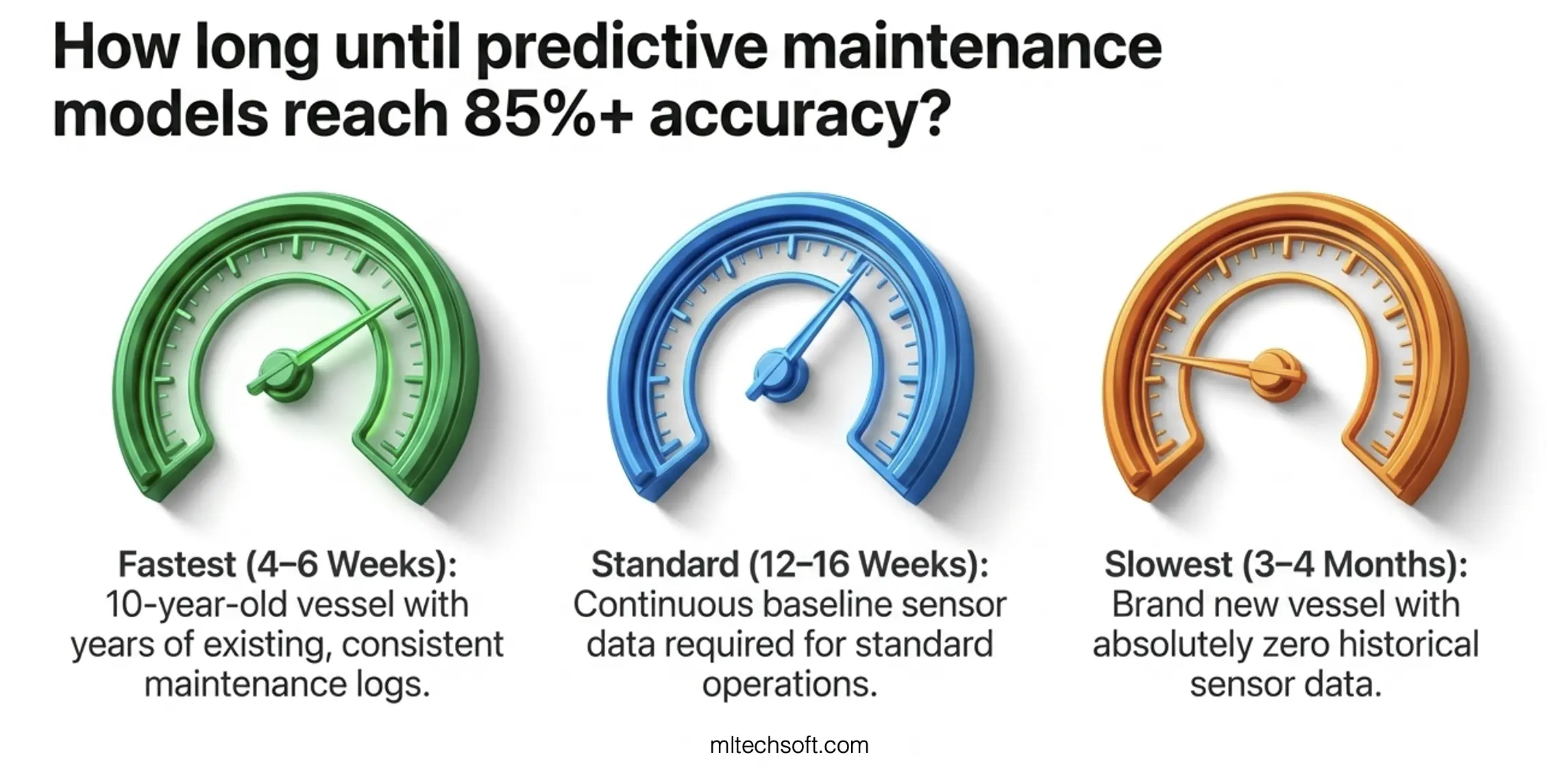
A: For most shipping predictive maintenance systems, expect 12–16 weeks of continuous sensor data before the model reaches 85%+ accuracy. The algorithm needs enough normal operation history to understand your ship’s baseline before it can reliably detect anomalies.
If your vessel is brand new and has no historical sensor data, the model will be unreliable for 3–4 months. If your vessel is 10 years old and you already have years of maintenance logs, the ramp-up can be faster — 4–6 weeks.
The key variable is consistency: Are you collecting the same sensor data from every vessel in your fleet, at the same frequency, with the same quality standard? If yes, 12–16 weeks. If your sensor suite varies by vessel age and condition, add 4–6 weeks.
Q3: Is generative AI secure for maritime compliance data?
A: Generative AI systems processing maritime compliance data must be deployed with ISO 27001:2022 (Information Security Management System) certification. This is not optional given IMO 2021 cybersecurity requirements.
The concern: crew records, vessel maintenance logs, and SMS documents are sensitive operational data. You cannot afford to expose them to an untrusted AI system. Any vendor offering RAG-based knowledge management for maritime compliance must demonstrate ISO 27001 certification, encrypt data at rest and in transit, and commit to not using your data to train public models.
MLTech Soft’s ISO 27001:2022 certification means client compliance data processed through our AI systems is handled under a certified information security management framework. This is table stakes for maritime AI deployment; if a vendor can’t demonstrate it, move to the next option.
Q4: Where is AI genuinely not ready yet for ship management?
A: The honest answer: any domain where human judgment is the actual value driver. AI is still struggling in three maritime areas:
Dispute resolution and maritime claims triage. A shipping accident involves complex judgments about liability, insurance coverage, regulatory violation severity, and commercial exposure. AI can help document the incident, but determining the claim strategy still requires human maritime lawyers.
Crew welfare and mental health assessment. Mental health deterioration, crew fatigue beyond standard metrics, and interpersonal conflicts aboard vessels are fundamentally human assessments. AI can flag objective metrics (fatigue hours, missed rest periods), but cannot diagnose or intervene in psychological states. This still requires trained maritime medical personnel and psychological support.
Autonomous vessel operations. Autonomous, unmanned vessel operations with zero crew are still in R&D. Remotely operated vessel systems (with a small crew ashore operating bridge functions) are closer to production, but regulatory frameworks, liability regimes, and insurance models are still being defined. Don’t expect autonomous ship operations at scale before 2028–2030.
Conclusion
AI is genuinely useful in ship management. The applications that are working now — document processing, predictive maintenance, crew scheduling — deliver measurable ROI within 12–20 weeks of deployment, assuming your underlying data is reasonably clean. Start there.
The applications that are promising but not yet production-ready — voyage optimisation, generative AI knowledge management — are worth monitoring and preparing for, but don’t expect them to deliver value until 2027–2028. They require deeper data infrastructure than most ship managers currently have in place.
The applications that are still primarily vendor demonstrations — autonomous port operations, AI-driven compliance auditing — are interesting from a strategic perspective but should not drive purchase decisions in 2026. Stay informed, but defer commitments.
Before Singapore Maritime Week, request a free maritime software assessment from MLTech Soft. We’ll tell you honestly whether your current ship management software architecture is ready to integrate AI — and which of the three production-ready applications would deliver the fastest ROI for your fleet. No vendor pitch. Just a technical opinion from a team that has built AI systems in regulated production environments.
Request a free maritime software assessment: Contact MLTech Soft to discuss AI readiness for your fleet before Singapore Maritime Week.