Singapore port digitalisation is the move from paper-based, manual port processes to a connected set of digital platforms. These include single-window clearance, AI-assisted vessel scheduling, a data-sharing digital twin, and open APIs. Together, they help coordinate vessel arrivals, clearances, and port services through standardised electronic data. For ship managers, this does not mean you must adopt one specific platform immediately. It does mean your operational systems will increasingly need to exchange clean, structured, real-time data with external systems. Systems that can do this should benefit from faster turnaround and less manual work. Systems that cannot will gradually have to catch up.
What does Singapore port digitalisation actually mean for ship managers?
It means the systems around your vessels — clearance, scheduling, bunkering, and port coordination — now expect to send and receive structured data electronically, not on paper or by email. A ship manager does not have to build any of these platforms, but increasingly needs software that can connect to them.
Four parts of Singapore’s digital port ecosystem matter most to a ship management company:
- digitalPORT@SG — the Maritime and Port Authority of Singapore’s (MPA) single-window portal for vessel, immigration, and port-health clearances. It consolidated 16 separate forms into one submission and, according to MPA, serves more than 550 shipping companies and saves the industry up to 100,000 man-hours a year.
- The JIT Planning and Coordination Platform — built into digitalPORT@SG, it uses AI to optimise arrival and departure scheduling so vessels spend less time waiting at anchorage. The first release targets container vessels, with tankers and bulk carriers to follow.
- The Maritime Digital Twin — launched by MPA with GovTech on 24 March 2025, this is a virtual model of Singapore’s port that combines real-time and historical data for simulation and planning. MPA has said it will publish a developer toolkit and APIs so companies can connect to its data stream.
- OCEANS-X — a data and connectivity marketplace that MPA says already hosts over 100 APIs and datasets for industry players to build and integrate new services.
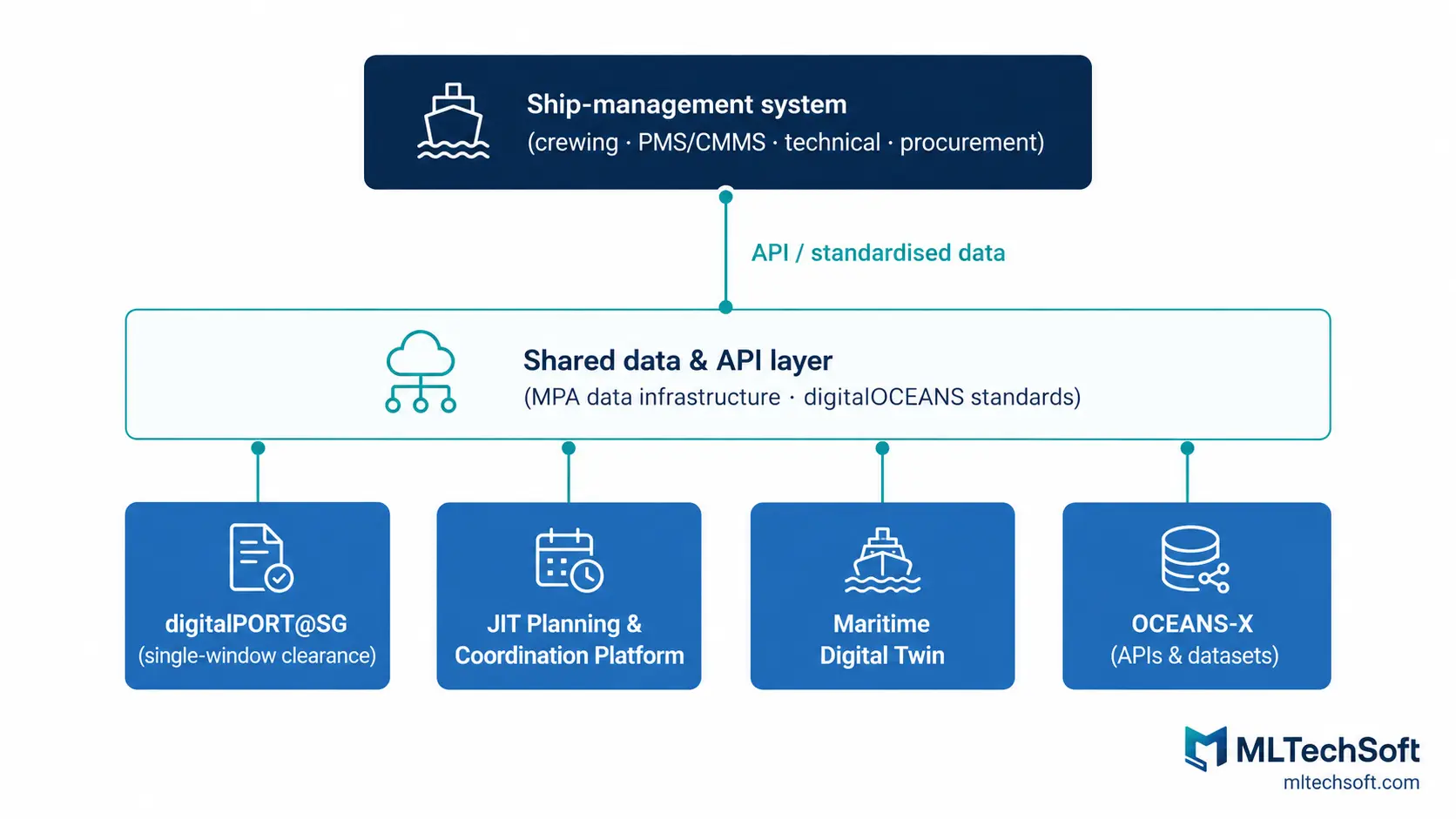
Under these platforms is a shared data layer — MPA’s data infrastructure and the digitalOCEANS data and API standards — designed to help systems work together. The direction is clear: standardised data, exchanged through APIs, across a connected ecosystem. If you want the fuller vision, our overview of maritime digitalisation in Singapore sets out where this is heading.
Why is Singapore port digitalisation accelerating now?
Because regulation and major industry players are now moving in the same direction. In 2026, that momentum has become much more visible. It is worth understanding, but it is not a deadline to panic over.
Two recent signals stand out. In June 2026, MPA and MSC — one of the world’s largest container carriers — signed a memorandum of understanding to collaborate on maritime digitalisation, including work to streamline vessel arrivals and port operations through data sharing. At Singapore Maritime Week 2026, MPA and the Singapore Maritime Institute also launched a new edition of the Singapore Maritime Technology and Research Roadmap. It names “intelligent and integrated port services” and “smart ships” among its four priority areas, with more than SG$100 million committed over five years.
There is also a regulatory baseline underneath this momentum. Maritime Single Windows became mandatory at ports worldwide from 1 January 2024 under the IMO’s FAL Convention. That made electronic, standardised data exchange for port clearance the global baseline. Singapore moved further earlier by making digital bunkering and electronic bunker delivery notes (e-BDN) the default in its port from April 2025, with additional pre-bunkering documentation requirements taking effect on 1 January 2026.
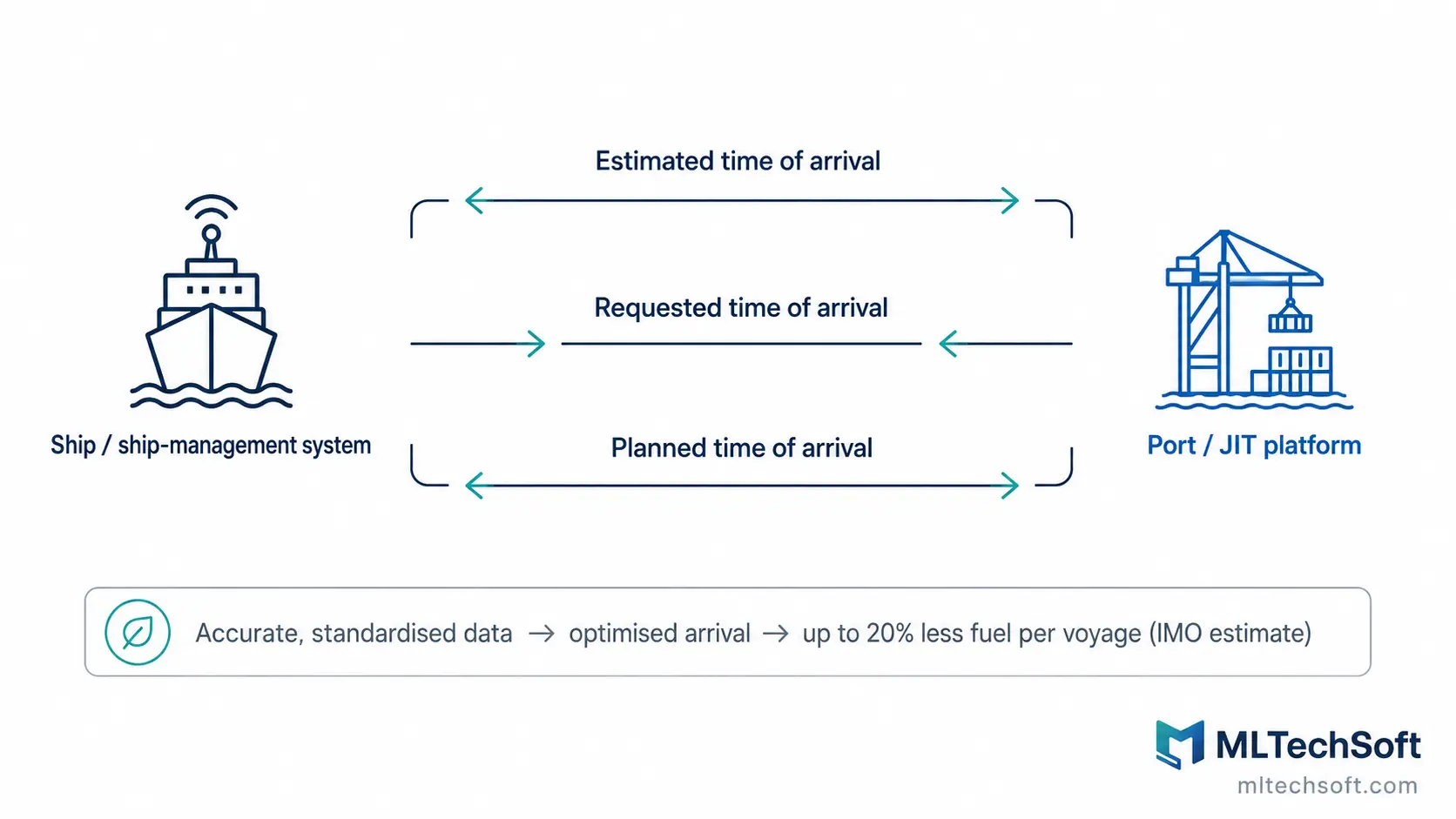
The pull is operational too, not just administrative. The IMO estimates that better port-call coordination — the goal of just-in-time arrival — can cut fuel consumption by up to 20% per voyage. That is a real incentive for owners and charterers. But it depends on ships and shore systems exchanging accurate arrival data in a common format.
What does port digitalisation require from your ship-management software?
Your system needs to share data in the way these platforms expect: in standard formats, through APIs, with controlled access and a reliable record of what happened. Most requirements come down to five capabilities.
| Capability | What a connected ecosystem expects | Where legacy systems often fall short |
|---|---|---|
| Standardised data | Fields that map to common maritime data models (vessel particulars, port-call events, certificates) | Custom, inconsistent field names and formats built up over years |
| An API layer | The ability to send and receive data programmatically, in real time | Data locked in a database or UI, with no clean way to expose it |
| Access control | Clear, role-based permissions over who and what can read or write data | Broad or shared logins; unclear who can access what |
| Audit trails | A dependable log of changes and data exchanges, useful for compliance | Sparse or missing logs, hard to reconstruct after the fact |
| Integration documentation | Documented interfaces so new connections can be built safely | Undocumented, tribal knowledge held by whoever built or last touched it |
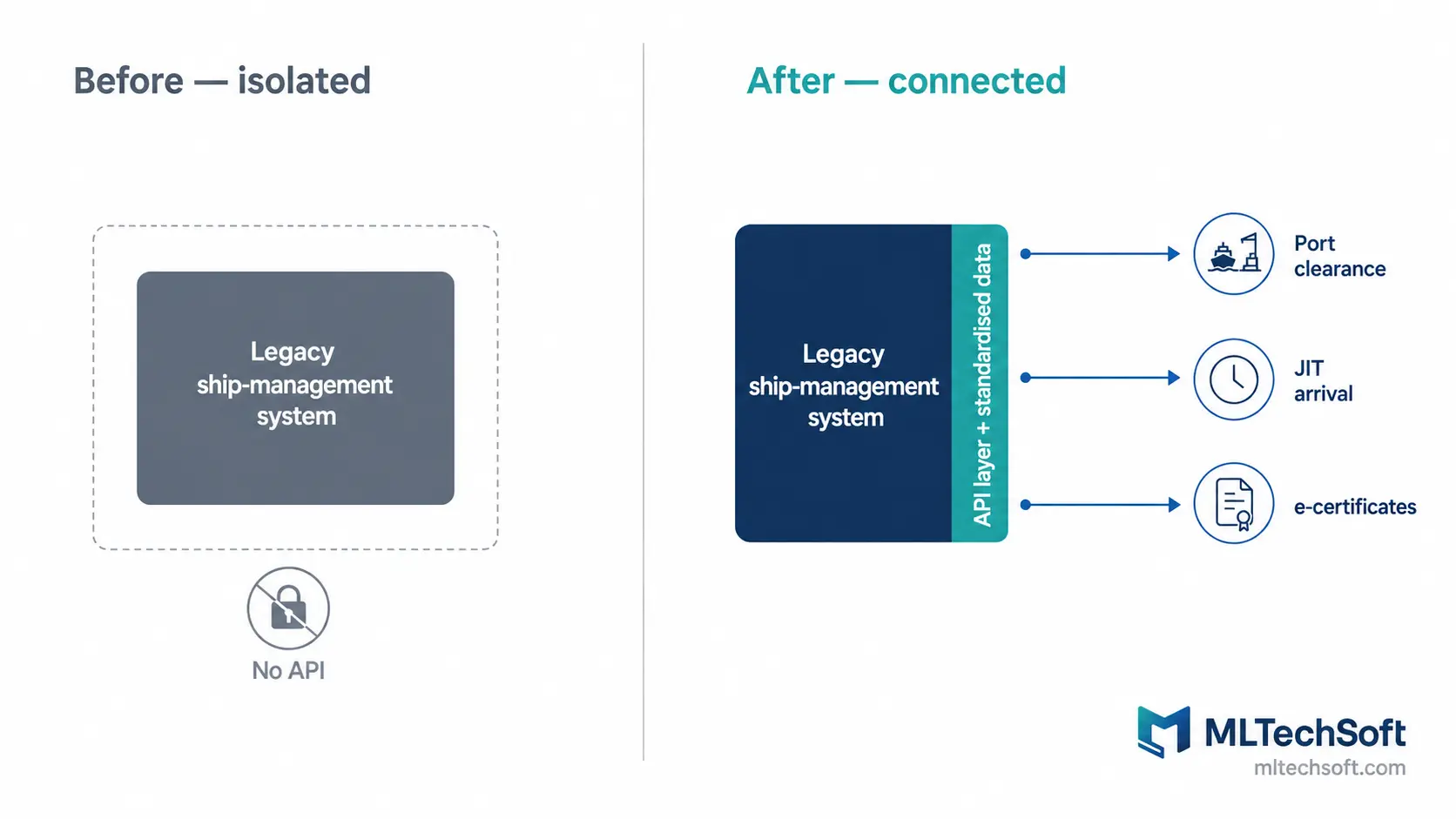
None of this is unusual. It is the basic plumbing of a system designed to work with other systems, rather than run alone. The challenge is that many ship-management systems still in use today — crewing, PMS/CMMS, technical management, procurement — were built ten or fifteen years ago, when isolation was normal and integration was often added later.
There is also a security angle. As systems start exchanging data with external platforms, access control and audit trails stop being nice-to-haves. They become part of how you show that maritime data is handled safely — the kind of practice ISO 27001 exists to formalise. Weak logging and unclear permissions are exactly what a cyber-risk audit under the ISM Code now looks for.
How can you tell if your current system is ready to connect?
You can get a useful first read by asking a few practical questions about your existing system — no vendor demo required. If you cannot answer them, that is usually the answer.
- Can it export core data in a standard format (not just a PDF or a screen), without someone re-keying it?
- Does it have any API, or is all data entry and retrieval done through the user interface?
- Are permissions role-based and documented, or does everyone effectively share access?
- Is there an audit log you could hand to a compliance auditor that shows who changed what, and when?
- Is there integration documentation, or does connecting anything new depend on one person’s memory?
- Do you know how the system behaves if an external connection fails mid-exchange — does it queue, retry, or silently drop data?
In maintaining a marine pilot management system for PSA Marine, Singapore’s leading port and marine-services operator, we have found that the honest starting point is almost never a rebuild. It is first to map how the existing system actually works: how its data is structured, where the business logic lives, what is documented, and what is not. That mapping step is where most integration and modernisation work quietly succeeds or fails. Our legacy maritime software modernisation approach starts there deliberately.
Build, buy, or modernise: how should ship managers respond?
The right response is proportionate: understand where your system stands, then decide when and how far to connect — on your own timeline, not a vendor’s. There is rarely one correct answer, and jumping straight to “replace everything” is usually the wrong one.
Three broad paths, stated plainly:
- Keep and maintain, for now. If your system works and you do not yet need to connect to external platforms, disciplined maintenance — security patching, monitoring, and documentation — keeps it stable and buys you time. This is where our maritime software maintenance work usually begins.
- Modernise selectively. If specific connections are becoming valuable (JIT arrival data, e-clearances, e-certificates), you can add an API layer and standardise the relevant data without a full rewrite. Phased change also helps preserve the business logic buried in the old system.
- Rebuild. This is warranted only when a system is truly at end-of-life, unmaintainable, or unable to meet new requirements. It is the highest-risk path and rarely the first step.
The trade-off is worth saying clearly: connecting to an ecosystem adds ongoing responsibility. You now depend on external systems, and you have to keep interfaces and security current. That is manageable, but it is real. It is a reason to connect deliberately, not just because a headline says you should. For a Singapore ship management company weighing this, a focused ship management software assessment is a lower-risk way to decide than committing to a direction blind.
Frequently asked questions
What is digitalPORT@SG? digitalPORT@SG is the Maritime and Port Authority of Singapore’s single-window portal for vessel, immigration, and port-health clearances. It consolidated 16 separate forms into one submission and, per MPA, serves more than 550 shipping companies while saving the industry up to 100,000 man-hours a year. It also hosts the Just-in-Time Planning and Coordination Platform for optimising vessel arrivals.
Do ship managers have to integrate their software with Singapore’s port platforms? Not everywhere, and not all at once. Electronic clearance through a Maritime Single Window is required — that has been mandatory globally since 1 January 2024 under the IMO FAL Convention. Beyond that baseline, deeper integration (JIT arrival data, digital twin APIs, e-certificates) is currently a choice driven by operational value. The practical priority is to make sure your system could connect when you decide to.
What makes a legacy ship-management system hard to connect? The common blockers are non-standardised data fields, no API layer for programmatic data exchange, unclear or shared access permissions, thin audit logs, and missing integration documentation. These issues are fixable, often without a full rebuild — but they need to be identified first through a system assessment.
Is e-BDN part of Singapore port digitalisation? Yes. Electronic bunker delivery notes (e-BDN) became the default for bunkering in the Port of Singapore from April 2025, with additional pre-bunkering documentation requirements from 1 January 2026. It is one of the clearest examples of a manual maritime process becoming a standardised digital one.
Will connecting to these platforms improve efficiency? It can. The IMO estimates that better port-call coordination through just-in-time arrival can reduce fuel consumption by up to 20% per voyage, and single-window clearance removes a lot of manual paperwork. The gains depend on accurate, standardised data flowing between ship and shore systems, which is why data readiness matters.
Does port digitalisation raise cyber-security expectations? Yes. Once a system exchanges data with external platforms, access control and audit trails become part of proving that data is handled safely — the focus of ISO 27001 and of cyber-risk management under the IMO’s ISM Code. Systems with weak logging and unclear permissions are the most exposed as connectivity increases.
Where to start
Singapore’s port digitalisation is best treated as a direction to prepare for, not an alarm to react to. The most useful first move is also the least risky: find out whether your current ship-management system can share clean, secure data with external platforms when you choose to connect — and, if not, what stands in the way.
If that is a question you are weighing, request a legacy maritime system / API-readiness assessment. It is a short review of your system’s data, interfaces, access control, and documentation, with a clear picture of what connecting would take — no rebuild assumed, and no pressure to act before it is worth it.