Evaluating a software development partner for ship management requires a fundamentally different framework than standard IT vendor selection. Generic criteria — portfolio size, team capacity, technology stack — don’t surface the factors that determine success in maritime operations.
The right questions go deeper: Does the team understand IMO 2021 compliance requirements? Do their security credentials meet maritime data handling obligations (ISO 27001, not just ISO 9001)? Can they execute a migration or new build without disrupting the operational calendar your fleet depends on? Have they actually delivered maritime systems before, or are they confident they can “learn maritime while building your system”?
Ship management software is mission-critical infrastructure. A system failure during a port call, a crew document system that doesn’t account for international certificate expiry cycles, or a maintenance platform that doesn’t integrate with flag state regulations isn’t just an operational inconvenience — it’s a compliance risk and a financial hit. The vendor you choose directly determines whether your next software project runs smoothly or becomes a cautionary tale.
This checklist is built specifically for maritime CTOs evaluating vendor shortlists in 2026. The 20 questions here are the ones that separate vendors who understand maritime operations from those who are confident they can learn it during your project.
Why Generic Software Vendor Checklists Fail Maritime CTOs
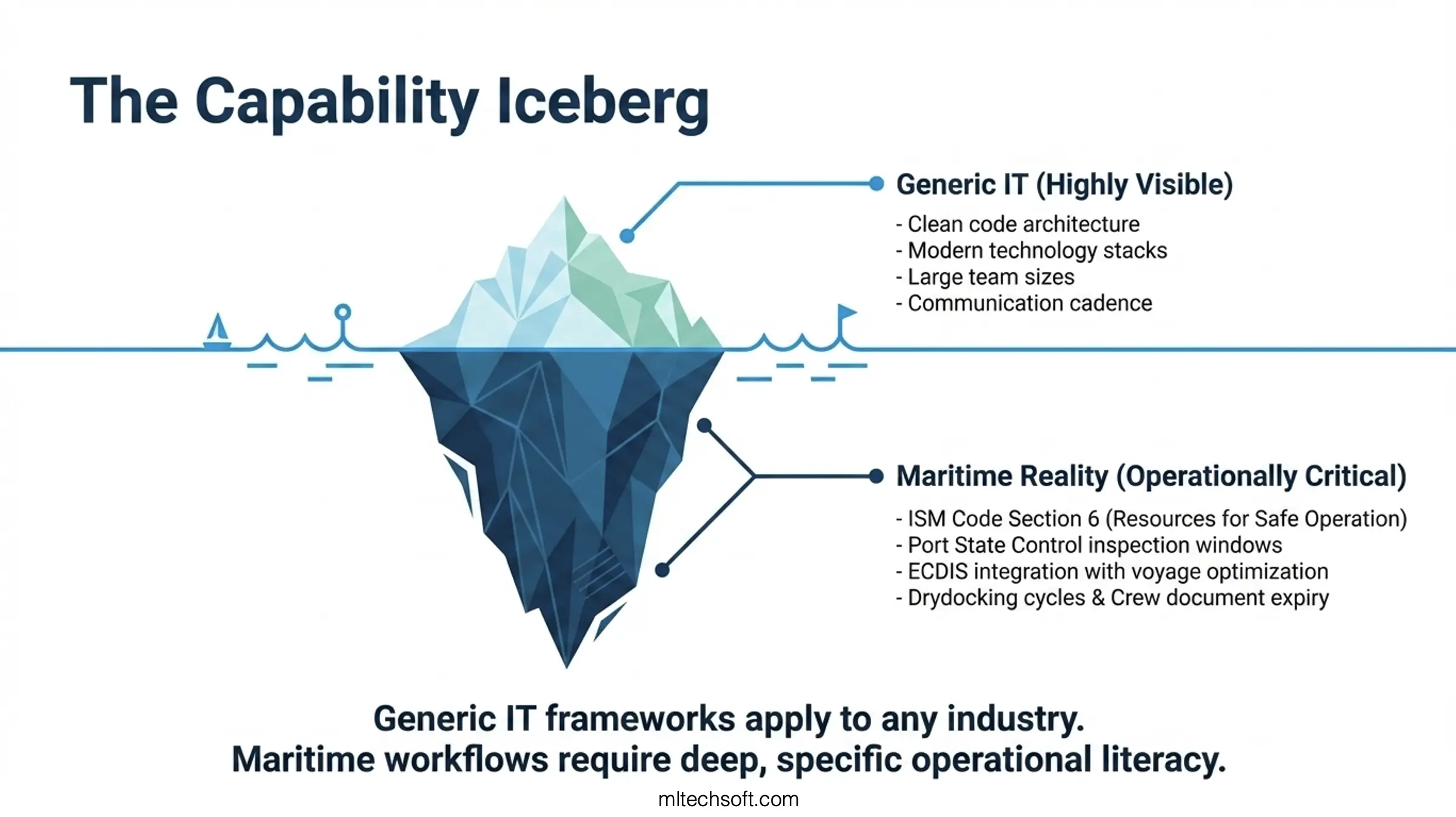
Any IT vendor evaluation framework — communication cadence, team size, technology stack — applies to any industry. Maritime operations are fundamentally different. Your crew management system must integrate with flag state compliance regulations. Your maintenance platform must account for drydocking cycles and port state control inspection windows. Your vessel scheduling system cannot go down during an active port call. Generic development shops don’t understand this operational environment.
A vendor with stellar e-commerce or fintech credentials may have strong technical teams and glowing reviews. But ask them how ECDIS (Electronic Chart Display Information System) integrates with voyage optimization workflows, or what ISM Code Section 6 (Resources for Safe Operation) means in system design terms, and you’ll encounter hesitation or surface-level answers. That’s not a technical capability gap — it’s maritime literacy.
Most offshore development firms compete on cost and generic quality metrics. Very few invest time in deeply understanding maritime operations well enough to ask the right questions during requirements gathering. And if they don’t ask the right questions, you spend 40% more time on rework post-launch because the delivered system doesn’t match how maritime operations actually work.
This checklist is built on a single premise: maritime domain expertise cannot be demonstrated with a portfolio slide. It must surface through specific, operational questions that separate vendors who have actually delivered maritime systems from those confident they can “learn on the job.”
The Five Evaluation Categories
Successful maritime software partnerships rest on five foundations. Each can be evaluated directly through specific questions — you can gauge a vendor’s readiness in 30 minutes.
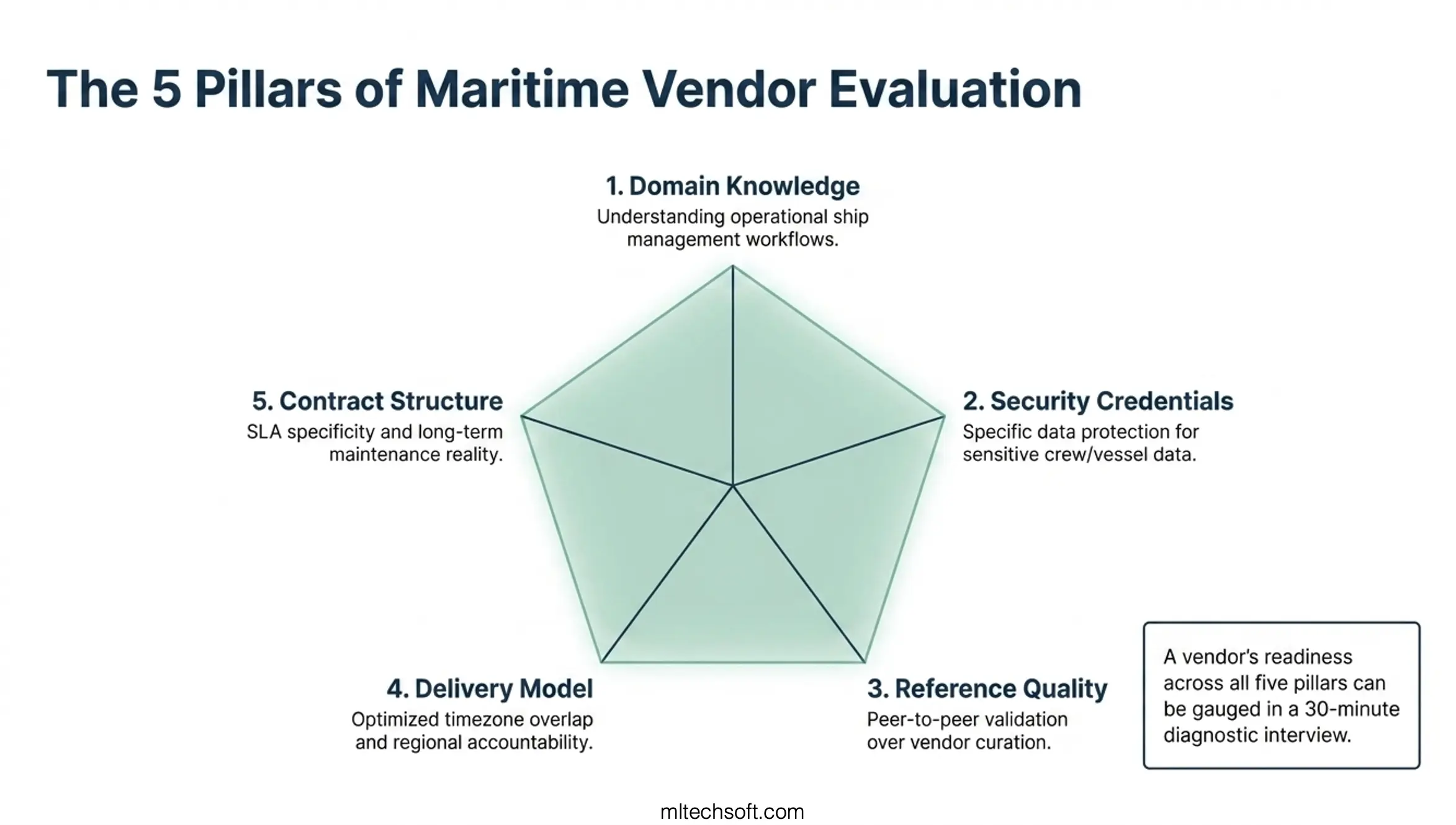
1. Maritime Domain Knowledge — A credible partner understands ship management workflows operationally: crew document cycles, why PMS entries lock during drydock, how vessel performance benchmarking integrates with fuel forecasting. They ask operational questions during requirements gathering: fleet composition, operational patterns, compliance calendar. Generic vendors jump to “what technologies?” Test: “Describe a ship management workflow that isn’t in a case study.” Hesitation = red flag.
2. Security Credentials — ISO 27001 vs. ISO 9001 — ISO 9001 certifies quality management (on-time delivery). ISO 27001:2022 certifies information security (data protection). Ship management data — crew records, voyage details, compliance docs — requires security certification, not just process certification. Maritime cyberattacks surged 103% in 2025. ISO 27001 is no longer a differentiator; it’s a minimum requirement. Ask: “What’s your ISO 27001 certification date and scope?” If they have only ISO 9001, that’s a no-go signal.
3. Reference Quality — Peer-to-Peer vs. Vendor-Curated — Vendor-curated references from non-maritime projects don’t reveal maritime capability. Ask: “Can you introduce me to another ship management company you’ve worked with?” If they can’t, maritime depth is superficial. Peer references are gold because the person on the other end has no incentive to oversell.
4. Offshore Delivery Model — Red Flags and Green Flags — Single-country offshore teams (all Vietnam or all India) create timezone chaos for maritime operations. A green flag: offshore-onshore model with local presence in Singapore. Senior architects and account management based in Singapore, development execution offshore (Vietnam, Philippines). You get 40–60% cost advantage without sacrificing communication or accountability. A red flag: “We can scale your team up quickly” means hiring juniors with minimal training — wrong for maritime where domain knowledge drives quality.
5. Contract Structure — Pilot, SLAs, Maintenance — Pilot projects (2–4 weeks, SGD 15K–30K) de-risk evaluation. Vague SLAs are worthless; maritime systems require specific response times and availability targets. Maintenance terms determine long-term success: is maintenance included post-launch? What’s the cost model? A 3+ year commitment signals long-term partnership thinking.
The Practical Checklist: 20 Questions to Ask Any Maritime Software Partner
The questions below are organized by the five evaluation categories. Ask every vendor in your shortlist the same questions, in the same order. Take notes. Pay attention not just to what they answer, but to how they answer: Do they pause and think? Do they ask clarifying questions about your operations? Or do they immediately pivot to technology recommendations?
An experienced maritime vendor will ask you questions back. They’ll want to understand your fleet composition, compliance calendar, and operational constraints before proposing solutions. A generic vendor will try to fit your needs into their standard delivery playbook.
The best way to use this checklist: email these 20 questions to each vendor ahead of your evaluation call. Ask them to provide written responses, then use the call to probe the gaps. This gives them time to research if they don’t know the answers, and it gives you a written record you can compare across vendors.
| Question | What a Credible Answer Looks Like |
|---|---|
| Maritime Domain Knowledge (1-5) | |
| 1. Describe a ship management workflow that isn’t covered in a case study on your website. | Addresses specific workflows (crew rotation, compliance, maintenance scheduling) without needing you to explain maritime terminology. |
| 2. Walk us through compliance requirements you’d ask about for crew management system implementation. | Mentions flag state regulations, STCW, SOLAS, and asks about specific flag states. Shows real maritime compliance knowledge. |
| 3. How should ISM Code Section 6 influence a maintenance platform design? | Connects ISM to system design (resource allocation, competency tracking, document management). Hesitation is a red flag. |
| 4. Have you delivered systems integrating Port State Control workflows or drydock cycle management? | Specific answer with real client context. Vague answer = red flag. |
| 5. What questions would you ask to understand our vessel performance benchmarking needs? | Probes fleet composition, operational patterns, benchmarking requirements, data availability. Shows operational thinking. |
| Security Credentials (6-10) | |
| 6. What’s your ISO 27001 certification status and scope? | “ISO 27001:2022 certified [date], covers all development and maintenance.” ISO 9001 only or cert older than 18 months = risk signal. |
| 7. Can you describe your data encryption, access control, and incident response procedures? | Specifics: encryption in/at rest, role-based access, multi-factor auth, incident reporting timeline, escalation. |
| 8. How do you handle crew member personal data under GDPR and Singapore PDPA? | Addresses data minimization, consent, retention, right to deletion. |
| 9. Do you conduct regular security audits and penetration testing? | “Yes, annual third-party pen testing and monthly internal assessments. Results shared with clients under NDA.” |
| 10. How do you vet subcontractor security standards? | Describes formal vendor assessment, security agreements, auditing procedures. |
| Reference Quality (11-13) | |
| 11. Can you introduce us to a ship management company you’ve worked with on a similar project? | “Yes, I’ll make an introduction.” If not, ask why — credible vendors have maritime peers willing to speak. |
| 12. What’s your longest-running maintenance engagement with a maritime client? | Answer is 3+ years. “One and done” signals no staying power. |
| 13. Do you have maritime-specific case studies you can share? | “Yes, we have [X] maritime case studies available.” No = lack of maritime depth. |
| Offshore Delivery Model (14-17) | |
| 14. What’s your Singapore operational presence and who’s our day-to-day point of contact? | “Singapore office with [name/title]. Project manager based in Singapore, development offshore.” |
| 15. What’s your typical team structure for a maritime project? | Mix of onshore (Singapore: PM, architect, QA) and offshore (Vietnam/Philippines: developers). |
| 16. What’s your team turnover rate and how do you mitigate knowledge loss? | Below 15% core team turnover. Addresses knowledge transfer, documentation, cross-training. |
| 17. What timezone overlap with Singapore, and how do you handle urgent issues outside business hours? | “GMT+7 to GMT+8 overlap (8am–5pm Singapore time). 24/7 on-call rotation for emergencies.” |
| Contract & Maintenance (18-20) | |
| 18. Do you offer a pilot project? How is it scoped and priced? | “Yes, 2–4 week pilot, fixed price SGD 15K–30K.” Unwillingness to offer = red flag. |
| 19. What does your maintenance SLA include and what are retainer costs for ship management systems? | “SGD X–Y/month includes 40 hours/month support, 4-hour critical response, quarterly inspections, monthly patching.” Vague = red flag. |
| 20. What’s your post-launch support commitment? | “3+ years minimum support, with explicit renewal negotiations.” Shows long-term partnership planning. |
A Comparison: Dedicated Maritime Partner vs. Generic Offshore Firm vs. Large Consultancy
| Criteria | Maritime Partner | Generic Offshore | Large Consultancy |
|---|---|---|---|
| Maritime Expertise | Deep: case studies, trained in ISM/IMO/SOLAS | Minimal: “can learn it”; treats maritime as any industry | Moderate: not core capability |
| ISO 27001 | Certified, full scope, current | Often missing or limited scope | Certified, but selective basis only |
| Local Presence | Yes: Singapore office, dedicated team | No: timezone gaps; communication friction | Yes: Singapore office, premium pricing |
| Monthly Retainer Cost | SGD 3K–8K; dev SGD 80–150/hr | SGD 1.5K–4K; dev SGD 40–80/hr (quality issues) | SGD 8K–25K+; dev SGD 200–400/hr (premium) |
| Custom System Flexibility | High: bespoke workflows, pilot encouraged | Medium: standardised, limited customization | Low: overhead slows custom work |
| Long-Term Maintenance | High: 5–10 year relationships | Low: maintenance distraction; high turnover | High: decades of support, premium cost |
| Pilot Projects | Yes: standard offer, SGD 15K–30K | Reluctant: views as lost opportunity | Sometimes: prefers large fixed contracts |
FAQ: Evaluating a Maritime Software Development Partner
Q1: Do I need both ISO 9001 and ISO 27001?
ISO 9001 = quality management (on-time delivery). ISO 27001 = information security (data protection). You need both. ISO 9001 ensures delivery discipline. ISO 27001 ensures crew records, voyage data, and compliance docs are handled securely. Don’t accept “planning to get ISO 27001 next year” — if security matters, they’d have it already.
Q2: How do I verify maritime experience if vendors can’t name clients?
Ask for anonymised case studies or peer introductions. A credible vendor says: “I can connect you with the CTO directly for a confidential call.” If they can’t, maritime experience is superficial. Ask them to describe a system they built without naming the client. Real vendors walk through crew scheduling logic, compliance tracking, maintenance cycles in concrete terms. Hesitation or asking you to explain maritime terminology = depth issue.
Q3: Is a pilot project always recommended?
Yes. A 2–4 week pilot (SGD 15K–30K) evaluates whether maritime understanding is real or superficial. It lets you assess code quality, communication, and whether they ask the right questions. The pilot should deliver a real, usable system piece — not just a proof of concept. If they can’t clearly scope it, that’s a red flag.
Q4: What contract terms protect us if the partner underdelivers?
Include: fixed-price milestones with explicit acceptance criteria, dedicated team assignment with named staff, source code escrow (code in your repo, not theirs), specific SLAs (4-hour response for critical issues, 99.5% availability), termination for cause (30-day notice), and knowledge transfer requirements (documentation, architecture diagrams, training week). Don’t accept vague language like “best effort.” Maritime requires precision.
Conclusion
Evaluating a maritime software partner isn’t just checking vendor scorecards. It’s about finding a team that has invested time in understanding maritime operations deeply — not just technically, but operationally. A team with security credentials appropriate for sensitive maritime data. A team that commits to long-term partnership and ongoing maintenance, not just one-off delivery.
A Singapore-based ship management company learned this lesson the hard way. They selected an offshore partner based primarily on cost. The team was technically skilled, the communication was responsive, and the developers were competent. But they lacked maritime literacy. The crew management system they delivered didn’t account for drydocking cycles, flag state certificate expiry workflows, or crew rotation patterns that differ by vessel type. The delivered system required extensive rework post-launch, ultimately costing 40% over budget and six months of delayed operations.
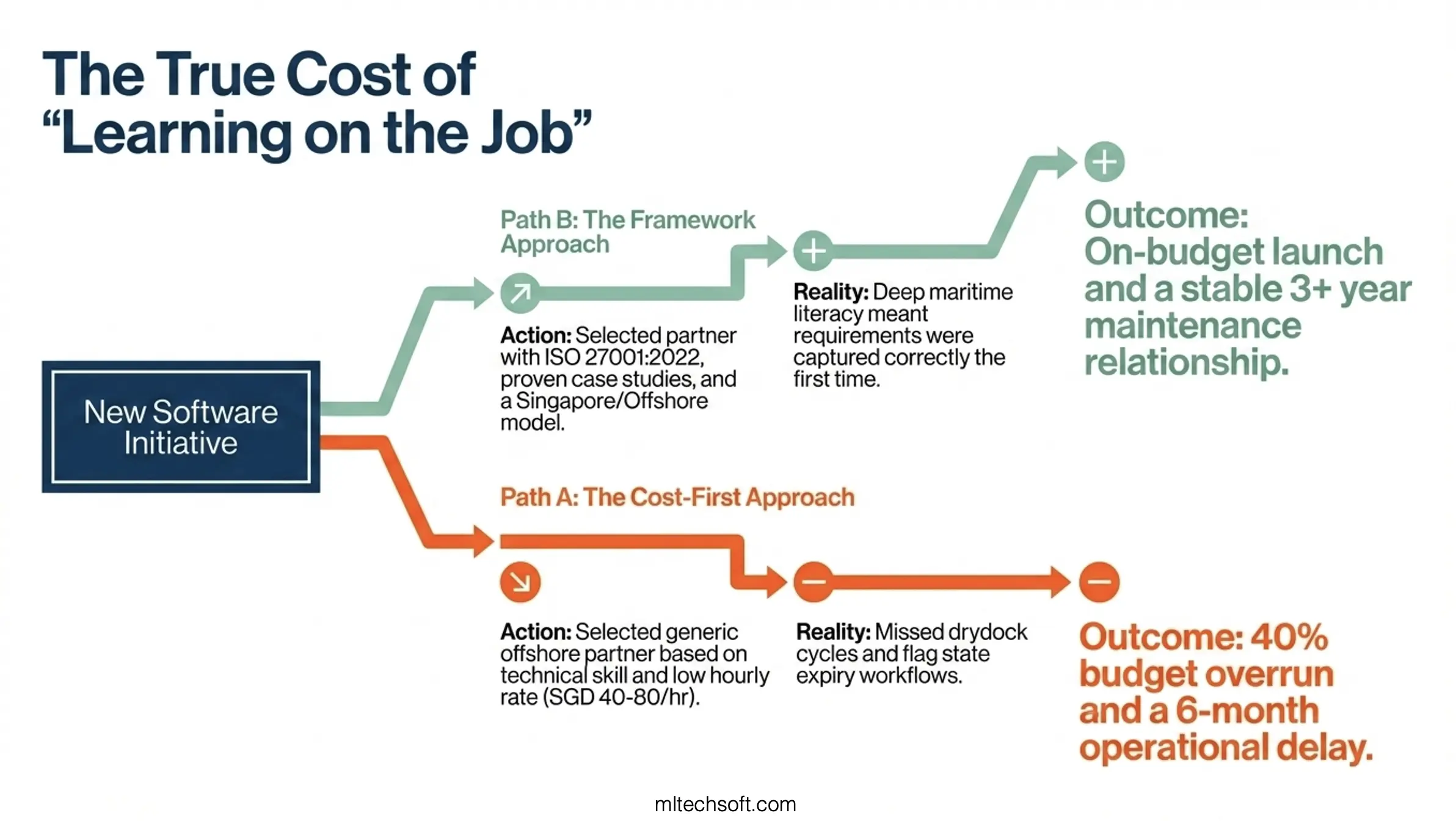
When the same company re-evaluated their next software initiative using a framework similar to this checklist, they chose a different partner: one with proven maritime case studies, ISO 27001:2022 certification, and an offshore-onshore model with senior architects based in Singapore. The second project came in on budget, required minimal rework, and resulted in a long-term maintenance relationship that the company still relies on three years later.
The 20 questions in this checklist are designed to surface those differences early. They’re not perfect — no evaluation framework is. But they’ll eliminate vendors who are confident they can “learn maritime on the job,” and that confidence, applied to a SGD 200K contract, costs more than you’ll recover.
Ready to Evaluate Your Next Maritime Software Partnership?
Request a free maritime software assessment from MLTech Soft. We’ll walk through your current software landscape, answer any of the questions in this checklist from our side, and give you an honest view of whether your situation matches what we’re built to deliver. No pitch, just clarity.
See also:
- The Real Cost of Legacy Ship Management Software — how poor vendor selection creates long-term operational and financial risk
- Migrate Legacy Systems Without Downtime — evaluating a vendor’s capability to execute migration safely