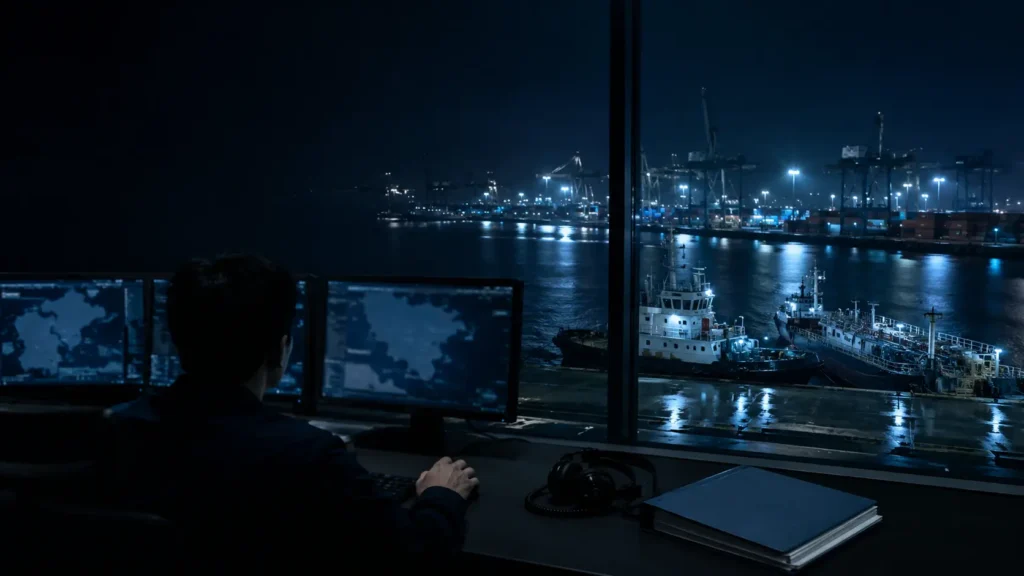
What Is a Progressive Web App? (The Short Answer Maritime Operations Leaders Need)
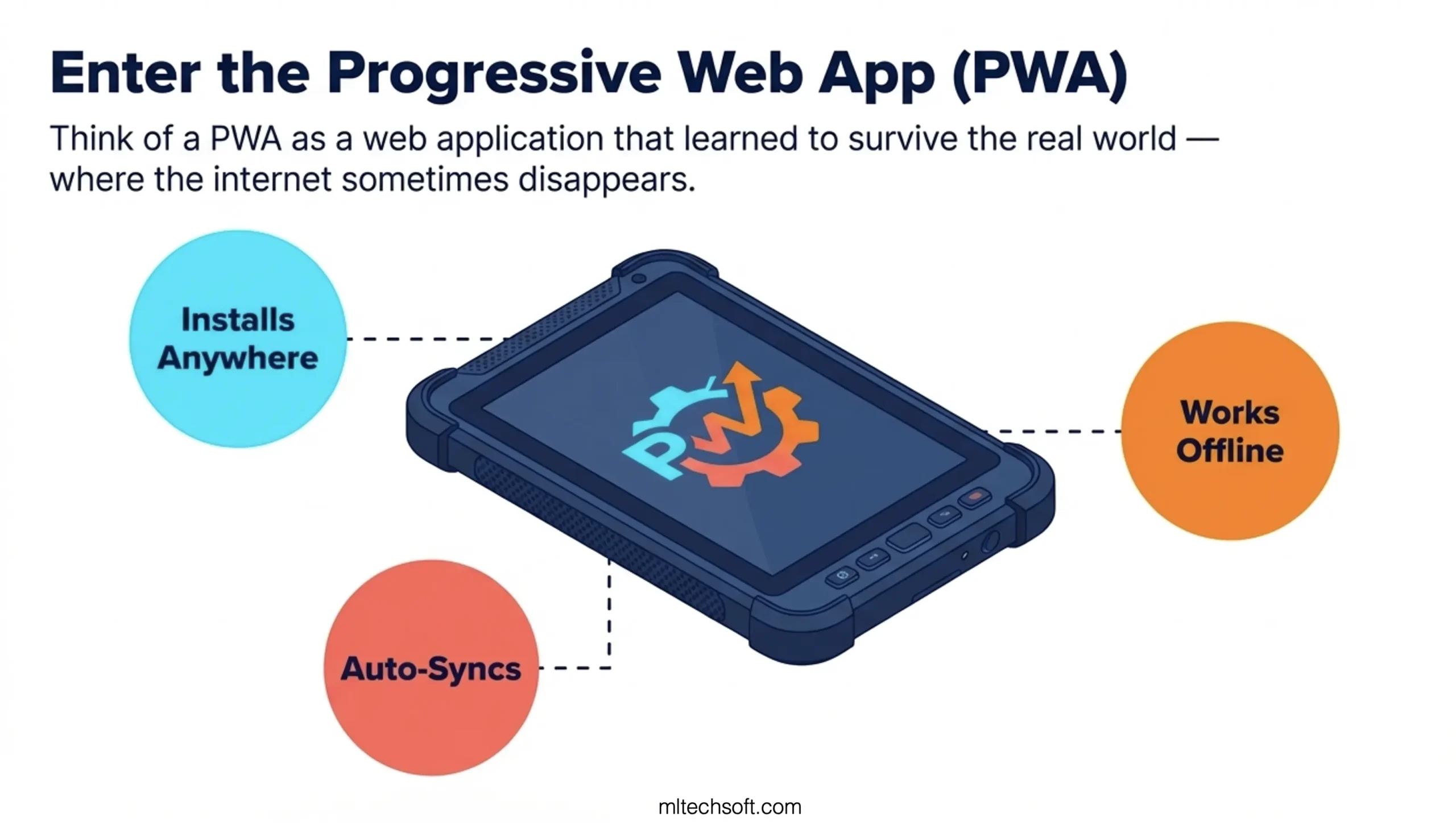
A Progressive Web App (PWA) is a web application that installs on any device, works offline, and syncs data automatically when connectivity returns. For maritime operations teams in low- or no-connectivity environments (vessel transits, remote port calls, offshore installations), PWAs ensure crew can continue working with operational systems even when connections are unavailable. Unlike cloud-only apps that fail when the connection drops, offline-first PWAs queue actions locally and sync when signal returns.
The Maritime Connectivity Reality: Why “Always-On” Is Still a Marketing Claim at Sea
Ask any maritime operations manager about connectivity at sea, and you’ll hear the same story: Starlink and VSAT are available, costs are dropping, and coverage maps show green everywhere. Yet in practice, connectivity is far more fragile than vendors admit.
Starlink Maritime covers 150,000+ vessels globally. But “available” does not mean “reliable.” During vessel transits, equipment handoffs, port approaches, and fairway manoeuvres, signal intermittently drops for minutes to hours. Shared satellite bandwidth in high-traffic ports creates timeouts. Remote port calls often lack cellular fallback infrastructure.
Cloud-only systems fail in these moments. A crew member pulls up a Planned Maintenance System (PMS) during transit to log an inspection. Network drops. The screen freezes. Shore-based teams have no visibility. Manual reconciliation is required later.
Callout: Even with Starlink Maritime on 150,000+ vessels, connectivity remains intermittent during port manoeuvres and fairway transit. Offline-first design is not a backup plan — it is the primary architecture.
Where Connectivity Fails in Maritime Operations
Vessel Transit: Crew members log maintenance tasks during open water transit. Intermittent satellite coverage creates work pauses.
Port Manoeuvres: During port entry, antenna tuning is unstable. ISM Code compliance records and crew documentation need updating.
Fairway Transit: In Singapore Strait and Straits of Malacca, bandwidth contention is severe. Crew workflows cannot wait for connectivity.
Offshore Installations: Crew on supply vessels may have zero coverage. Equipment logs and safety checklists cannot pause.
Offline-first PWAs solve all of these scenarios.
How Offline-First Works in Practice: A Non-Technical Explanation
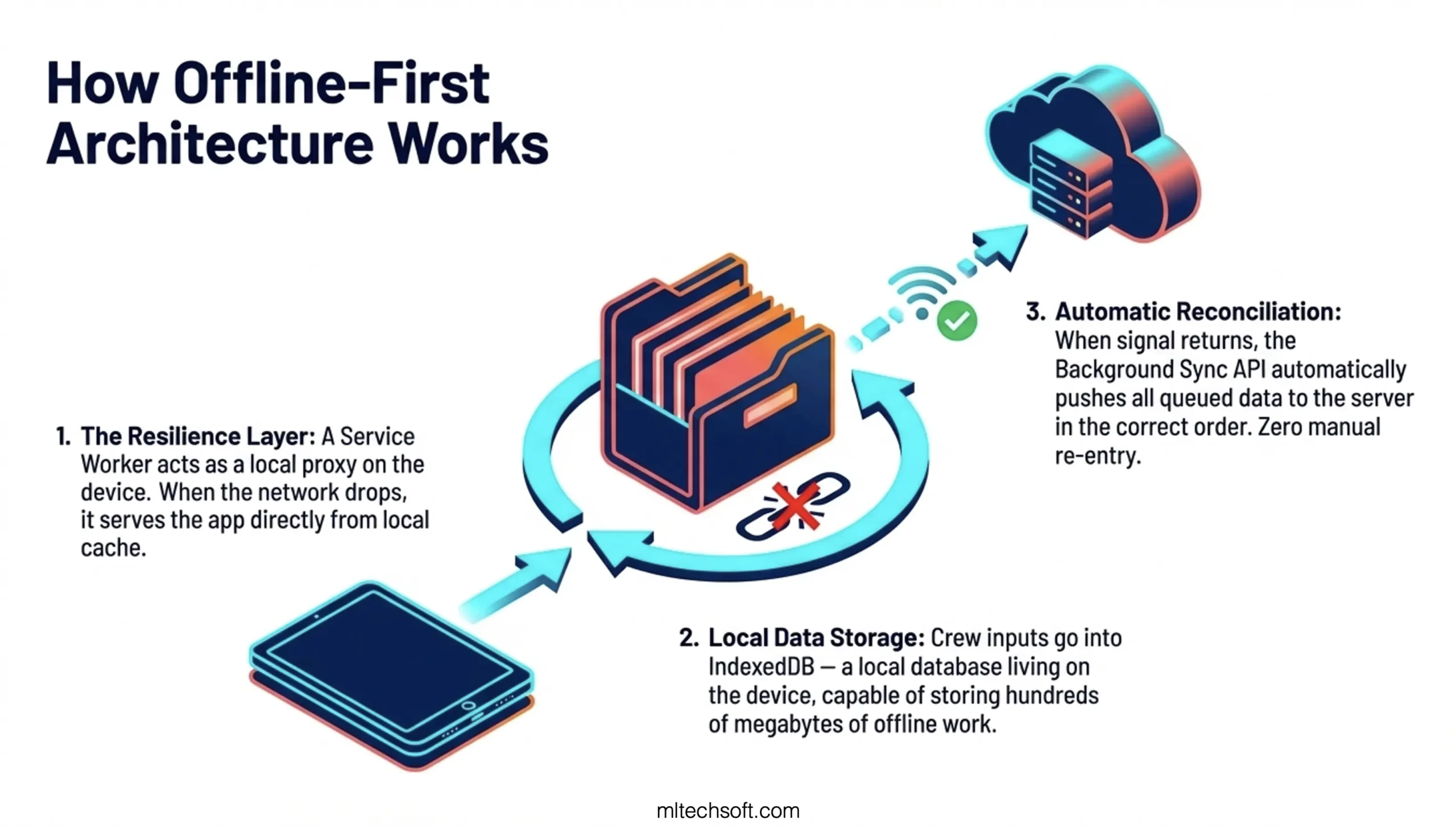
When a user opens a PWA with offline-first architecture, the app loads from cached data stored on the device — not from the server. This means the app works instantly, regardless of connectivity.
First visit: Crew member visits the PWA link from their browser. The app installs to the device home screen automatically and downloads offline-capable features locally.
Offline use: Network drops. The crew member opens the app anyway. The cached app loads instantly. They create maintenance records, log inspections, and update schedules — all stored locally. The app feels completely normal.
Data sync on reconnection: Signal returns. The system automatically syncs all offline work back to the server. Shore-based teams see the complete timestamped record. No data loss. No manual reconciliation.
Service Workers: The Resilience Layer
A Service Worker acts like a local filing cabinet on the device — it stores a copy of what the user needs so they can keep working when the network disappears. It operates as a proxy between the app and the network, first checking if data is available locally. When the network disappears, the Service Worker keeps serving from local cache. When connectivity returns, it automatically syncs all changes back to the server.
How Data Syncs When Connectivity Returns
PWAs use IndexedDB, a local database that lives on the crew member’s device. When offline, task records go into IndexedDB instead of the server. When connectivity returns, the Background Sync API tells the Service Worker to sync. The Service Worker pulls all offline changes and sends them to the server. The server merges the data, respects timestamps, and reconciliation is automatic — unlike cloud-only apps that lose offline data or require manual re-entry.
PWA vs. Native App vs. Cloud-Only: Which Is Right for Maritime Operations?
Maritime operations managers evaluate three solutions for crew systems: progressive web apps, native mobile apps, and cloud-only web apps. Here is the comparison:
Maritime operations managers evaluate three solutions for crew systems: progressive web apps, native mobile apps, and cloud-only web apps. Here is the comparison:
| Factor | PWA (Offline-First) | Native App | Cloud-Only Web App |
|---|---|---|---|
| Offline Capability | Full offline work, auto-sync when connected | Full offline capability | None — inaccessible without internet |
| Connectivity Resilience | Excellent — designed for intermittent connectivity | Excellent — data cached locally | Poor — single network failure blocks use |
| Deployment Cost | Low — single codebase, auto-updates, no app store | High — separate iOS/Android teams | Low — instant updates |
| Maintenance Overhead | Low — updates ship instantly to all users | High — manual updates, slow adoption | Low — automatic for all users |
| Installation Time | 30 seconds via QR code | 5–10 minutes per app store | No installation needed |
| Cost to Scale (100+ users) | Moderate — predictable hosting | High — app distribution infrastructure | Moderate — hidden resilience costs |
| Best for Maritime Operations? | Yes — designed for unreliable connectivity | Possible — if budget permits | No — too risky for mission-critical systems |
The verdict: For most maritime operations teams, an offline-first PWA is the right choice. It delivers native-app reliability at a fraction of the cost, with instant deployment and global crew accessibility.
Real-World Proof: How an Industrial Maintenance System Serves 100+ Users with No Reliable Connectivity
A global FMCG enterprise with Southeast Asia manufacturing operations engaged MLTech Soft to build an offline-first PWA for facility maintenance management. The system served 100+ maintenance staff across multiple plants in zones with zero cellular coverage and unreliable Wi-Fi. Crews needed to log equipment inspections and update compliance records whether connected or not.
The system used Service Worker caching, IndexedDB for local data, and Background Sync for automatic reconciliation. Crews installed the app from a single web link and worked offline during inspection rounds. When they returned to connected areas, the system synced all records back automatically.
Results over 5+ years of continuous operation:
- 100+ maintenance staff using the system daily
- Zero missed maintenance records due to connectivity gaps
- No manual data reconciliation required
- 99.2% system uptime
- 60% faster compliance audits because all records are timestamped and traceable
This proves offline-first PWAs work at industrial scale. The same architecture applies directly to maritime operations with identical connectivity challenges.
Is a PWA Right for Your Maritime Operations? A Quick Diagnostic
- Do crews lose access to critical systems during vessel transits or port manoeuvres?
- Does your team manage manual workarounds for connectivity gaps?
- Do you operate in areas where connectivity is intermittent?
- Does your system need to work on multiple crew devices?
- Is your system mission-critical for crew safety or compliance?
- Do you need instant system updates across your fleet?
- Is your crew size over 20 people across multiple vessels?
If you answered yes to three or more, offline-first PWA architecture is worth evaluating now.
FAQ: Progressive Web Apps for Maritime Operations
Do all crew devices support PWAs? Yes. Any device with a modern web browser (iOS Safari, Android Chrome, Windows Edge) from the last 5 years supports PWAs fully.
Is an offline-first PWA secure? Yes. Security works like enterprise web applications: HTTPS encryption, API authentication, and role-based access. Local data is encrypted by the browser. Offline-first PWAs reduce attack surface because data isn’t perpetually cached on cloud servers.
What happens if a crew member is offline for 10+ days? IndexedDB stores hundreds of megabytes locally. When connectivity returns, Background Sync syncs everything in correct order. No data loss.
Can PWAs integrate with our existing PMS or ERP system? Yes. A PWA connects to backend systems via APIs, integrating with existing databases, legacy PMS, and crew management software — becoming your modern, offline-capable interface.
Conclusion
Connectivity at sea is improving but will never be perfect. Vessel transits, port manoeuvres, and remote callouts will continue to create connectivity gaps. Cloud-only systems fail in these moments. Native apps are expensive and slow to update across global fleets.
Offline-first progressive web apps are built for maritime operations. They work offline by default, sync automatically when signal returns, deploy instantly, and cost a fraction of native apps. The technology is proven at industrial scale with zero data loss and 99.2% uptime over 5+ years.
If you answered yes to three or more diagnostic questions above, offline-first PWA architecture is worth evaluating now. The right architecture assumes connectivity will sometimes disappear, and works anyway.
Talk to MLTech Soft
MLTech Soft has built offline-first PWAs for industrial-scale field operations. We can assess your operational context — crew systems, PMS integration, connectivity profile — and recommend whether an offline-first PWA is right for you.
Schedule a free maritime software assessment with MLTech Soft — no obligation. Just a technical conversation about whether offline-first PWA architecture makes sense for your operations.