A maritime software maintenance retainer is a monthly or annual contract between a maritime company and its software development partner that defines the scope, SLA, and terms for ongoing system support — typically covering incident response, bug fixes, security patching, version upgrades, quarterly system inspections, and user support. Unlike break-fix arrangements (where you call when something breaks and pay per incident), a retainer commits the vendor to proactive, ongoing care of your system. For maritime companies running mission-critical software — crew management systems, fleet operations platforms, port operations dashboards — the difference between a retainer and break-fix is often the difference between a minor patch and an operational crisis.
This post is not about planned maintenance systems (PMS) for vessels. It’s about the support contract you have with the company that built your shore-side or operational software — and what that contract should actually say.
What Is a Software Maintenance Retainer — and How Is It Different from Break-Fix Support?
A software maintenance retainer is a fixed monthly or annual fee that gives you guaranteed access to a defined scope of ongoing support from your development partner. The key word is “defined” — the retainer specifies exactly what the vendor will do, how fast they’ll respond, and what falls outside the agreement.
The break-fix trap most maritime software vendors default to
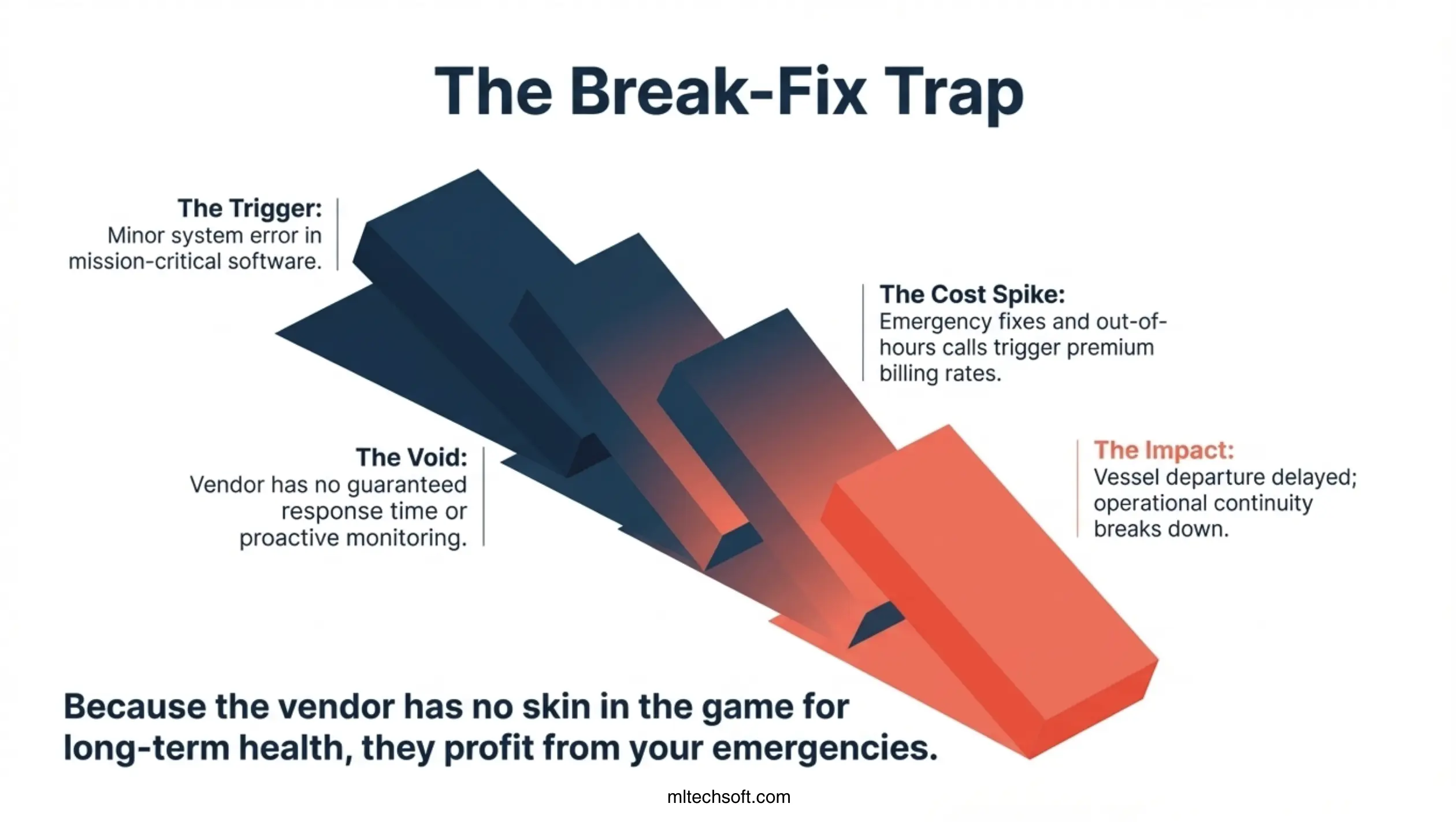
Most software vendors, after delivering a project, default to an informal arrangement: you contact them when something breaks, they fix it, you pay. This sounds reasonable until you’re trying to process crew documentation at midnight before a vessel departure and your contact is unavailable, unresponsive, or three time zones away from caring.
Break-fix support has no guaranteed response time, no proactive monitoring, and no obligation for the vendor to flag risks before they become incidents. It also tends to get expensive fast — emergency fixes, urgent change requests, and out-of-hours calls are typically billed at premium rates. And because the vendor has no skin in the game for long-term system health, they have little incentive to prevent problems rather than react to them.
What a retainer model actually commits your vendor to
A well-structured retainer defines the relationship in contractual terms. It specifies: how many support hours are included each month; what categories of work are covered (incident triage, bug fixes, user support, security patching, change requests); the SLA tiers for different types of issues; the schedule for proactive work like system inspections and version upgrades; and what happens when you exceed the included scope.
The comparison below illustrates why retainers reduce total cost despite the upfront commitment:
| Break-Fix Support | Maintenance Retainer | |
|---|---|---|
| Response time | No guarantee | Defined SLA by severity |
| Security patching | On request, billed separately | Included and proactive |
| Quarterly inspections | Not included | Scheduled and documented |
| Cost predictability | Variable — spikes during incidents | Fixed monthly fee |
| Vendor accountability | None between incidents | Ongoing, documented |
| Incident frequency | Tends to increase over time | Decreases with proactive care |
What a Well-Structured Maritime Software Maintenance Retainer Should Include
Not every retainer is built the same. Here’s what the contract should explicitly cover — and why each element matters for maritime operations specifically.
Incident management and ticket SLAs — response time vs. resolution time aren’t the same
Response time and resolution time are different metrics, and a vendor who conflates them is a vendor who will disappoint you. Response time is how quickly they acknowledge the ticket. Resolution time is how quickly the issue is fixed.
A strong retainer defines both, tiered by severity. A P1 incident — a crew management system that’s inaccessible during pre-departure processing — should get a response within one hour and a resolution within four. A P3 cosmetic bug can wait 48–72 hours. If the contract only says “we respond within 24 hours,” it tells you nothing about when the problem gets fixed. Maritime operations don’t pause for ambiguous SLAs.
Quarterly system inspections — what they should cover
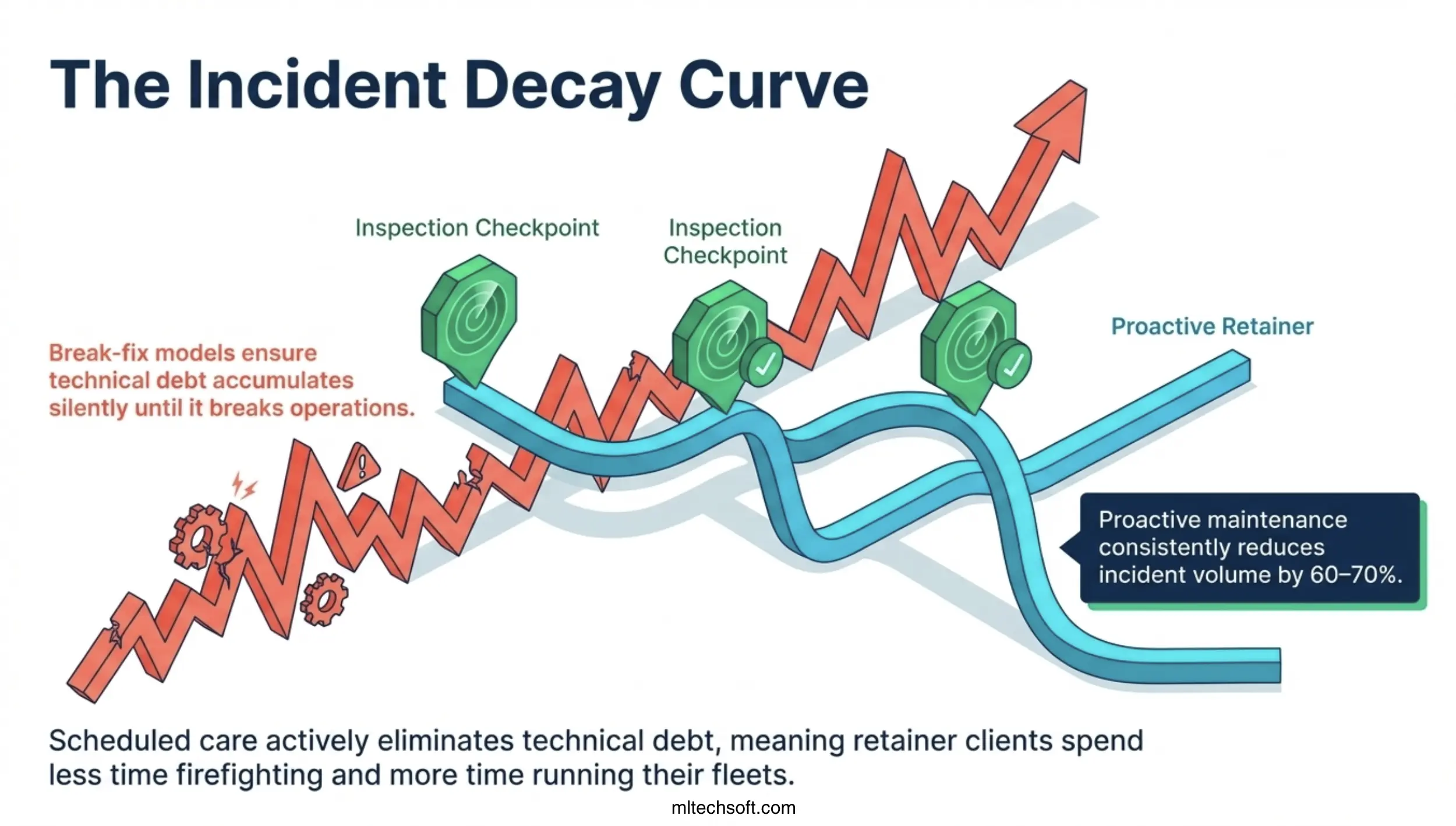
Quarterly inspections are one of the most undervalued components of a maintenance retainer. In our work with maritime clients — including a major Singapore port and maritime services operator — we’ve found that scheduled inspections catch 70–80% of potential issues before they surface as incidents. A system that isn’t inspected accumulates technical debt silently: library versions fall behind, database indices degrade, security patches pile up.
A quarterly inspection should produce a written report covering: security vulnerability scan results and remediation status; database performance review; dependency and library version audit; user access review; backup verification; and a risk register of items to address in the next quarter. If your vendor can’t tell you what their inspection covers, they’re not doing inspections — they’re billing for the promise of one.
Security patching and version upgrades
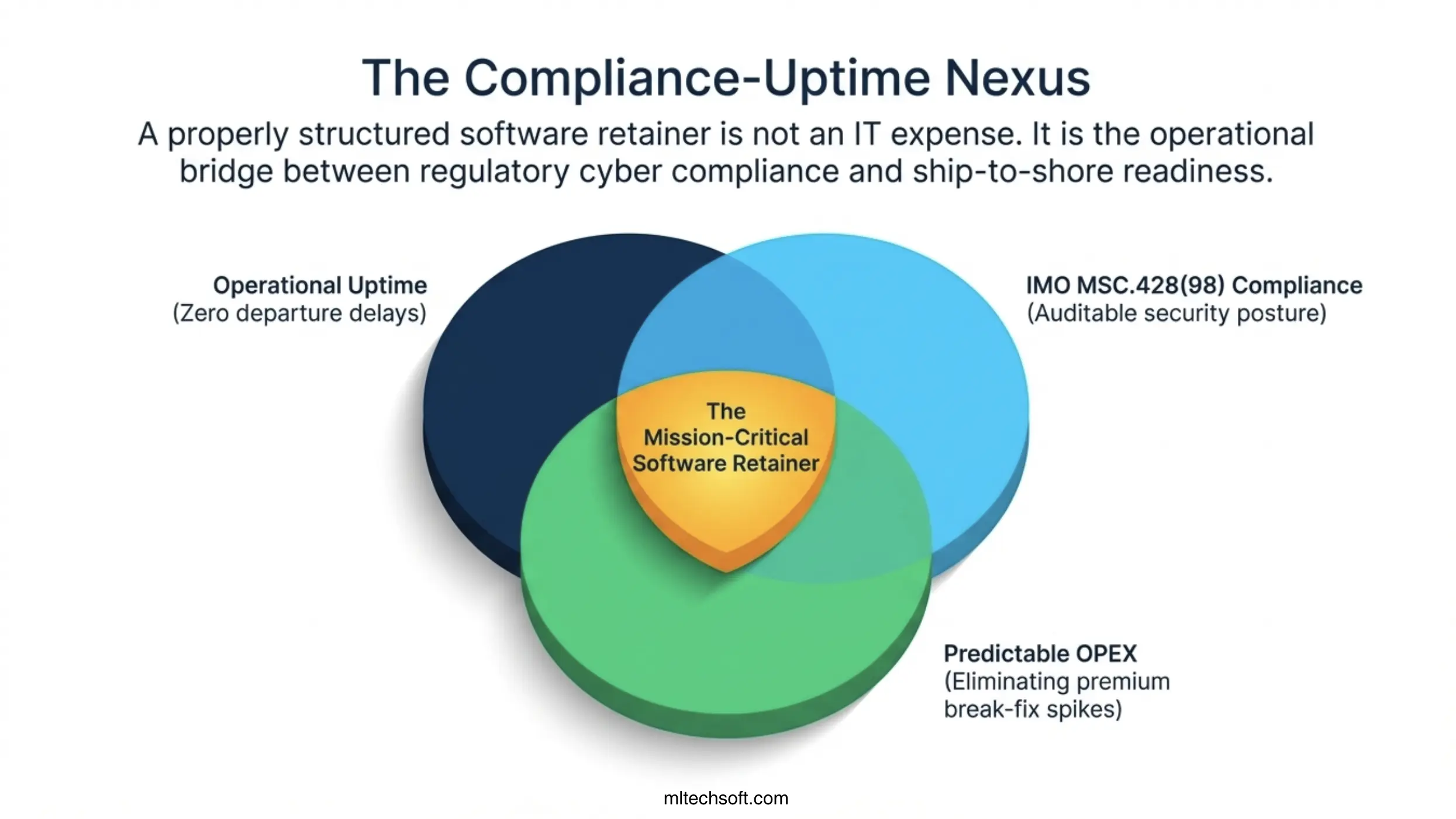
This is where maritime-specific regulatory context matters. IMO Resolution MSC.428(98), which took effect from January 2021, requires maritime companies to address cyber risk management within their Safety Management Systems under the ISM Code. The resolution explicitly names software maintenance and upgrades as procedural controls. Your software maintenance vendor has a direct role in your IMO compliance — and they should know it.
According to CYTUR’s 2026 Maritime Cyber Threat White Paper, maritime cyber incidents surged 103% in 2025, rising from 408 to 828 recorded incidents. DDoS and ransomware attacks more than doubled. A maintenance contract that doesn’t include defined security patching timelines — with severity classification and guaranteed remediation windows — is a compliance gap, not just a service gap.
Key stat: Maritime cyber incidents surged 103% in 2025, from 408 to 828 incidents, according to CYTUR’s 2026 Maritime Cyber Threat White Paper. Does your current maintenance contract include defined security patching timelines and vulnerability remediation SLAs?
User support — and what most retainers quietly exclude
User support is often listed in retainer descriptions as a single line item, with no definition of what it covers. Does it include new user onboarding? Password resets? Training sessions? System configuration requests? These are all “user support” — and they consume real hours.
A transparent retainer specifies the support channel (helpdesk email, ticketing system, hotline), the hours of coverage (business hours only, or 24/7 for critical systems), what user requests are included versus what triggers a change request, and the maximum monthly hours allocated to user support tasks. If these aren’t defined, the vendor can throttle support at their discretion and still be technically compliant with the contract.
What Most Vendors Leave Out (and How to Spot It Before You Sign)
The gap between what vendors promise in a sales conversation and what appears in the contract is where most maritime companies get burned. These are the most common omissions:
No defined incident categories. The retainer says “bug fixes included” but doesn’t define what a bug is versus a change request. Vendors exploit this to reclassify legitimate fixes as billable scope additions.
Security patching as an optional add-on. Many vendors list security patching separately from the standard retainer, or include it only if you ask. Under IMO 2021 requirements, this is not a nice-to-have — and a vendor who treats it as one doesn’t understand your regulatory context.
No rollback or escalation protocol. What happens if an update breaks something? A professional maintenance retainer includes a documented rollback procedure and an escalation path when the assigned engineer can’t resolve an issue within the agreed SLA window.
No system inspection schedule. Proactive inspections are often described in proposal documents but absent from contracts. If it isn’t in the signed agreement with a defined frequency and deliverable, it won’t happen consistently.
Unlimited scope for a fixed fee — until it isn’t. Some retainers advertise “unlimited support” without defining what support means. The first time you submit a change request that the vendor considers out of scope, you’ll discover that “unlimited” has a ceiling you weren’t told about.
The Questions to Ask Any Maritime Software Vendor Before Signing a Maintenance Contract
Use this checklist before signing — with any vendor, including us. A vendor who objects to specific questions about their contract terms is telling you something important.
“Can you show me the SLA table in the contract — with defined response and resolution times, tiered by incident severity?” You’re looking for P1–P3 (or equivalent) severity categories with explicit time commitments for both response and resolution. Not “best efforts.”
“What does your quarterly system inspection include, and can you share a sample inspection report?” A vendor that does real inspections will have a documented methodology and be able to show an example. One that doesn’t will say they “review the system regularly.”
“How do you handle security patching — what’s your vulnerability classification process and what are your remediation timelines?” Under IMO Resolution MSC.428(98) and ISO 27001 third-party vendor controls, your vendor’s patching process is part of your security posture. They should be able to articulate critical-to-minor timelines without hesitation.
“What’s classified as a change request versus a bug fix, and who makes that determination?” This is the single most common source of billing disputes. Get the definition in writing before you sign.
“What is your rollback procedure if an update causes an incident? Who is the escalation contact, and what’s the response time if the assigned engineer can’t resolve within SLA?” An experienced maintenance team has thought through failure scenarios. A vendor who doesn’t have a ready answer hasn’t.
“Do you hold ISO 27001 certification at the company level, and can you share your current certificate?” For maritime companies handling crew data, vessel records, and operational information, ISO 27001 is the benchmark standard. An uncertified vendor managing your production systems is a risk you’ll need to disclose to your own compliance team.
How We Structure Maintenance Retainers for Maritime Clients
When we take on a new maintenance client at MLTech Soft, the first thing we do is a baseline system inspection — something most vendors skip because it wasn’t in the original project scope. That inspection produces a written risk register: every dependency version, every open vulnerability, every configuration drift from the original specification. The client sees exactly what they’re inheriting before the retainer starts.
Our retainers are built around four-tier SLA structures with defined response and resolution windows, monthly support hour statements, and a fixed quarterly inspection schedule with written deliverables. Security patching follows a severity-classified protocol aligned with our ISO 27001:2022 certification — critical vulnerabilities within 48 hours, high-severity within seven days. Clients receive patch notifications and remediation confirmations in writing, which feeds directly into their own IMO compliance records.
In our ongoing engagement with a major Singapore port and maritime services operator, this approach has maintained system stability over an extended period, with the quarterly inspection cycle consistently identifying and resolving issues before they affect operations. It isn’t complicated — it’s just what a properly structured retainer looks like when both parties have agreed in writing on what “support” actually means.
The full scope of our maintenance retainer offering is available on our Software Maintenance & Support page — including what’s covered as standard and how we scope retainers for different system complexity levels.
If the topic of why maritime companies are now accelerating software modernisation decisions is useful context, the opening post in this series covers the forces driving that shift in 2026.
FAQ: Maritime Software Maintenance Retainers Answered
What is typically included in a maritime software maintenance retainer?
A well-structured maritime software maintenance retainer covers incident management with defined SLA tiers, bug fixes, security patching with documented timelines, quarterly system inspections with written reports, version and library upgrades, and user support within a defined scope. What separates a strong retainer from a weak one is specificity: response and resolution times should be tiered by severity, inspections should have a defined methodology, and security patching should reference a classification framework. Retainers that describe coverage in vague terms — “ongoing support,” “system monitoring,” “updates as needed” — typically leave the maritime company with no recourse when the vendor underdelivers.
How is a software maintenance retainer different from a planned maintenance system (PMS)?
These are two completely different things that happen to share the word “maintenance.” A planned maintenance system (PMS) is software used by vessel operations teams to schedule and track equipment maintenance onboard a ship — think machinery servicing, safety equipment checks, and drydock planning. A software maintenance retainer is the support contract you hold with the company that built your shore-side or operational software systems. The PMS is a product your crew uses; the software maintenance retainer governs the relationship with your technology partner. If you’re running crew management software, a fleet operations platform, or a port operations dashboard, the software maintenance retainer is what keeps those systems running.
Does my software maintenance vendor have any obligations under IMO 2021?
Not directly — IMO Resolution MSC.428(98) places the obligation on the ship operator or ship manager to address cyber risk within their Safety Management System under the ISM Code. However, your vendor’s practices are part of your cyber risk management posture. If your vendor handles production systems containing operational data, their security standards — including patching protocols, access controls, and incident response procedures — are relevant to your own IMO compliance. This is why ISO 27001 certification at the vendor level matters: it provides documented evidence that your software partner applies a certified information security management framework, which you can reference in your own SMS documentation. A vendor without ISO 27001 leaves you with a gap in your third-party risk management record.
How much should a maritime software maintenance retainer cost?
Retainer pricing depends on system complexity, included hours, SLA tier requirements, and the criticality of the systems covered. As a general reference: for custom maritime software systems of moderate complexity, monthly retainers typically range from SGD 2,000–10,000 per month. Simple systems with standard SLAs and low incident volume sit at the lower end; mission-critical systems requiring 24/7 incident response, frequent patching, and dedicated senior engineer availability sit at the higher end. The question to ask isn’t “what’s the monthly fee?” — it’s “what is the cost per incident if I don’t have a retainer?” One emergency fix with premium out-of-hours rates can exceed a month of retainer fees. Two or three in a year, and the break-fix model is clearly more expensive.
If your current support arrangement can’t answer the six questions in Section 4 of this post, it’s worth understanding what a properly structured retainer would look like for your system.
Contact MLTech Soft for a free maritime software assessment — we’ll review your current system and support arrangement, identify gaps in your maintenance coverage, and give you a plain-language summary of what a structured retainer for your system would include. No sales pitch, no commitment required.