
Maritime AI tools usually give wrong answers not because the model is faulty, but because the data feeding it is inconsistent, incomplete, or scattered across systems. An AI assistant can only reason over what it is given: if each vessel records information differently and certificates sit in dozens of folders under different names, the tool will guess — and it will guess with full confidence. This is the old “garbage in, garbage out” rule, and it is the single biggest reason AI disappoints in ship management. The good news is that it is fixable, and the fix is mostly about data, not about chasing a smarter model.
Why does an AI tool give wrong answers about your fleet?
Because it answers from the data you hand it, and in most ship-management setups that data is messier than anyone expects. The AI is not “thinking” about your fleet the way a superintendent does — it is pattern-matching over whatever records it can read. When those records disagree with each other or leave gaps, the tool does not stop and ask; it produces a fluent answer that looks right and isn’t.
A useful way to picture it: AI is like a highly capable new hire on their first day. Give them a tidy, well-labelled set of records and they are brilliant. Hand them forty folders where every vessel names things differently, some dates are typed by hand and some are missing, and no one is sure which version is current — and they will still answer your question, just often wrongly. The tool inherits the quality of your records, good or bad.
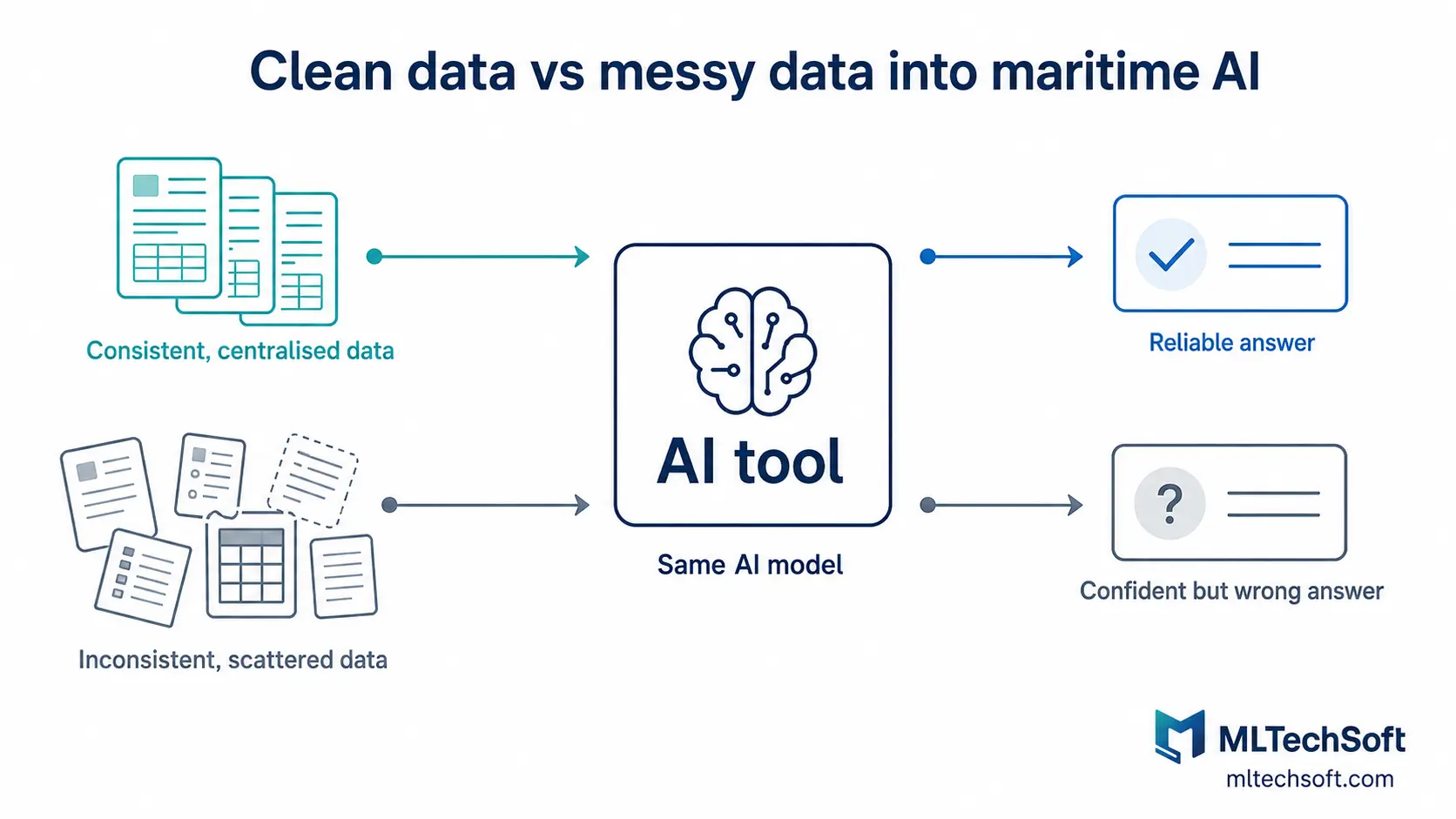
This is why the same AI product can feel impressive at one company and useless at another. The model is identical; the data underneath it is not.
What does “garbage in, garbage out” look like in ship management?
It looks like ordinary, everyday record-keeping that was never designed to be read by a machine. None of it is negligence — it is how systems grow over ten or fifteen years — but each habit quietly degrades any AI built on top of it.
Common examples across crewing, technical, and compliance workflows:
- Every vessel logs the same thing differently. One ship records a component as “M/E cyl. head no.3”, another as “main engine cylinder head 3”, a third as a free-text note. A human reads all three as the same part; an AI may treat them as three different things.
- Certificates and records are scattered. Class certificates, insurance, and regulatory filings live across shared drives, email attachments, and a document module, under inconsistent names — so an AI asked “which certificates expire in the next 60 days?” can only see part of the picture.
- Manual entry and free text. Planned maintenance notes, defect reports, and remarks are typed by hand, with abbreviations and local conventions that only the person who wrote them fully understands.
- No single source of truth. The same data exists in the PMS/CMMS, a spreadsheet, and a shore report, and they don’t always agree — so the AI’s answer depends on which copy it happened to read.
The result is not a dramatic failure. It is a plausible answer that is subtly wrong — the most dangerous kind, because you might act on it.
How much of the AI problem is really a data problem?
Most of it — and this is now well documented across industries and specifically in shipping. The barrier for most organisations is not deciding to use AI; it is the state of the data underneath it.
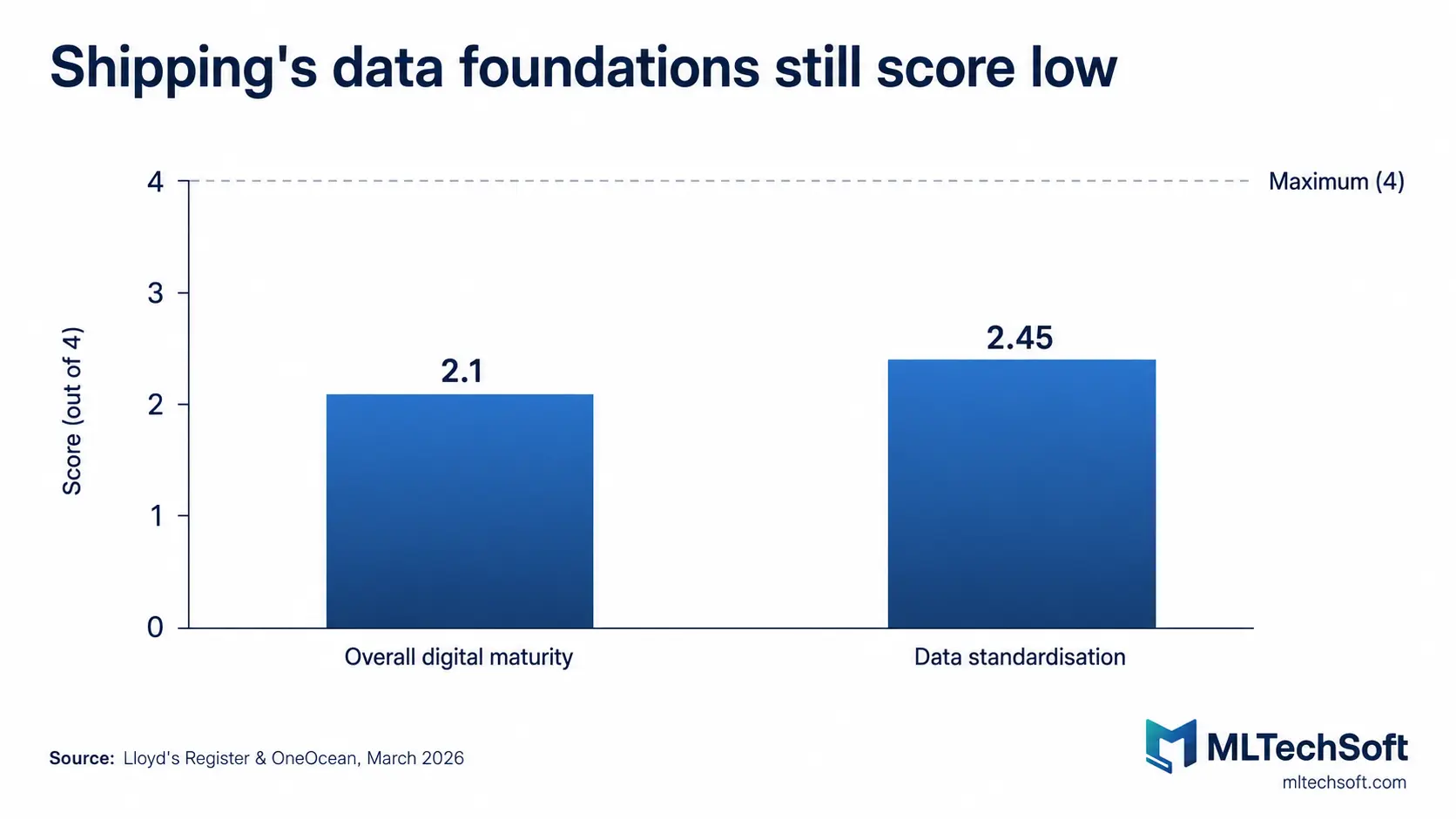
According to Gartner, at least 30% of generative AI projects were expected to be abandoned after proof of concept by the end of 2025, and poor data quality was named as a leading cause alongside unclear business value and cost. In maritime specifically, a March 2026 report from Lloyd’s Register and OneOcean, Mastering maritime data for competitive advantage, put shipping’s overall digital maturity at 2.1 out of 4 and data standardisation at 2.45 out of 4 — with weaknesses appearing at the earliest stage, where information is still entered manually or held in isolated systems.
The same report is blunt about what this means for AI: advanced technologies such as artificial intelligence and predictive analytics “depend heavily on the quality of the underlying data,” and without consistent governance and verification, “automated systems risk amplifying inaccuracies rather than delivering operational insight.” In other words, weak data doesn’t just limit AI — it can make AI actively misleading.
Three questions to ask before you buy any AI tool for your ships
Before signing up for an AI product, these three plain questions will tell you more than any demo. They move the conversation from “how clever is the AI?” to “can our data actually feed it?”
- Where will this tool get its data, and is that data consistent? If the answer involves pulling from several systems that record things differently, expect wrong answers until that is reconciled. A demo runs on tidy sample data; your fleet does not.
- Can the tool actually reach our systems — and can we check its answers? If your ship-management system has no clean way to share data (no reliable export or API), the AI is working from a partial or stale copy. And you need a way to verify what it tells you, not just trust a confident sentence.
- What happens when the data is wrong or missing? A well-built tool flags uncertainty; a poor one invents an answer. Ask the vendor directly how the tool behaves with incomplete records — because your records will be incomplete somewhere.
If a vendor can’t answer these clearly, the problem you’re about to buy is not an AI problem. It’s a data problem wearing an AI badge.
What does “getting your data ready” actually involve?
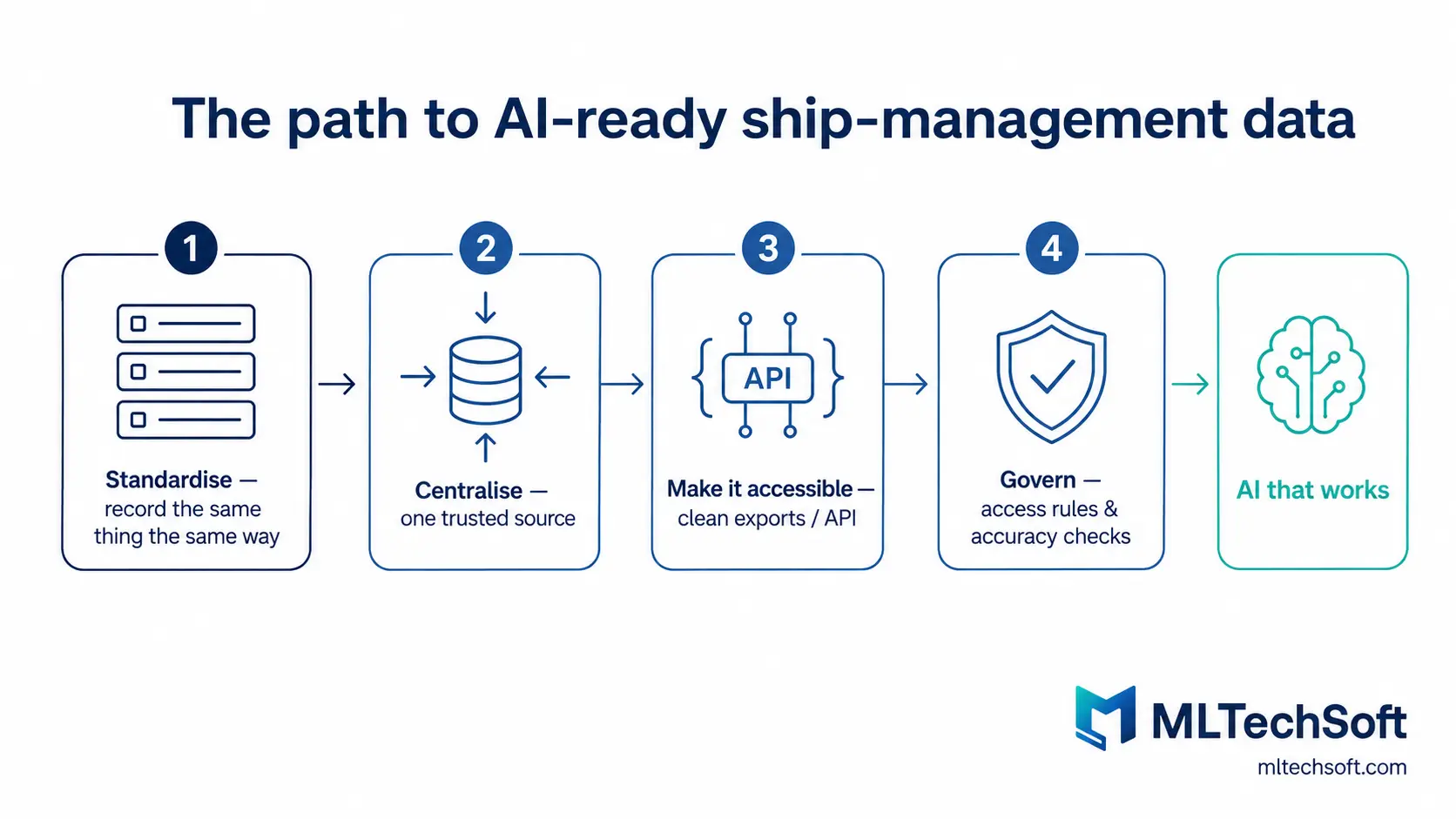
It means making your existing records consistent, centralised, and readable by other systems — before you layer AI on top. This is unglamorous work, and it is exactly where a maintenance and modernisation partner earns its keep. It usually runs in stages: standardise how key data is recorded, bring scattered records into a single trusted source, expose that data cleanly (through structured formats or an API), and set clear rules for access and accuracy.
In maintaining a marine pilot management system for PSA Marine, we’ve seen how much operational meaning is buried in free-text fields and local conventions that only make sense to the people who entered them. Mapping and structuring that information — carefully, without losing the business logic it encodes — is what turns a decade-old system into something a modern tool can safely build on. It is the same groundwork behind modernising a legacy maritime system and behind Singapore’s port moving to shared, API-based data: AI is just one more thing that needs clean data to work.
Practically, most ship managers don’t need a full rebuild to start. A focused review of how your data is recorded and stored — and where the gaps are — is usually enough to show whether an AI project is worth starting yet, and what to fix first.
So should you wait on AI until the data is perfect?
No — and waiting for “perfect” data is its own trap, because it never arrives. The honest position is in between: you don’t need flawless data everywhere, but you do need good-enough data in the specific area where you want AI to help. Singapore’s direction of travel makes this worth acting on soon: the MPA and the Singapore Shipping Association have agreed to accelerate AI adoption across the sector, with an AI use-case library and a Maritime AI Forum planned for the second half of 2026. The tools are becoming easier to access; the differentiator will be whose data is ready to use them.
The sensible path is narrow and staged: pick one workflow (say, certificate tracking), clean and structure the data behind just that, prove the AI works there, then expand. Clean as you go, on the parts that matter — rather than buying a broad AI platform and hoping your records can keep up.
Frequently asked questions
Why does AI give confident answers that are wrong? Because language-based AI is designed to produce fluent, plausible responses, not to flag when it is unsure. If the data it reads is inconsistent or incomplete, it fills the gaps with its best guess and presents it in the same confident tone as a correct answer. This is why verifying AI output — and improving the underlying data — matters more than the model itself.
Do we need to replace our ship-management system to use AI? Usually not. In many cases the existing system can stay, and the work is making its data consistent and accessible — standardising key fields, consolidating scattered records, and adding a clean way to share data. A legacy modernisation assessment can tell you whether your current system can feed AI as-is or needs targeted changes first.
What is “AI-ready data” in a maritime context? It is operational data that is consistent (the same thing is recorded the same way across vessels), centralised (one trusted source rather than several disagreeing copies), structured or API-accessible (other systems can read it cleanly), and governed (clear rules on access and accuracy). Lloyd’s Register’s 2026 research found shipping still scores low here, which is why many AI efforts underdeliver.
Which maritime AI use cases actually work today? The ones built on reasonably clean, well-scoped data — such as certificate and document extraction, compliance-record processing, and maintenance alerting — tend to deliver, while broad “AI for everything” promises tend to disappoint. We covered which applications hold up in practice in AI in ship management operations.
How do we start without a big project? Pick one workflow, review the data behind it, fix that data, and pilot the AI there before expanding. A short data-readiness review is a low-risk way to find out where you stand.
If you’re weighing up an AI tool and unsure whether your data can actually support it, that’s the right question to ask first. We offer a free maritime software assessment — a short, no-cost review of your current systems, data quality, and where an AI project would realistically start paying off. It commits you to nothing beyond a clearer picture. Request a free maritime software assessment and we’ll tell you honestly whether your data is ready — and what to fix if it isn’t.