
Singapore’s Maritime 5G network rollout is complete. As of 2025, the Maritime and Port Authority (MPA), Infocomm Media Development Authority (IMDA), and M1 Limited have deployed Maritime 5G SA (standalone) coverage across all major fairways, anchorages, terminals, and boarding grounds in Singapore — making the Port of Singapore the first in the world with full 5G standalone maritime coverage. For ship operators and fleet managers, this means high-bandwidth, low-latency connectivity is now a reliable infrastructure reality within Singapore waters. The question is no longer whether the network is ready — it’s whether your onboard and fleet management software can take advantage of it.
Singapore’s Maritime 5G Rollout: What’s Actually Been Completed
The Port of Singapore now has full 5G SA (standalone) network coverage in all major operational zones. This is not a pilot or limited deployment — it is complete infrastructure. The rollout was a collaboration between MPA, IMDA (which leads Singapore’s 5G Innovation and Ecosystem Development Programme), and mobile operator M1 Limited, which provides the underlying cellular infrastructure.
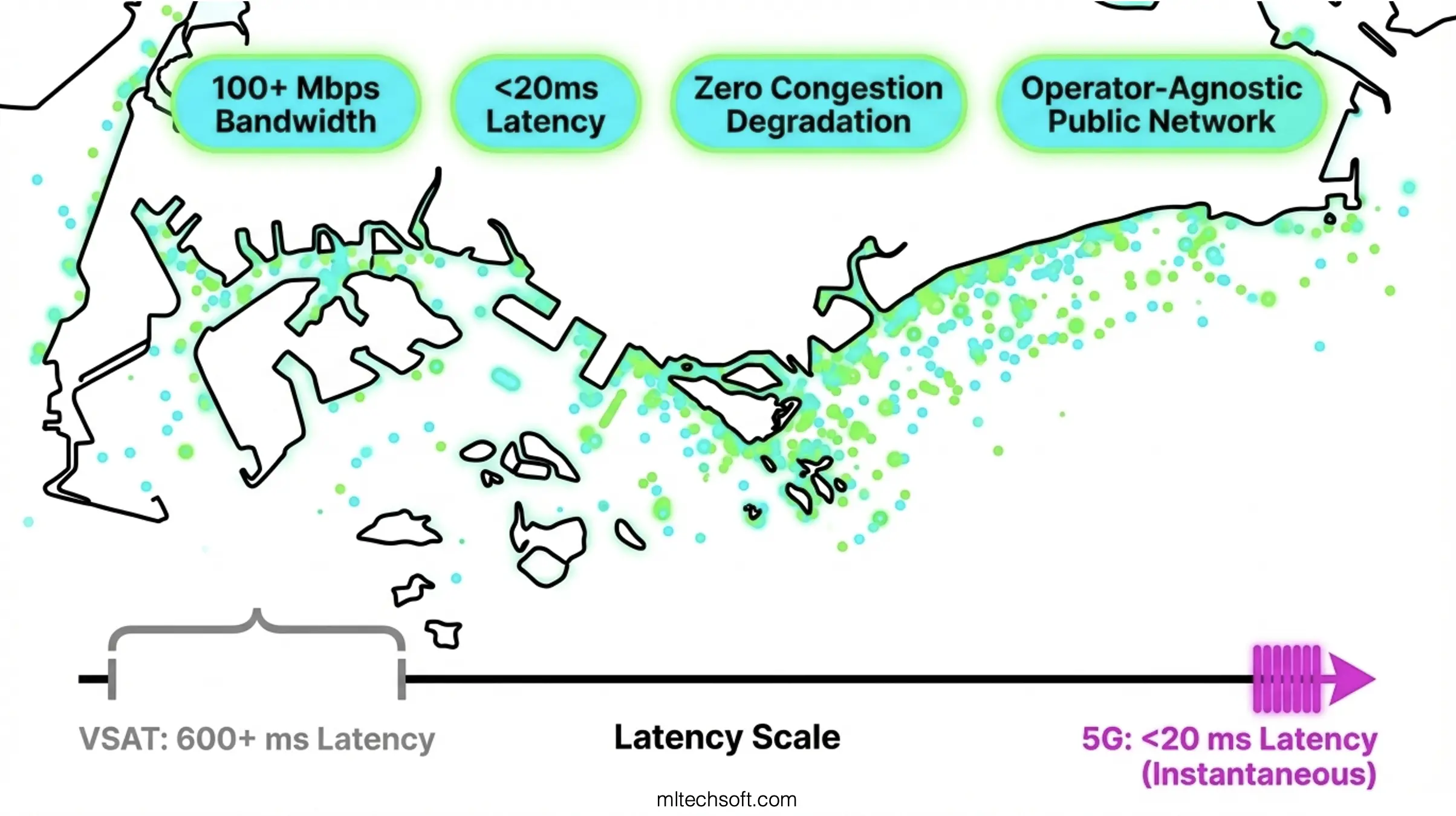
Coverage includes Singapore Strait fairways, major anchorages, Tanjong Pagar Terminal, Pasir Panjang Terminal, and all boarding ground locations where pilots and port service providers operate. The 5G network is public and operator-agnostic, meaning any vessel with a compatible device or onboard system can connect within port approaches and territorial waters.
The network delivers what 5G promises: bandwidth in the 100+ Mbps range, latency under 20 milliseconds (compared to VSAT’s typical 600+ millisecond latency), and reliable coverage that doesn’t degrade during peak congestion. For the first time, Singapore’s port environment has connectivity infrastructure comparable to onshore metropolitan networks.
This is the factual baseline. The infrastructure story is complete.
What High-Bandwidth, Low-Latency Connectivity Actually Unlocks for Ship Operators
5G doesn’t unlock applications automatically — it unlocks them only if software is designed to use what 5G delivers. Understanding what becomes possible is the first step in evaluating whether your current systems can take advantage.
Real-Time Vessel Data Feeds
Legacy systems poll vessel sensors and machinery telemetry on a schedule — every 15 minutes, every hour, or every 4 hours depending on bandwidth assumptions. Real-time 5G connectivity enables event-driven data streams: the moment a machinery parameter exceeds a threshold, the shore-based operations center receives that alert immediately. Engine room sensors, fuel consumption, cargo hold conditions, and hull stress monitoring all stream in real-time rather than being batched.
Shore-based operations teams can now monitor vessel condition continuously rather than reviewing synced data hours after it was collected. This eliminates decision latency for maintenance decisions, fuel optimization, and emergency response.
AI Inference at the Edge
Predictive maintenance models have existed for years, but they typically run on shore-based servers, processing historical data in batches. Real-time 5G enables lightweight AI models to run directly on the vessel’s systems, ingesting live sensor data and making predictions in seconds. A predictive pump failure model can alert the chief engineer to emerging cavitation signatures before a pump catastrophically fails.
The vessel still sends summarized results and alerts to shore, but the compute-heavy inference happens locally, on the ship. This requires onboard systems architected for edge computing, not cloud-dependent processing.
Remote Video Inspections
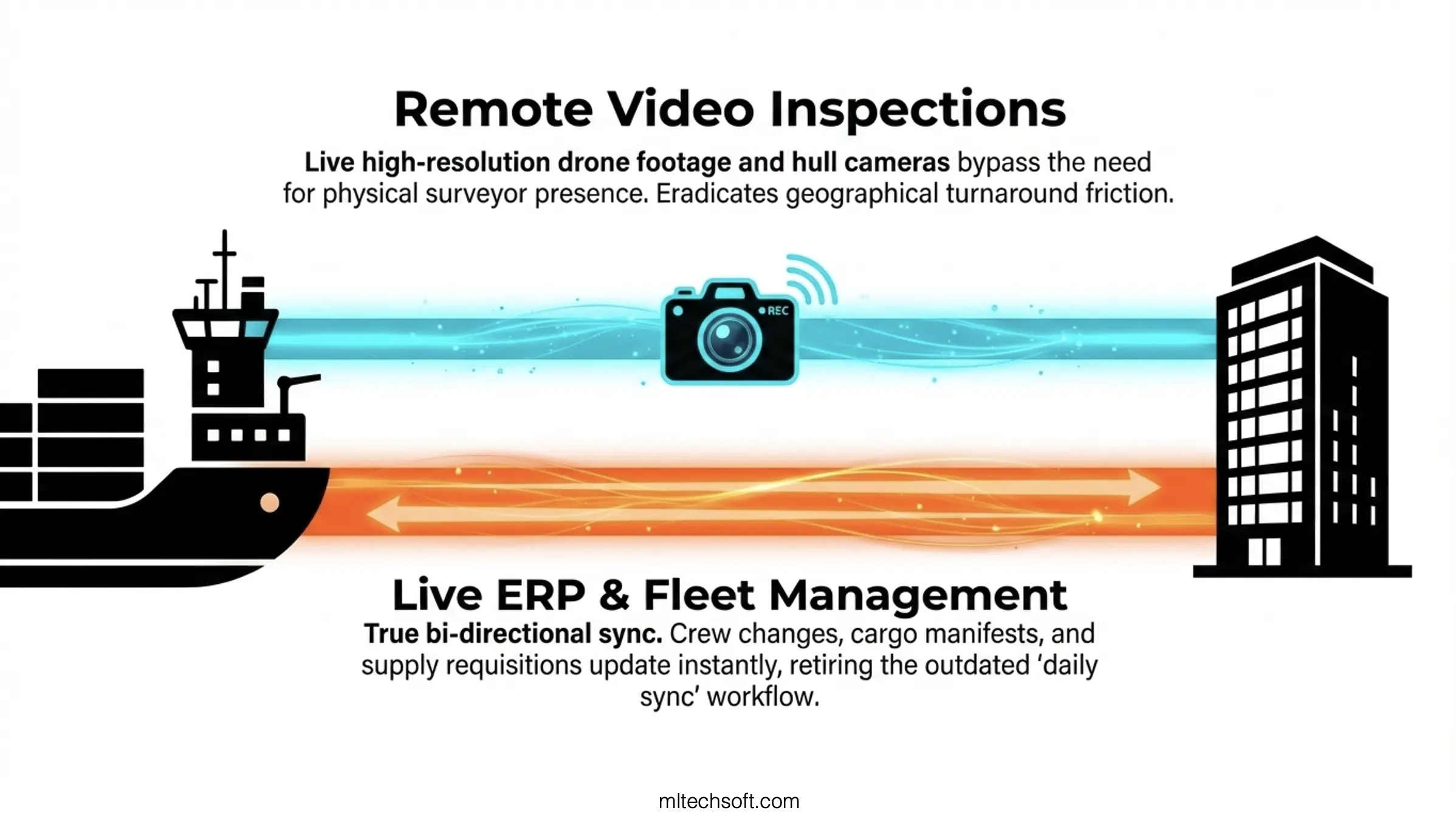
Classification society surveyors and regulatory inspectors currently conduct physical surveys during docking or port calls. Real-time 5G enables remote video inspection: high-resolution drone footage or fixed cameras on the hull stream to shore-based experts, who can guide field technicians or surveyors in real-time rather than relying on photos and written inspection reports. This reduces inspection turnaround time and eliminates geographical friction for global survey firms.
Live ERP and Fleet Management Sync
Most legacy ERP and fleet management systems sync data with onboard systems once per day, or multiple times per day if configured aggressively. During active port operations — cargo planning, crew changes, supply coordination — data is hours out of date. Real-time 5G enables true bi-directional sync: crew records, maintenance schedules, cargo manifest updates, and supply requisitions are synchronized instantly. A crew change on the vessel is reflected in the company’s crew management system immediately, not 4 hours later.
This capability requires systems architected for event-driven synchronization and real-time APIs, not batch-export-and-import workflows.
Why Your Legacy Software Is Now the Bottleneck — Not the Network
Most legacy ship management software was designed for a world where connectivity was expensive and intermittent. That world no longer describes Singapore’s port environment.
Systems built before 2015 — and many built as recently as 2018 — embody architectural assumptions that were correct at the time: bandwidth is precious, store locally and sync when connectivity is available, batch operations efficiently to minimize transmission costs, use compact data formats to fit through low-bandwidth pipes. These systems are still operational and still valuable, but their architecture is now obsolete in Singapore’s 5G port environment.
The constraint is not technical limitation — modern data synchronization patterns exist (event-driven architecture, webhooks, real-time APIs, streaming data pipelines). The constraint is architectural design that was fit-for-purpose five years ago and is now misaligned with available infrastructure.
Specific architectural patterns that become bottlenecks:
Batch-sync architecture. A fleet management system designed to pull all vessel records from a central server once per shift, cache them locally, allow field teams to make changes, and push changes back once per day. In a bandwidth-constrained world, this is sensible. In a 5G port environment, this design means field teams have stale data during active operations. The system itself hasn’t changed — but the infrastructure has made the design pattern suboptimal.
Polling intervals. An engine monitoring system that queries machinery sensors every 10 minutes and records results in a local database, syncing summary reports to shore once per hour. This pattern minimized bandwidth cost when VSAT bandwidth was SGD 50 per gigabyte. With unlimited 5G bandwidth at port, the 10-minute polling interval is arbitrary, and the 1-hour sync window means shore-based teams are making decisions on 1-hour-old data.
Fixed-size data exports. A cargo management system that exports manifest data in a simplified CSV format to minimize transmission size over satellite. That design was correct for 512 Kbps VSAT. With 5G’s 100+ Mbps available, the CSV export is now unnecessary, but the system still generates it because that’s how it was designed.
Lack of real-time APIs. Most legacy maritime software does not expose real-time APIs for other systems to subscribe to data changes. Integrations are built through nightly batch ETL jobs: extract data from System A, transform it, load it into System B. This pattern is standard in enterprise software architecture, and it was reasonable when that was the only reliable connectivity pattern available.
These are not bugs. They are design choices that made sense in a bandwidth-constrained environment. But 5G changes the constraint.
Singapore is now the first country with full 5G SA coverage in major fairways, anchorages, and terminals. The network is ready. The constraint is your software architecture.
What becomes urgent in 2026 is not immediately deploying 5G applications, but understanding which architectural patterns in your current systems are now misaligned with available infrastructure. A system that works perfectly well for batch-sync operations may not be the right choice for real-time operational decisions.
Three Software Architecture Decisions to Make Before Singapore Maritime Week 2026
The Port of Singapore’s 5G infrastructure is complete, and most of the early-stage applications (digital bunkering pilots, unmanned surface vessel trials, remote pilotage advisory) are already underway or scheduled for H1–H2 2026. For companies operating in Singapore waters, the infrastructure is not a distant roadmap — it’s here now.
This does not mean you must implement 5G applications in the next 30 days. It does mean three architecture decisions need clarity before vendor conversations at Singapore Maritime Week (April 20–23).
Decision 1: Assess Your Current System’s Real-Time Data Capability
Ask your fleet management or ERP vendor: Can your system consume a live data stream, or does it batch-process? Specifically:
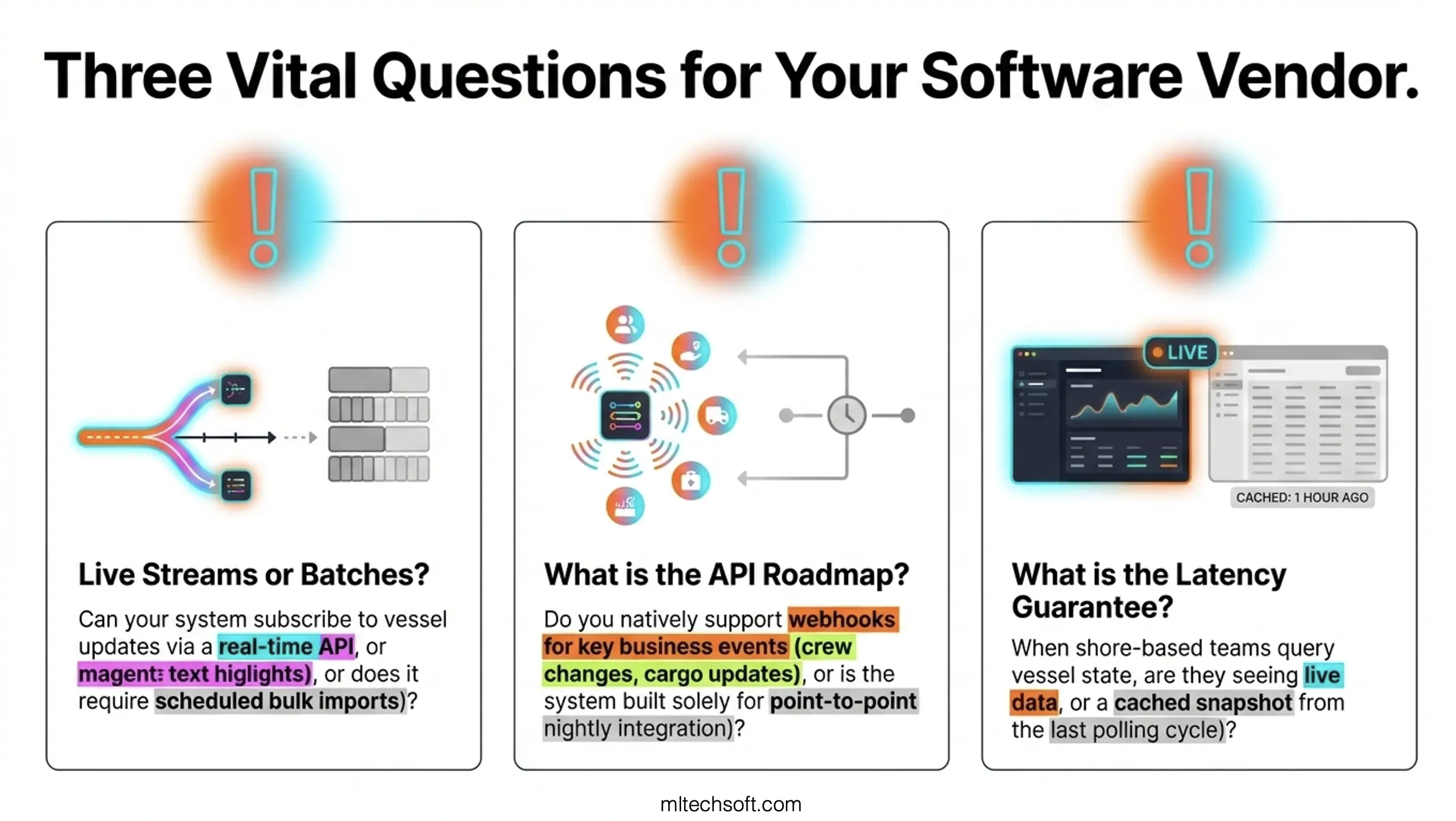
- Can your system subscribe to vessel data updates via a real-time API, or does it only support scheduled bulk imports?
- Are events (equipment alarms, crew changes, cargo status updates) processed as they occur, or are they collected in a queue and processed in batch cycles?
- When you query vessel state, does the system return live data, or cached data from the last sync?
If the answer to all three is no, your system’s architecture is batch-process-dependent. That’s not a disqualification — batch processing is still valid for many use cases — but it means real-time capability requires either a system upgrade or a parallel real-time infrastructure.
Decision 2: Evaluate Your Vendor’s 5G-Ready API Roadmap
Ask your software vendor directly: What is your roadmap for real-time data APIs and event streaming? Specifically:
- Do you have or plan to release webhook support for key business events (crew changes, maintenance alerts, cargo updates)?
- Is your system architected to support multiple consumers subscribing to the same data stream, or is it built for point-to-point integrations?
- What is your latency guarantee for data updates pushed to integrated systems?
A vendor’s 5G readiness is not whether they’ve announced a 5G product — it’s whether their architectural roadmap moves toward real-time APIs and event-driven sync. Many established vendors are moving in this direction. Some are not yet committing to timelines.
Decision 3: For Legacy Systems — Retrofit vs. Modernisation
If your current system is not architected for real-time data, you have three options:
Keep the system as-is. If your operational needs are genuinely batch-oriented (maintenance planning, crew scheduling, regulatory reporting), the system may not need to change. Not every process needs to be real-time.
Retrofit with a real-time middleware layer. Build or deploy a separate system that sits between your legacy ERP and your operational teams, consuming 5G-enabled real-time data streams and presenting them through a separate interface (operational dashboard, mobile app). Your core system continues to batch-process, but time-sensitive decisions are made on real-time data from elsewhere.
Modernise the core system. Replace or significantly upgrade the legacy system with a platform designed for event-driven, real-time data synchronization. This is the most resource-intensive option but provides the tightest integration.
MLTech Soft’s assessment of maritime clients in this position consistently identifies batch-sync architecture as the first system component to evaluate — it’s the most common constraint on real-time data capability in legacy platforms. The decision to retrofit or modernize is not technical; it’s a business decision about whether the operational need for real-time data justifies the investment.
FAQ: Maritime 5G and Onboard Software in Singapore
Q1: Does Maritime 5G work while the vessel is underway, or only in port?
Maritime 5G coverage is live in Singapore’s fairways and territorial waters. The signal strength and reliability degrade as the vessel moves beyond the 12-nautical-mile territorial waters limit. For vessels transiting through Singapore Strait, Marie Byway approaches, and major anchorages, 5G is reliable. For open ocean or waters beyond Singapore’s EEZ, vessels rely on VSAT, Starlink, or other satellite connectivity. 5G is a Singapore-port-adjacent technology, not a global ocean connectivity solution — at least for the next 2–3 years until other ports roll out similar infrastructure.
Q2: Will our current VSAT contract be made redundant by Maritime 5G?
No. VSAT remains essential for open ocean transit, emergency backup connectivity, and vessels operating outside Singapore waters. 5G is a supplementary network in port approaches, not a replacement. However, some maritime companies are already re-evaluating VSAT bandwidth tier (moving from premium 10 Mbps contracts to lower-cost 3–5 Mbps for ocean transit, since all intensive sync operations will happen in Singapore waters on 5G). The economics of satellite connectivity are shifting, but VSAT will remain part of hybrid vessel connectivity for at least 5–10 years.
Q3: How much does our vessel software need to change to benefit from 5G?
It depends on the application. If you want real-time machinery monitoring, your onboard systems need to support real-time sensor data ingestion (either through updated firmware or new edge computing devices). If you want live ERP sync during port operations, your fleet management system needs real-time API support — either a vendor upgrade, middleware layer, or system replacement. If you’re only using 5G for faster daily backups or accelerated file transfers, minimal software changes are needed — 5G just makes existing operations faster.
Most vessel systems can benefit from 5G without total replacement, but the extent of change depends on your operational priorities. Start with the three decisions in Section 4 to scope that change accurately.
Q4: When does 5G coverage extend beyond Singapore waters?
There is no announced timeline for 5G maritime coverage beyond Singapore’s territorial waters. Vietnam is exploring M1’s expertise in 5G maritime operations (as of early 2025), and port cities in other Southeast Asian countries will likely follow. However, Singapore is currently the first jurisdiction with full operational 5G maritime coverage. Vessels operating in Malaysian waters, Indonesian archipelago, or major regional ports (Port Klang, Port of Tanjung Pelepas, Laem Chabang) would not have reliable 5G coverage yet.
If your vessels operate primarily within Singapore waters or frequent Singapore-based logistics hubs, 5G readiness is operationally relevant now. If your fleet is globally distributed, 5G is a medium-term infrastructure investment, not an immediate decision driver.
Conclusion
Singapore’s Maritime 5G infrastructure is complete and operational. The technical conversation is no longer “is 5G ready?” but “is our software ready?” For most shipping companies and fleet operators, the answer requires assessment, not panic. Many systems are viable as-is; some benefit from targeted upgrades; others genuinely require modernization.
The window for making this assessment before Singapore Maritime Week (April 20) is narrow but critical. Vendors and digital transformation consultants will be present at the event, and having clarity on your own architectural constraints before those conversations is the difference between a productive vendor evaluation and a frustrating sales pitch. Use the three decisions framework in Section 4 to audit your current software stack, have those conversations with your vendor, and go into your SMW meetings with direction.
The infrastructure is ready. Your software readiness is the question that matters now.
Ready to Assess Your Maritime Software Architecture?
If you’re not sure whether your current ship management platform can take advantage of Maritime 5G’s real-time capability, MLTech Soft can assess your current architecture and give you a clear answer — what’s possible with your existing system, and where modernisation is genuinely required. No sales pitch. Just a technical assessment before you have these conversations at Singapore Maritime Week.