Ship management software modernisation is accelerating in 2026 because four forces have converged simultaneously: maritime cyberattacks more than doubled in 2025 — a 103% year-on-year increase, according to Safety4Sea — Singapore’s Maritime 5G infrastructure reached full coverage creating connectivity that legacy systems cannot exploit, the IMO published updated cybersecurity risk management guidelines in April 2025 tightening compliance obligations, and the specialist talent pool capable of maintaining decade-old ship management codebases is shrinking faster than companies can recruit replacements. For Singapore-based ship managers, these pressures are not abstract trends — they are operational and compliance realities arriving together in the same budget cycle.
If you are heading into Singapore Maritime Week with a list of vendor conversations scheduled and a vague sense that something needs to change in your software stack, this post gives you the frame you need before those conversations start.
Four Forces That Make 2026 Different From Any Previous Year
The argument for ship management software modernisation is not new. IT Directors at Singapore ship management companies have been hearing it for a decade. What has changed in 2026 is that four separate forces — each independently significant — have arrived in the same 18-month window, compressing the timeline for a decision that most companies have been comfortable deferring.
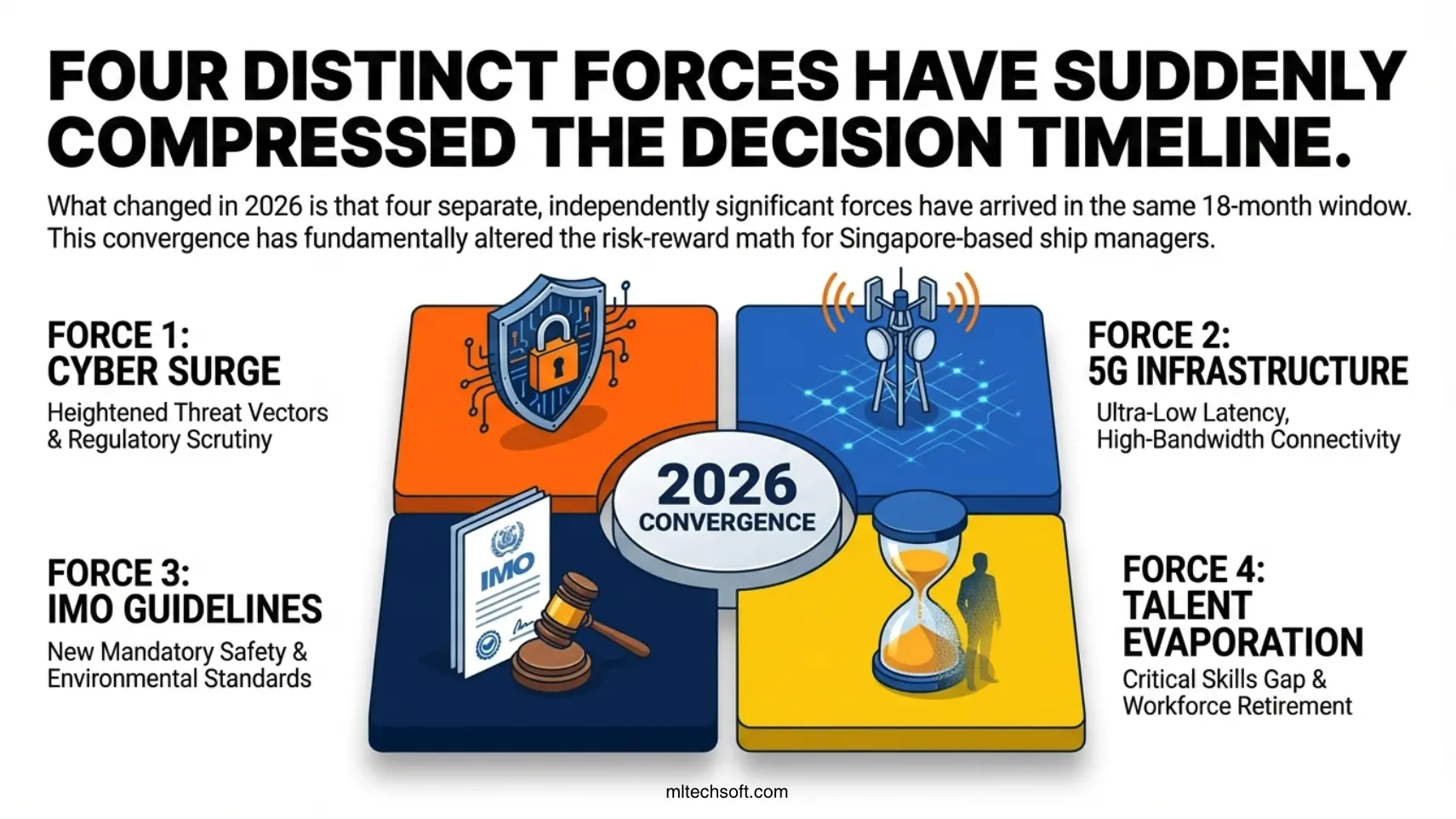
Force 1 — The 103% Surge in Maritime Cyberattacks Has Made Legacy Systems a Board-Level Risk
Maritime cyberattacks more than doubled between 2024 and 2025. The number of reported incidents rose from 408 to 828 — a 103% increase — with ransomware cases alone jumping from 156 to 372. On the operational technology side, attacks on maritime OT systems increased by 150%, with 87% of those driven by ransomware.
Key stat: Maritime cyber incidents rose 103% year-on-year in 2025. For ship managers still running unpatched, decade-old software, that number is not an industry statistic — it is a risk profile.
The dominant attack vector has shifted. In 2024, unpatched vulnerabilities were the primary entry point. In 2025 and into 2026, the leading method is exploitation of valid, stolen credentials — which means the question is no longer just “have we patched the system?” but “does our software architecture even support the access controls and audit logging that modern credential security requires?” Most legacy ship management platforms built before 2015 do not.
When the cyber incident involves a crew management system or voyage planning module, the operational disruption is immediate. Port state control records become inaccessible. Crew certification data is locked. The board conversation that follows is not about IT — it is about the company’s insurance position, its ISM Code compliance status, and who is responsible.
Force 2 — Singapore’s Maritime 5G Infrastructure Is Complete, and Legacy Systems Can’t Use It
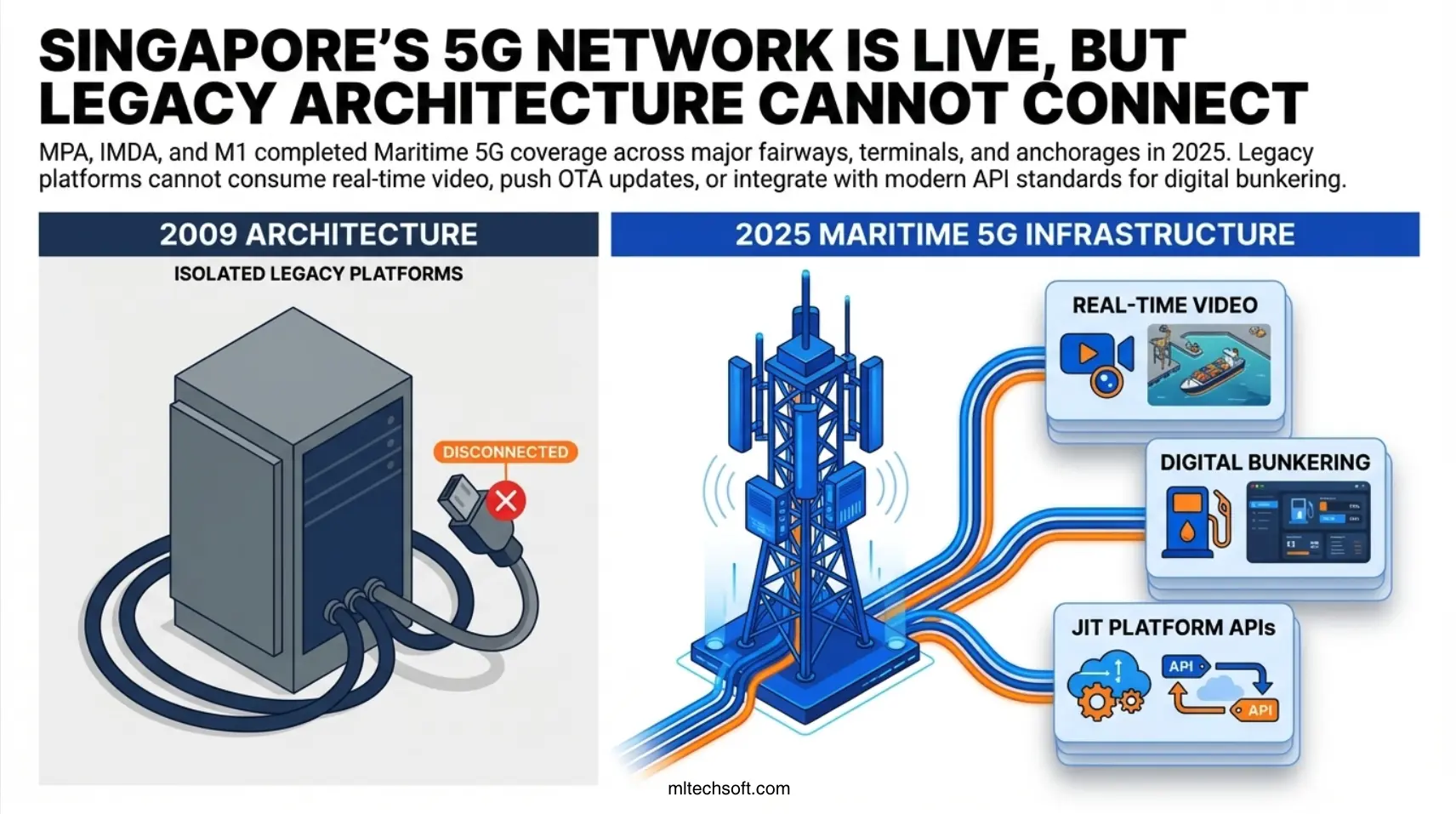
MPA, working with IMDA and M1, completed the rollout of Maritime 5G coverage across Singapore’s major fairways, anchorages, terminals, and boarding grounds in 2025. Singapore was already the first country to extend public 5G standalone coverage to sea for maritime operations. That infrastructure is now fully in place.
The practical implications are significant. The 5G network provides high-bandwidth, low-latency connectivity that enables real-time video inspections, live data transfers between ship and shore for digital bunkering operations, autonomous vessel trials, and ship-to-shore communications for next-generation vessel traffic management. MPA’s Just-In-Time Platform, launched in 2024 and expanded through 2025, now connects more than 150 port users for automated coordination of marine services.
The problem is architectural. A ship management platform designed in 2009 — even one that has been regularly patched — was not built to consume real-time data streams, push updates to onboard devices over 5G, or integrate with port community systems that assume modern API standards. The infrastructure investment Singapore has made is only accessible to software that was designed to use it. Legacy systems sit on the wrong side of that line.
Force 3 — Updated IMO Cybersecurity Guidelines Have Narrowed the Compliance Window
The IMO published MSC-FAL.1/Circ.3/Rev.3 on 4 April 2025 — the most comprehensive update to the Guidelines on Maritime Cyber Risk Management since IMO Resolution MSC.428(98) encouraged shipping companies to integrate cyber risk into their Safety Management Systems under the ISM Code. The previous version (Rev.2) was withdrawn.
The updated guidelines require effective cyber risk management to start at senior management level, with an embedded culture of cyber risk awareness across all organisational levels, and a continuous management regime that is constantly evaluated. Ships with complex digital systems — which describes virtually every ship management company with multiple vessels running integrated PMS, crew management, and compliance modules — are specifically flagged as requiring greater care.
What this means operationally: if your ship management software does not support the access controls, audit trails, incident response logging, and third-party vendor oversight that a credible ISMS requires, your Safety Management System has a gap. Classification societies including DNV and Bureau Veritas are increasingly examining this in ISM audits. The compliance window that existed before these guidelines were published is narrower now.
In our work with maritime operators across the region, we find that this is the force that moves the conversation from IT to the CEO’s desk. Cybersecurity compliance under the IMO framework is not optional, and a software platform that cannot support it is a liability the board can no longer ignore.
Force 4 — The Talent Pool That Maintains Your Legacy System Is Disappearing
This force is the least visible in industry reporting, but it is the one we hear about most consistently from IT Directors at Singapore ship management companies. The developer who has maintained your crew management system since 2011 is approaching retirement. Their replacement — if they were ever hired — has moved on. The institutional knowledge of why the procurement module behaves the way it does during drydock cycles lives in one person’s head, and that person is not available at 2am when the system fails during a vessel inspection.
According to industry research, over 67% of maritime professionals acknowledge a significant digital skills shortage in the sector, and the demand for technically skilled maritime IT staff is outpacing supply globally. The 5G rollout, the Digital Twin programme, and the push for AI-assisted operations have made software talent in Singapore’s maritime sector scarcer and more expensive. Competing against that talent market to find someone who wants to learn a 15-year-old codebase is not a winning proposition.
This is not a theoretical risk. In our system assessment engagements with Singapore-based ship management companies, we have found live production systems where the last security patch was applied in 2021, where database schema documentation does not exist, and where the system’s dependency on a specific server configuration has never been formally recorded. The system works — until it doesn’t.
Why Ship Managers Have Been Slow to Modernise — and Why That’s Changed
The reasons for slow modernisation are well understood by anyone who has managed ship management software through an operational cycle. The systems work. Uptime is acceptable. The team knows the quirks. A migration carries risk of disruption — and in ship management, disruption during a port call, a crew rotation, or a classification survey is measured in operational and regulatory cost, not just inconvenience.
There is also a procurement problem. Evaluating software vendors requires time that senior IT staff do not have, and the maritime software market is not transparent. The difference between a vendor who understands how crew handover data flows across vessels in a staggered rotation cycle and one who doesn’t becomes apparent only after the contract is signed.
What has changed is that the cost of inaction has crossed the cost of action. That crossover has not happened gradually — it has happened in a compressed window because the four forces described above arrived simultaneously. A ship manager who deferred modernisation decisions in 2023 was making a reasonable risk calculation. The same deferral decision in 2026 — after the cyber surge, after the 5G rollout, after the IMO guidance update — is a different calculation entirely.
Singapore Maritime Week, held each April, brings every major maritime software vendor and every major ship management decision-maker into the same conference space. The conversations that happen there will move faster this year, because the urgency is no longer manufactured by vendors — it is visible in incident reports, in insurance renewal conversations, and in compliance reviews.
What “Modernisation” Actually Means for Ship Management Operations
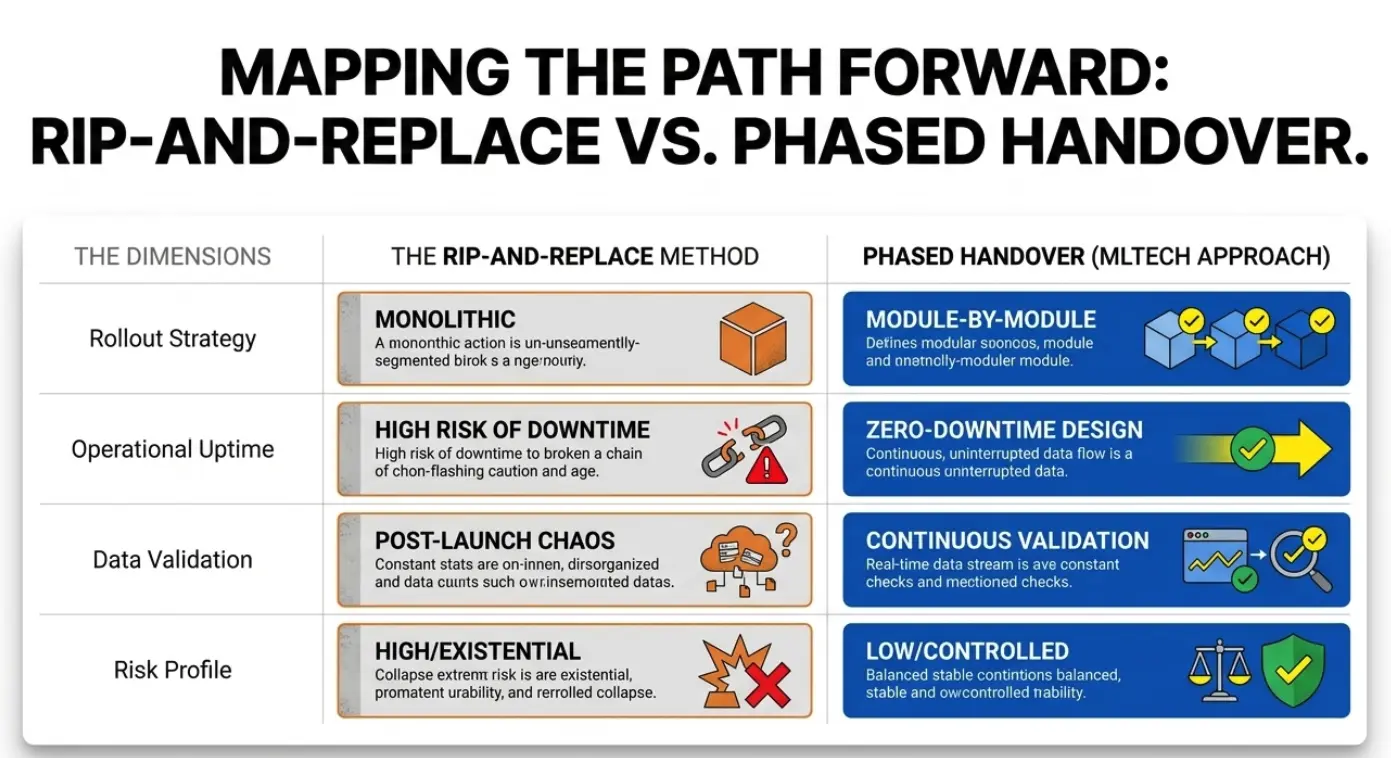
The word “modernisation” triggers anxiety in ship management IT departments for good reason. The assumption is that modernisation means a rip-and-replace project — six months of parallel running, data migration risk, staff retraining across multiple offices, and a go-live date that everyone is nervous about.
That model exists, but it is not the only one. In practice, effective ship management software modernisation for a company managing 30–100 vessels looks more like a phased handover approach: starting with the modules that carry the highest risk (compliance tracking, security-sensitive crew data, anything touching regulatory filings), migrating them to a modern architecture while legacy systems remain live, validating data integrity at each stage, and only cutting over when each module is stable.
The key enablers are: a development partner who understands maritime workflows well enough to design the migration around watch schedules, drydock windows, and port call timing rather than against them; a phased architecture that allows rollback at each stage; and a data validation process that treats crew certification records and PSC inspection history with the same rigour as financial data.
MLTech Soft’s maintenance engagement with PSA Marine — Singapore’s leading port and maritime services provider — has given our team direct exposure to the operational pressures that ship management software must accommodate. The systems that keep maritime operations running are not like enterprise software in other industries. Downtime windows are measured in hours, not days, and the consequences of a failed migration extend from scheduling to compliance to crew welfare.
Ship management modernisation is also not a one-time project. It includes the ongoing maintenance capability to keep the new system patched, security-certified, and aligned with evolving regulatory requirements. That is a different conversation from a build engagement — and it is the one that separates long-term software partners from project vendors.
The Modernisation Window: Why the Cost-Risk Equation Favours Acting in 2026
The concept of a modernisation window is straightforward: there is a period during which the cost of changing systems is lower than the accumulated cost of the risks you carry by not changing. The window is not open indefinitely.
For Singapore-based ship management companies, the 2026 window has three characteristics that will not hold beyond 2027.
First, the talent to migrate is still available. Experienced maritime software engineers who understand both legacy system architectures and modern cloud-native development approaches exist in the market now. As digital transformation accelerates, that specific combination becomes harder to find and more expensive to contract.
Second, the regulatory environment is still in a guidance phase. MSC-FAL.1/Circ.3/Rev.3 was published as guidelines, not as mandatory amendments to the ISM Code — though the direction of travel is clear. Acting while the framework is still advisory costs less than acting after it becomes enforceable, because the pressure to move faster and accept higher-risk migration plans increases when deadlines are regulatory rather than strategic.
Third, the competitive gap is still closeable. Ship management companies that complete modernisation in 2026 will be positioned to use Singapore’s 5G infrastructure, integrate with the Maritime Digital Twin, and connect to the JIT Platform from a position of technical readiness. The companies that wait will be playing catch-up against competitors who have already made those integrations operational.
MPA’s development of the Maritime Singapore Master Plan, announced in early 2026, signals that the infrastructure investment continues. The regulatory and infrastructure context will continue to move forward. The question is whether your software stack moves with it.
The modernisation window is not permanently open. For ship managers whose legacy systems are still operational today, that is a reason for a structured decision process — not a reason to defer.
FAQ: Ship Management Software Modernisation Questions Answered
How long does a ship management software modernisation project typically take?
For a mid-size ship management company managing 30–60 vessels, a phased modernisation of core modules — crew management, planned maintenance, compliance tracking — typically takes 9–18 months from initial assessment to full handover. The timeline depends heavily on data quality in the legacy system, the number of third-party integrations, and whether the migration is structured as a phased rollout or a parallel-run cutover. Companies that attempt to compress this timeline to under 6 months typically do so at the cost of data validation rigour, which creates problems post-go-live.
Can we modernise our ship management software without operational downtime?
Yes, with a properly designed phased approach. The critical design principle is that legacy systems remain live and fully operational during each migration phase, with the new system running in parallel until data integrity at that module level has been validated. Cutover happens module by module, not as a single event. The detailed mechanics of this approach — parallel-run architecture, watch-cycle-aware migration scheduling, rollback protocols — are covered in a follow-on post in this series.
What should we look for in a ship management software partner to handle this kind of project?
Three things matter most in vendor selection for ship management modernisation. First, maritime domain knowledge that is evidenced — not claimed. A development partner should be able to discuss crew rotation data structures, ISM Code compliance module requirements, and PSC inspection record formats without being briefed. Second, verifiable security credentials. ISO 27001:2022 certification at the company level — not just on selected projects — is the minimum standard for a partner handling sensitive maritime operational data, particularly given the IMO cybersecurity guidance framework. Third, a demonstrated commitment to post-go-live support. A partner who walks away after deployment is not a partner for ship management software. The ongoing maintenance requirement — security patching, regulatory updates, system inspections — is as important as the initial build.
Is now the right time to evaluate modernisation, or should we wait until after Singapore Maritime Week?
The right time to evaluate is before Singapore Maritime Week, not after. Arriving at SMW with a structured view of your current system’s gaps — and a set of specific questions for vendors — produces far more useful conversations than arriving open to whatever vendors pitch. The four forces driving ship management software modernisation in 2026 are not going to be less pressing after the conference. If anything, the vendor conversations at SMW will clarify how your current software stack compares to what is now standard in the industry.
Ship management software modernisation is not an abstract IT upgrade. In 2026, it is a response to a specific set of operational, regulatory, and infrastructure forces that have arrived together — creating both urgency and opportunity. The companies that develop a clear-eyed view of where their systems stand, and what a structured modernisation path looks like for their fleet size and operational model, will be better placed for the decisions that SMW and the rest of the year will demand.
The rest of this April series goes deeper on each component of that picture: what a maintenance retainer should actually cover, how to build the internal business case for modernisation, the mechanics of a zero-downtime legacy migration, and the vendor evaluation framework a ship management CTO should use when the conversations start.
Ready to understand where your current software stack stands?
If you are a Singapore ship manager heading into SMW with legacy system questions on your mind, request MLTech Soft’s free maritime software assessment. In a 60-minute session, we will map your current system landscape, flag the gaps that create compliance and security risk, and give you a plain-English modernisation roadmap — before the conference floor conversations start.